- Plants
- ›Vascular Plants
- ›Ferns
- ›Leptosporangiate Ferns
- ›Polypod Ferns
- ›Pteridineae
- ›brake family
- ›lip fern subfamily
- ›Myriopteris
- ›Myriopteris covillei
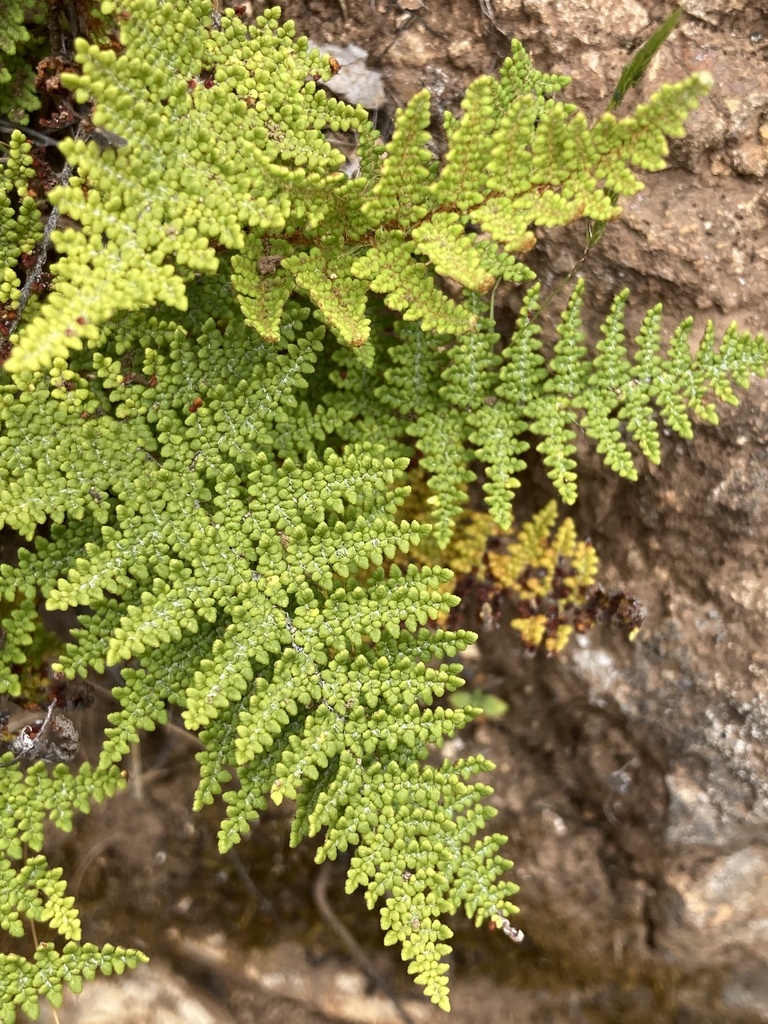
Cleveland's Lipfern
Myriopteris clevelandii
Myriopteris clevelandii or Cleveland's lip fern is a small to medium-sized fern native to southern California and Baja California in Mexico. The leaf is divided into small, bead-like segments densely covered with scales beneath. In M. clevelandii, some of these scales are reduced to hairlike structures, which help distinguish it from the closely related Coville's lip fern (M. covillei). One of the cheilanthoid lip ferns, it was usually classified in the genus Cheilanthes as Cheilanthes clevelandii until 2013, when the genus Myriopteris was again recognized as separate from Cheilanthes. It is usually found growing on exposed rock, particularly igneous rock. The species is named in honor of Daniel Cleveland, who collected the type specimen.
From the article Myriopteris clevelandii on Wikipedia (CC BY-SA), quoted section by section
Description
The rhizomes are horizontal and range from 1 to 3 millimeters (0.04 to 0.1 in) in diameter. The leaves are closely or broadly spaced along them. The rhizome bears persistent linear-lanceolate scales, which are dark brown or brown to red-brown in color and shiny. The scales may be of a uniform brown color, or bear a dark central stripe with paler edges. The margins of the scales are entire or erose to slightly toothed with teeth well-spaced. The scales are straight or slightly twisted and strongly appressed (pressed against the rhizome). The fronds arise from the rhizome in clusters or as somewhat scattered individual leaves. Unlike many ferns, they do not emerge as coiled fiddleheads (noncircinate vernation). When mature, they are 8 to 40 centimeters (3 to 20 in) long. The stipe (the stalk of the leaf below the blade) makes up about half the length of the frond, measuring 5 to 31 centimeters (2.0 to 12 in) long. The stipe is shiny, rounded, and dark to light brown, covered with 1-to-2-millimeter (0.04 to 0.08 in)-long hairs and filiform (threadlike) scales that are gray to red-brown in color. The covering is lost as the frond ages. The stipe is typically less than 2 millimeters (0.08 in) wide, sometimes up to 3 millimeters (0.1 in). The leaf blades are oblong-lanceolate to ovate and tetrapinnate (cut into pinnae, pinnules, pinnulets, and divisions of pinnulets) at the base. …
Range & habitat
The fern is native to southern California, specifically the Peninsular Ranges and several of the northern Channel Islands, and to northern Baja California, Mexico. It is found in a variety of rocky, exposed habitats, including chaparral, on slopes and ledges, or at the bases of boulders and in crevices. It usually prefers igneous rocks. It is found from 0 to 1,600 meters (0.0 to 5,200 ft) in elevation.
Wikipedia: “Distribution and habitat”
What it does
Myriopteris clevelandii is classified as globally vulnerable (G3) by NatureServe. It faces few distinct threats, but its natural range is limited.
Wikipedia: “Conservation and ecology”
Where it lives
Recorded sightings
—
geo-referenced records in GBIF, from museums, herbaria and field observers.
Drag the globe to turn it. Dots are where records exist, not a range map; darker means more records.
In the stacks
Searching the stacks…
Every page naming Myriopteris clevelandii in the Biodiversity Heritage Library →
This page is assembled live from iNaturalist, GBIF, Wikipedia, the Source Library and the Internet Archive. It is not yet part of the hand-edited codex. iNaturalist taxon 481699.