- Plants
- ›Vascular Plants
- ›Ferns
- ›Leptosporangiate Ferns
- ›Polypod Ferns
- ›Pteridineae
- ›brake family
- ›lip fern subfamily
- ›Myriopteris
- ›Myriopteris covillei
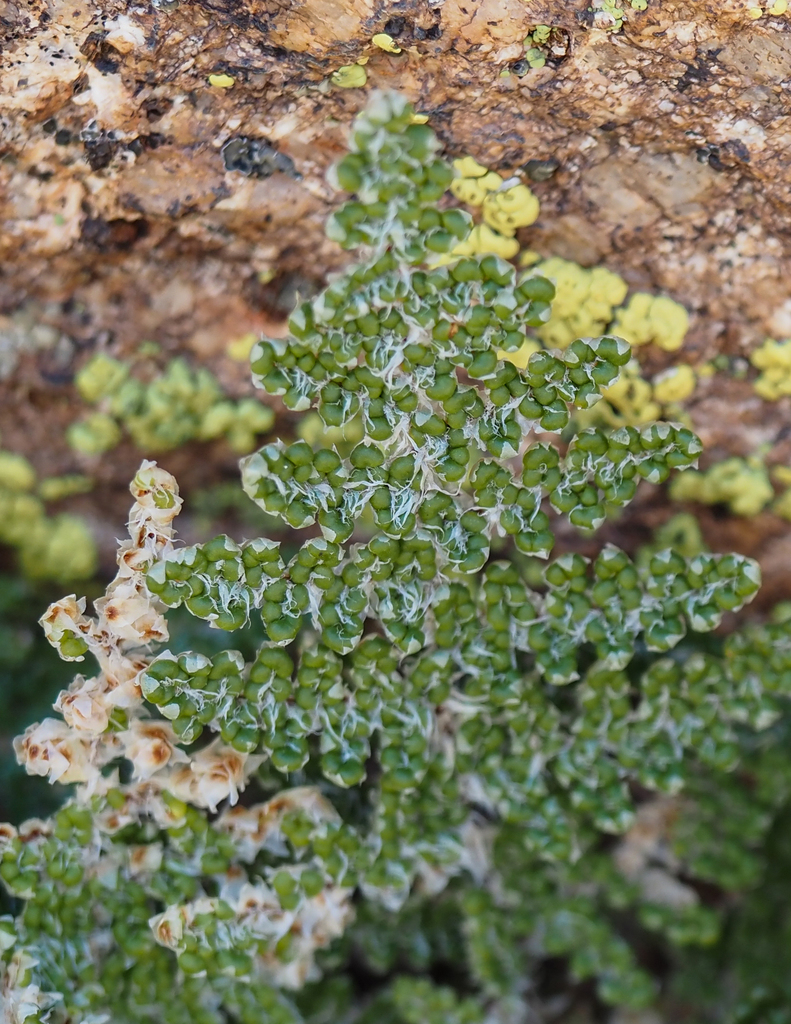
Coville's lip fern
Myriopteris covillei
Myriopteris covillei, commonly known as Coville's lip fern, is a small fern found in the southwestern United States and on the Baja California peninsula, with an outlying population in southern Oregon. Its leaves grow in clusters and are dissected into beadlike segments; the undersides of the leaf axes are covered with whitish scales that conceal the green tissue of the leaf. One of the cheilanthoid lip ferns, it was usually classified in the genus Cheilanthes as Cheilanthes covillei until 2013, when the genus Myriopteris was again recognized as separate from Cheilanthes. The species usually grows on or near rocks. It is named in honor of the botanist Frederick Vernon Coville, co-collector of the type specimen in 1891.
From the article Myriopteris covillei on Wikipedia (CC BY-SA), quoted section by section
Description
Leaf bases are closely spaced along the rhizome, which is typically 2 to 4 millimeters (0.08 to 0.2 in) in diameter. It is covered with persistent scales about 2 millimeters (0.08 in) long, which are linear to narrowly lanceolate, straight or slightly twisted, and tightly appressed (pressed against the surface of the rhizome). They are a uniform dark brown to black in color, or in some cases have paler, narrow margins of a light brown color, and lack marginal teeth. The fronds spring up in clusters; they do not unfold as fiddleheads like typical ferns (noncircinate vernation). When mature, they are 5 to 30 centimeters (2.0 to 12 in) long, and 2 to 4 centimeters (0.8 to 2 in) (or even up to 6 centimeters (2 in)) wide. The stipe (the stalk of the leaf below the blade) is 3 to 16 centimeters (1.2 to 6.3 in) long and less than 2 millimeters (0.08 in) wide, rounded on the upper surface, dark brown to dark reddish-brown or dark purple in color. It is covered with white to red-brown, lanceolate to linear scales up to 3 millimeters (0.1 in) long. …
Range & habitat
M. covillei ranges south from California into Baja California and Baja California Sur (with a disjunct presence in southern Oregon) and east to Arizona, Nevada, and Utah. It grows in crevices and atop ledges, and on rocky ground at the base of boulders. It tolerates both sun and shade. It is more common on igneous rocks, such as granite, but is also associated with sandstone boulders. It is found at altitudes from 100 to 2,500 meters (330 to 8,200 ft).
Wikipedia: “Distribution and habitat”
What it does
While globally apparently secure (G4), M. covillei is threatened in the northern part of its range. NatureServe considers it to be critically imperiled (S1) in Oregon, imperiled (S2) in Utah, and vulnerable (S3) in Nevada.
Wikipedia: “Ecology and conservation”
How it is grown
Myriopteris covillei can be cultivated, and should be grown under high light in well-drained garden soil. The soil should be dry to moist-dry.
Wikipedia: “Cultivation”
Where it lives
Recorded sightings
—
geo-referenced records in GBIF, from museums, herbaria and field observers.
Drag the globe to turn it. Dots are where records exist, not a range map; darker means more records.
In the stacks
Searching the stacks…
Every page naming Myriopteris covillei in the Biodiversity Heritage Library →
This page is assembled live from iNaturalist, GBIF, Wikipedia, the Source Library and the Internet Archive. It is not yet part of the hand-edited codex. iNaturalist taxon 481701.