- Plants
- ›Vascular Plants
- ›Ferns
- ›Leptosporangiate Ferns
- ›Polypod Ferns
- ›Pteridineae
- ›brake family
- ›lip fern subfamily
- ›Myriopteris
- ›Myriopteris covillei
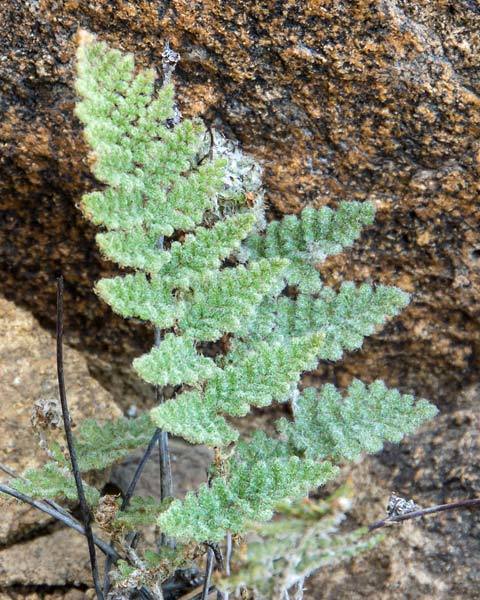
Villous Lipfern
Myriopteris windhamii
Myriopteris windhamii, formerly known as Cheilanthes villosa, is a species of lip fern, known as villous lipfern. This plant is native to the southwestern United States where it grows in rocky mountains and deserts. For example, it is found along with the elephant tree, Bursera microphylla, and other desert species in the Waterman Mountains of southeastern Arizona (northern Pima County).
From the article Myriopteris windhamii on Wikipedia (CC BY-SA), quoted section by section
Description
Myriopteris windhamii is a medium-sized tufted fern growing from a short rhizome with bicolored scales. Leaves are up to 20–30 cm (7.9–11.8 in) long. The leaf blades are mostly lanceolate, 3- or 4-times divided, and green to grayish on top, with bead-like ultimate leaf segments. The abaxial (lower) leaf surface is densely covered with whitish hairs, which often also envelop and entangle hairs on the adaxial (upper) surface. Scales on the costae are not ciliate or rarely with one or a few cilia. Myriopteris windhamii is similar in appearance to Myriopteris lindheimeri but can be distinguished by bicolored rhizome scales, costal scales not markedly ciliate, and hairs attached directly to the adaxial (upper) leaf segments (not just growing over the upper leaf surface as in Myriopteris lindheimeri).
Range & habitat
Myriopteris windhamii is native to the southwestern United States where it grows in rocky mountains and deserts. For example, it is found along with the elephant tree, Bursera microphylla, and other desert species in the Waterman Mountains of southeastern Arizona (northern Pima County). It is often found on limestone or other calcium-rich rocks and soils.
Wikipedia: “Range and Habitat”
How it is grown
Myriopteris windhamii can be relatively easily cultivated, and should be grown under high light in well-drained garden soil. The soil should be basic and moist-dry to moist.
Wikipedia: “Cultivation”
Where it lives
Recorded sightings
—
geo-referenced records in GBIF, from museums, herbaria and field observers.
Drag the globe to turn it. Dots are where records exist, not a range map; darker means more records.
In the stacks
Searching the stacks…
Every page naming Myriopteris windhamii in the Biodiversity Heritage Library →
This page is assembled live from iNaturalist, GBIF, Wikipedia, the Source Library and the Internet Archive. It is not yet part of the hand-edited codex. iNaturalist taxon 481745.