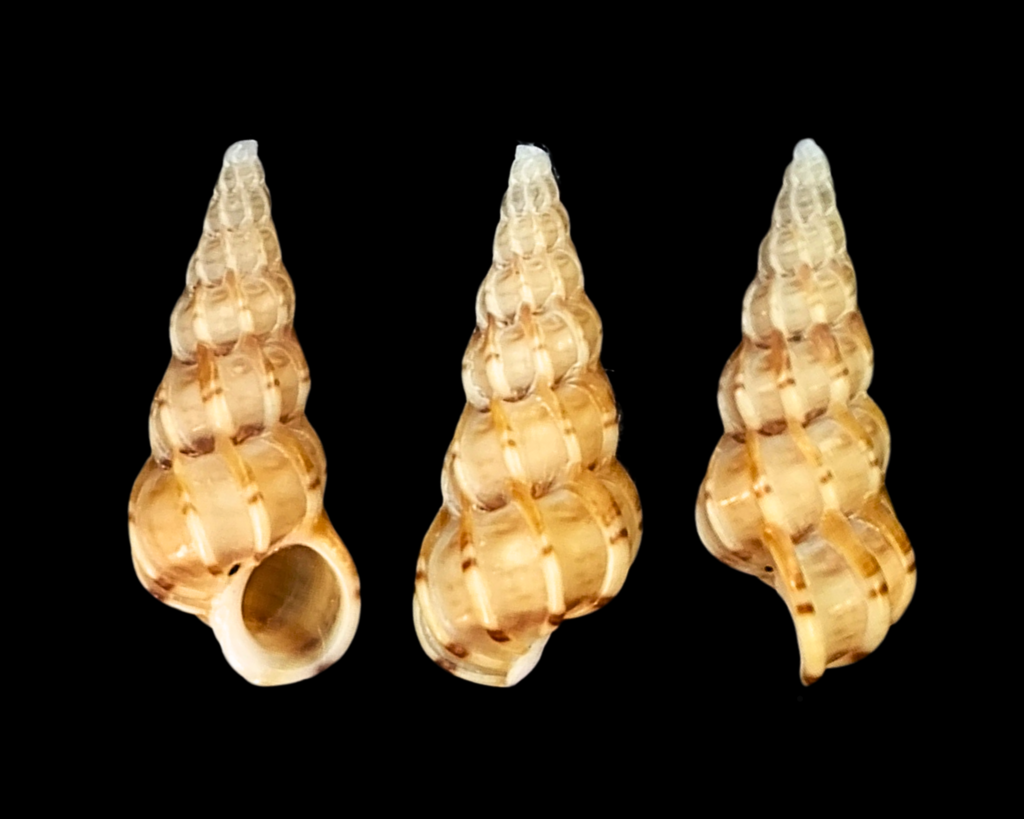
Common Wentletrap
Epitonium clathrus
Epitonium clathrus, also known as the common wentletrap, is a species of small predatory sea snail, a marine gastropod mollusc in the family Epitoniidae, the wentletraps.
From the article Epitonium clathrus on Wikipedia (CC BY-SA), quoted section by section
Description
Shell: The cone-shaped shell reaches a height of 35 mm. It is shiny white to cream coloured, often with brown spots. Seven thick and very distinct costae (spiral ribs) wind around twelve to fifteen whorls. These convex whorls often contain two or three purple bands that can best seen when they cross the lamella of the outer lip. The protoconch is usually blunt. The aperture is entire and rounded. Its top coincides with a suture. The umbilicus is lacking. The operculum is horny and paucispiral. Soft parts (data compiled from George Washington Tryon (1887) and Johannes Thiele (1929)): The short foot is truncated in front and extends far in advance of the head. The long tentacles are narrow and close together. The eyes are situated on the base of the tentacles. The mantle margin is simple and contains a rudimentary siphonal fold. The radula is wide and more or less bent at the end. The radular teeth are elongate and hook shaped or needle shaped, with many teeth in a series. The species is hermaphroditic.
Range & habitat
The common wentletrap is very common along the eastern Atlantic coast, in the North Sea up to Norway, the Mediterranean and the Black Sea. Live specimens have only rarely been observed. While it does occur in the Baltic Sea, it has become a vulnerable species there.
Wikipedia: “Distribution”
What it does
Epitonium clathrus is a predator of sea anemones (Anthozoa, Actiniaria) and corals (Anthozoa, Scleractinia). It has been seen feeding on the sea anemone Anemonia sulcata and found in the neighbourhood of sea anemones Sagartia troglodytes and Sargartiogeton undatus.
Wikipedia: “Feeding habits”
Where it lives
Recorded sightings
—
geo-referenced records in GBIF, from museums, herbaria and field observers.
Drag the globe to turn it. Dots are where records exist, not a range map; darker means more records.
In the stacks
Searching the stacks…
Every page naming Epitonium clathrus in the Biodiversity Heritage Library →
This page is assembled live from iNaturalist, GBIF, Wikipedia, the Source Library and the Internet Archive. It is not yet part of the hand-edited codex. iNaturalist taxon 482316.