- Plants
- ›Vascular Plants
- ›flowering plants
- ›monocots
- ›lilies, supplejacks, and allies
- ›lily family
- ›true lily subfamily
- ›true lilies and allies
- ›Erythronium
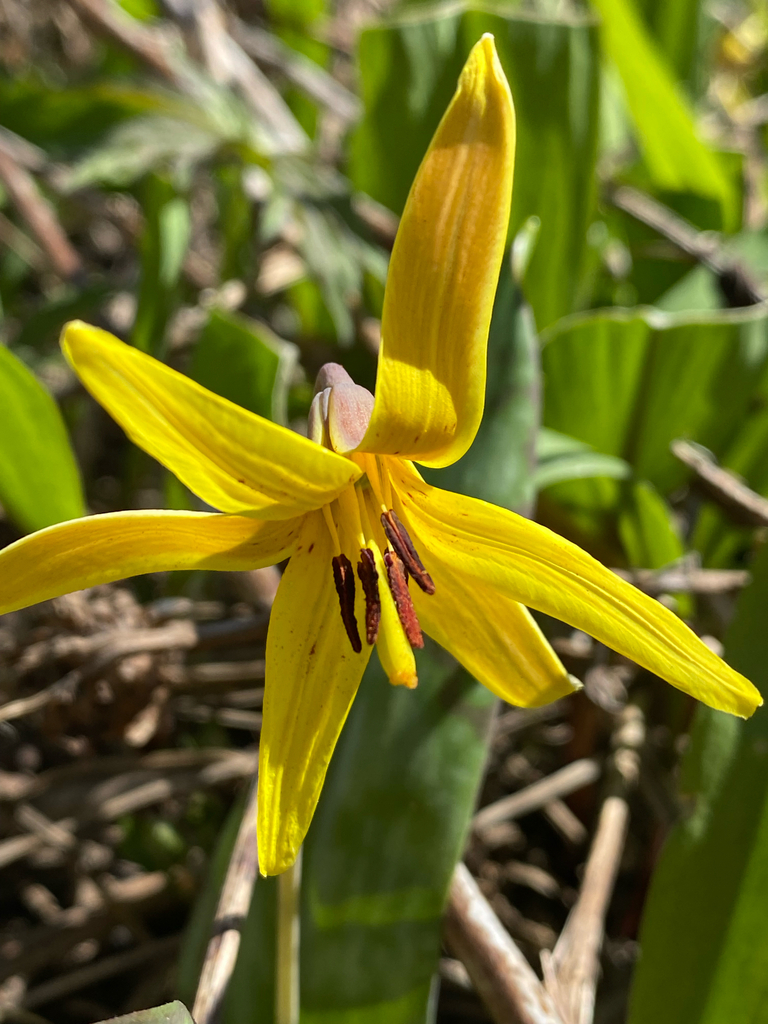
yellow trout lily
Erythronium americanum
Erythronium americanum, the trout lily, yellow trout lily, fawn lily, yellow adder's-tongue, or yellow dogtooth violet, is a species of perennial, colony forming, spring ephemeral flower native to North America and dwelling in woodland habitats. Within its range it is a very common and widespread species, especially in eastern North America. The common name "trout lily" refers to the appearance of its gray-green leaves mottled with brown or gray, which allegedly resemble the coloring of brook trout.
The range is from Labrador south to Georgia, west to Mississippi, and north to Minnesota.
From the article Erythronium americanum on Wikipedia (CC BY-SA), quoted section by section
What it does
Erythronium americanum does not reproduce very effectively via sexual reproduction with only 10% of pollinated flowers developing seeds. The fruit is a 12 to 15 mm long capsule that is held off the ground by the flower stalk. E. americanum is a myrmecochorous plant, meaning that ants help disperse the seeds and reduce seed predation. To make the seeds more appealing to ants they have an elaiosome which is a structure that attracts ants.
Wikipedia: “Fruit and sexual reproduction”
Where it lives
Recorded sightings
—
geo-referenced records in GBIF, from museums, herbaria and field observers.
Drag the globe to turn it. Dots are where records exist, not a range map; darker means more records.
In the stacks
Searching the stacks…
Every page naming Erythronium americanum in the Biodiversity Heritage Library →
This page is assembled live from iNaturalist, GBIF, Wikipedia, the Source Library and the Internet Archive. It is not yet part of the hand-edited codex. iNaturalist taxon 48240.