- Plants
- ›Vascular Plants
- ›conifers
- ›conifers
- ›cypress family
- ›Cypresses, Cedars, Junipers, and Allies
- ›Thuja
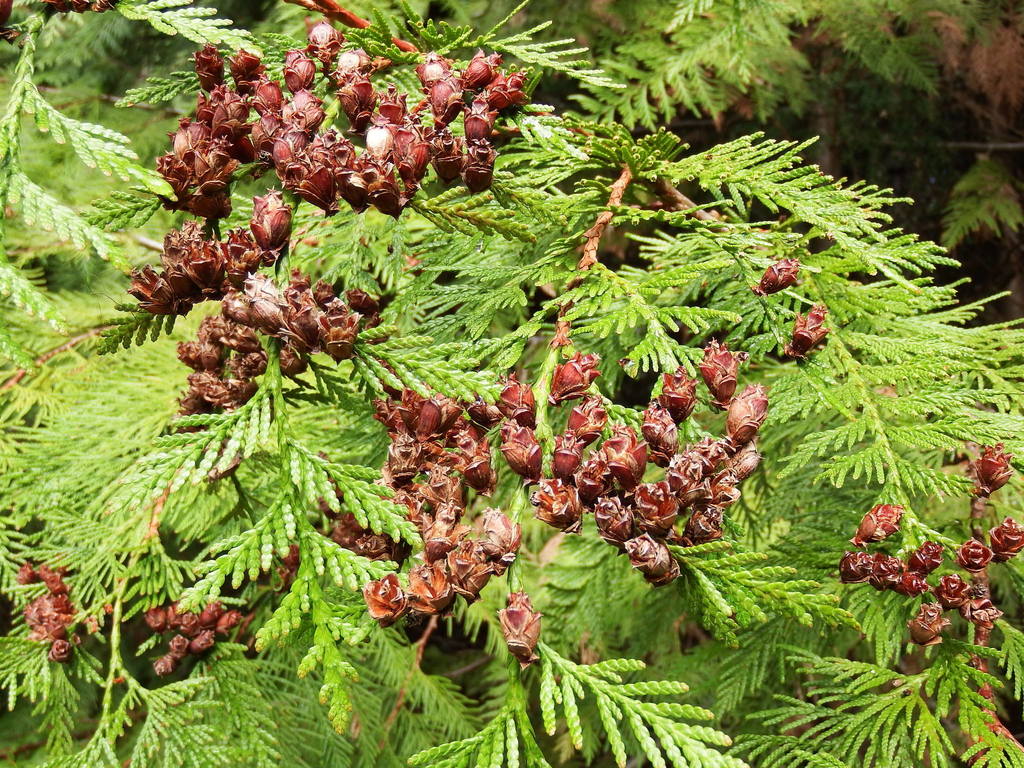
western redcedar
Thuja plicata
Thuja plicata is a large coniferous tree in the cypress family, Cupressaceae, native to the Pacific Northwest of North America. Its common name is western redcedar, although it is not a true cedar. It is also less commonly called western red cedar, pacific red cedar, giant arborvitae, western arborvitae, just cedar, giant cedar, or shinglewood. T. plicata is the largest species in the genus Thuja, growing up to 70 metres (230 ft) tall and 7 m (23 ft) in diameter. It mostly grows in areas that experience a mild climate with plentiful rainfall, although it is sometimes present in drier areas on sites where water is available year-round, such as wet valley bottoms and mountain streamsides. The species is shade-tolerant and able to establish in forest understories and is thus considered a climax species. It is a very long-lived tree, with some specimens reaching ages of well over 1,000 years.
Indigenous peoples of the Pacific Northwest use the wood of this species for many purposes, such as building canoes, totem poles, and tools. The bark is harvested by indigenous peoples and processed into a fiber, which they use to make items such as rope, baskets, clothing, and rain hats. Because of its wide range of uses, the species is of great cultural importance to these people. Western redcedar wood is aromatic and rot-resistant and is used for applications such as the construction of shingles and siding. It has been introduced to cool temperate areas in other parts of the world, such as Northern Europe and New Zealand.
From the article Thuja plicata on Wikipedia (CC BY-SA), quoted section by section
Description
Thuja plicata is a large to very large tree, ranging up to 45 to 70 metres (150 to 230 feet) tall and 2.4 to 7 m (8 to 23 ft) in trunk diameter, larger than any other species in its genus. The trunk swells at the base and has shallow roots. The bark is thin, gray-brown, and fissured into vertical bands. Trees growing in the open may have a crown that reaches the ground, whereas trees densely spaced together will exhibit a crown only at the top, where light can reach the leaves. As the tree ages, the top is damaged by wind and replaced by inferior branches. The species is long-lived; some trees can live well over a thousand years, with the oldest verified aged 1,460. The foliage forms flat sprays with scale-like leaves in opposite pairs, with successive pairs at 90 degrees to each other. The foliage sprays are green throughout but marked with whitish stomatal bands below; they emit a strong aroma reminiscent of pineapple when crushed. The individual leaves are 1 to 4 millimetres (1⁄32 to 5⁄32 in) long and 1 to 2 mm (1⁄32 to 3⁄32 in) broad on most foliage sprays but up to 12 mm (1⁄2 in) long on strong-growing lead shoots. The foliage of individual branchlets turns orange-brown before falling off in autumn. …
Range & habitat
Thuja plicata is among the most widespread trees in the Pacific Northwest. It is associated with Douglas-fir (Pseudotsuga menziesii) and western hemlock (Tsuga heterophylla) in most places where it grows. It grows best on moist sites in areas with a wet, maritime climate, and only occurs where precipitation exceeds 71 centimetres (28 in) annually. It grows from the Cascade Range and Coast Mountains westward to the Pacific Ocean, from central South East Alaska (near the village of Kake) to northern California (growing closer to the coast at the northern and southern extremes). A disjunct population occurs inland from central-southeast British Columbia through the Idaho Panhandle. The easternmost extent of its distribution occurs in Glacier National Park in Montana, where it is a major component of forests surrounding Lake McDonald. It is present east of the continental divide in the park, growing in a handful of small, isolated stands. It is usually found from sea level to elevations of 1,100 m (3,600 ft), but grows at altitudes of up to 2,290 m (7,510 ft) at Crater Lake in Oregon and 1,500 m (4,900 ft) in Idaho. Western redcedar grows on many types of soils. It is present on all landforms and soil classes on Vancouver Island, but is restricted to wet, low-lying areas and streamsides in the drier eastern portions of its range. …
Wikipedia: “Distribution and habitat”
What it does
It is considered to have low to moderate fire resistance, as its thin bark, shallow roots, low dense branching habit and flammable foliage offer little protection. Smaller trees are commonly killed by fire, but larger specimens often survive due to their size if they are not completely girdled. The intervals between fires within western redcedar stands tend to be very long, from 50 up to 350 years or more.
Wikipedia: “Fire ecology”
At the table
It is also widely used throughout Europe and America for making beehive components. Its bark has been studied for applications in polyurethane. Used in the construction of windows and doors (joinery grade timber). Western red cedar is still highly valued as "tonewood" for stringed instruments' sound boards.
Wikipedia: “Other uses”
How it is grown
Like its relative Thuja occidentalis and many other conifer species, T. plicata is grown as an ornamental tree, and for screens and hedges, throughout the world in gardens and parks. A wide variety of forms, sizes, and colors are available.
Cultivars The following cultivars have gained the Royal Horticultural Society's Award of Garden Merit:
'Atrovirens' 'Aurea' 'Stoneham Gold' 'Whipcord' 'Zebrina'
Wikipedia: “Cultivation”
In human culture
The species name plicata derives from the Latin word plicāre and means 'folded in plaits' or 'braided,' a reference to the pattern of its small leaves. Most authorities, both in Canada and the United States transliterate the English name in two words as 'western redcedar', or occasionally hyphenated as 'western red-cedar', to indicate that it is not a true cedar (Cedrus), but it also appears as 'western red cedar' in some popular works. In the American horticultural trade, it is also known as the giant arborvitae, by comparison with arborvitae for its close relative T. occidentalis. Other names include giant red cedar, Pacific red cedar, shinglewood, British Columbia cedar (being the province's official tree), canoe cedar, and red cedar. Arborvitae comes from the Latin for 'tree of life'; coincidentally, Native Americans of the West Coast also address the species as "long life maker". One endonymous name for the tree is the Halkomelem word xepá:y, from the roots xíp, meaning 'scratch' or 'line', and á:y, 'bark'; the former root may be in reference to both the lined or "folded/braided" appearance of the bark and the tree's ubiquity in carving and other forms of woodwork. It is called x̱ápay̓ay in the Squamish language. Further south, in the Lushootseed language, the root for red cedar is x̌payʔ and x̌payʔac refers to a red cedar tree.
Wikipedia: “Etymology”
Where it lives
Recorded sightings
—
geo-referenced records in GBIF, from museums, herbaria and field observers.
Drag the globe to turn it. Dots are where records exist, not a range map; darker means more records.
In the stacks
Searching the stacks…
Every page naming Thuja plicata in the Biodiversity Heritage Library →
This page is assembled live from iNaturalist, GBIF, Wikipedia, the Source Library and the Internet Archive. It is not yet part of the hand-edited codex. iNaturalist taxon 48252.