- Animals
- ›Molluscs
- ›Bivalves
- ›Autobranchia
- ›Pteriomorphia
- ›Oysters and Allies
- ›Ostreoidea
- ›True Oysters
- ›Saccostreinae
- ›Saccostrea
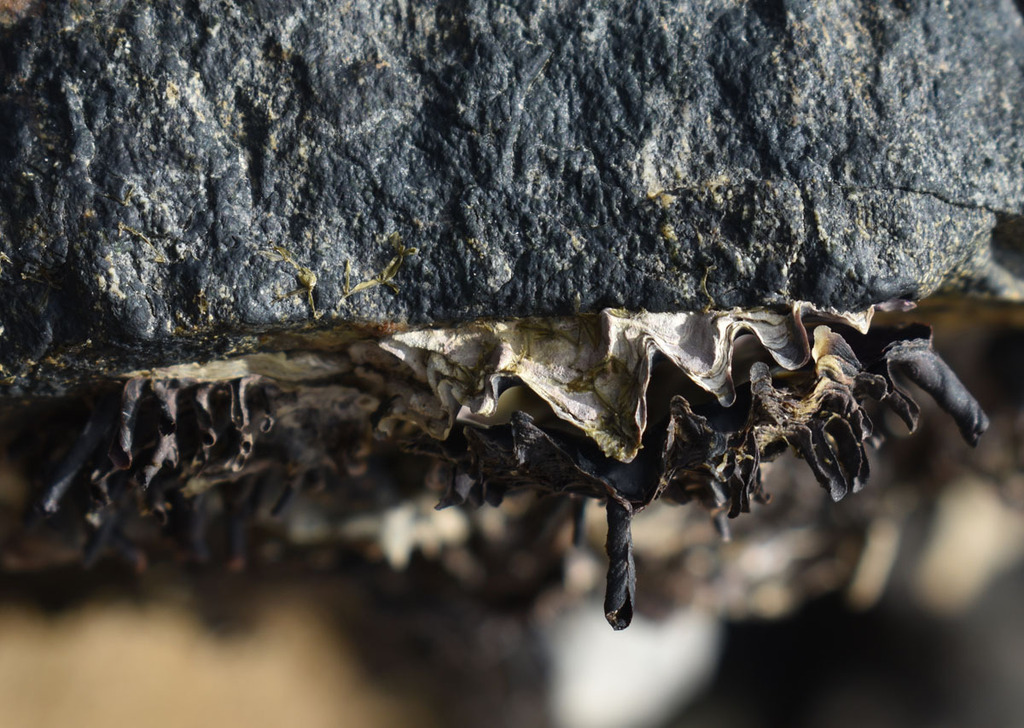
Spiny Rock Oyster
Saccostrea echinata
Saccostrea echinata, commonly known as the tropical black-lip rock oyster, blacklip rock oyster, blacklip oyster, and spiny rock oyster, is one of several tropical rock oyster species, occurring in tropical seas across the Indo-Pacific, including coastal waters across northern Australia to Noumea.
The history of Indigenous Australians' harvesting of the oysters goes back many generations, as evidenced by the numerous shell middens along Australia's northern coastline. More recently, the wild oysters have been collected off the rocks and bottled for sale.
From the article Saccostrea echinata on Wikipedia (CC BY-SA), quoted section by section
Description
A 2019 study on the reproductive cycles of three populations of the oyster in the Northern territory showed that it is probably a dioecious species, occasionally functioning as hermaphrodites. A major finding was that the species spawns almost continuously during the wet season from October to April, while it rests for the rest of the year, during the dry season.
Range & habitat
A 2019 study focused on four populations identified four genetic clusters: one in Noumea, two in NT, and one in Queensland. This species also occurs off Ambon Island, Indonesia.
Wikipedia: “Distribution and habitat”
In human culture
Due to its large size, fast rate of growth and an already established potential market, the black-lip rock oyster is well-suited to the creation of an aquaculture industry in tropical Australia and the Indo-Pacific region. It has also been shown to withstand harsh weather better than other species, and it produces a greater quantity of meat. Much research has been done on breeding the oyster in hatcheries and on-site, in particular at locations in Western Australia (WA), the Northern Territory (NT) and Queensland. In Bowen, Queensland, the only current Australian commercial farm of black-lip rock oysters has been operating for quite a few years now. This farm has been solely operating using wild spat collection techniques and mainly selling locally due to the high demand for the product. This, however, may soon change as researchers in the DAF Queensland's new Bribie Island Research Centre Oyster Hatchery have just produced over 500,000 spat, proving the possibility of hatchery stock for future commercial production. The Cooperative Research Centre for Developing Northern Australia (CRCNA) is also running a three-year project worth A$4,124,090, set to finish on 30 September 2023 to conduct research on issues affecting the tropical rock oyster industry across WA and NT, hoping to develop a new aquaculture industry for the region which will create jobs for 500+ people. …
Wikipedia: “Aquaculture in Australia”
Where it lives
Recorded sightings
—
geo-referenced records in GBIF, from museums, herbaria and field observers.
Drag the globe to turn it. Dots are where records exist, not a range map; darker means more records.
In the stacks
Searching the stacks…
Every page naming Saccostrea echinata in the Biodiversity Heritage Library →
This page is assembled live from iNaturalist, GBIF, Wikipedia, the Source Library and the Internet Archive. It is not yet part of the hand-edited codex. iNaturalist taxon 482640.