- Plants
- ›Vascular Plants
- ›flowering plants
- ›Dicots
- ›Sunflowers, Bellflowers, Fanflowers, and Allies
- ›Sunflowers, Daisies, Asters, and Allies
- ›Asteroideae
- ›asters and allies
- ›Brachyscominae
- ›Calotis
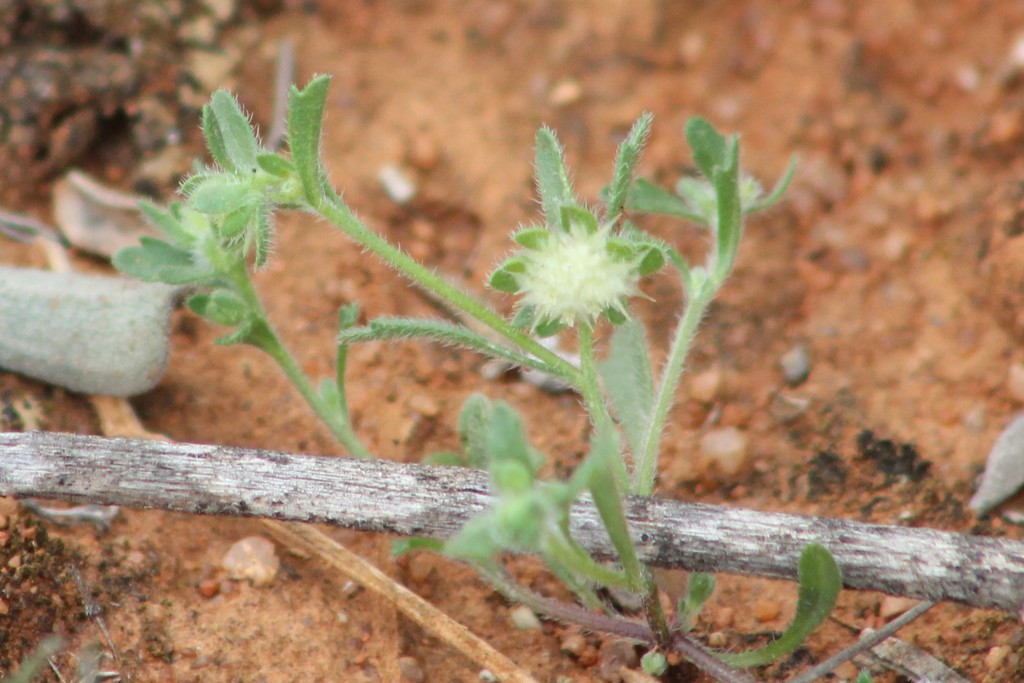
Hairy Burr-daisy
Calotis hispidula
Calotis hispidula, commonly known as the Bogan flea or bindi eye, is a hairy species of daisy found in many parts of mainland Australia. It is a small herbaceous plant growing up to 10 centimetres tall, with white flowers that are often seen in the winter months. The specific epithet hispidula refers to the plant's covering of stiff hairs.
Calotis spp. are innocent looking daisies until they fruit, when the flower heads develop into masses of rigid needle-sharp barbs. Mainly opportunistic inhabitants of grasslands, their barbed burrs can be easily transported by livestock.
From the article Calotis hispidula on Wikipedia (CC BY-SA), quoted section by section
Description
Calotis hispidula is an annual ascending herb which may grow to 10 to 12 centimetres (3.9 to 4.7 in) high, with rough, hirsute hairs. It has no basal leaves; the aerial leaves are somewhat wedge-shaped, 0.5 to 2 centimetres (0.20 to 0.79 in) long and 1 to 7 millimetres (0.039 to 0.276 in) wide. The barbed flower heads range from 4 to 10 millimetres (0.16 to 0.39 in) in diameter, supported by bracts that encase a conical, scaled receptacle. The florets are yellow and sprout to be 1 mm long.
Range & habitat
Calotis hispidula grows in heavy clays to shallow stony soils, in a wide variety of communities; it is widespread, especially in inland districts. Known and current populations range within New South Wales, Queensland, Victoria, Northern Territory, South Australia, and Western Australia. It is found abundantly in Central Australia.
Wikipedia: “Distribution”
What it does
The species grows in sandy soil on flats, low dunes and small hills and appears to be associated with Acacia woodlands and shrublands dominated by chenopods. Apparently a perennial that flowers in the first year of growth; no plants of this species have been observed to survive for more than two years; flowering is recorded for September and fruit have been collected in October, though it will flower as early as August.
Case study. At Mount Mulyah, northwest of Louth, New South Wales, Calotis spp. grows in an area cleared of original acacia cambagei woodland and subsequently invaded by dodonaea viscosa subsp. angustissima, which repressed the growth of herbaceous species. No regeneration of this species has been seen at Mount Mulyah since 1984. Calotis hispidula can often be found growing in conjunction with other Calotis species, such as C. cymbacantha and C. erinacea, and are very similar morphologically.
Wikipedia: “Ecology”
Where it lives
Recorded sightings
—
geo-referenced records in GBIF, from museums, herbaria and field observers.
Drag the globe to turn it. Dots are where records exist, not a range map; darker means more records.
In the stacks
Searching the stacks…
Every page naming Calotis hispidula in the Biodiversity Heritage Library →
This page is assembled live from iNaturalist, GBIF, Wikipedia, the Source Library and the Internet Archive. It is not yet part of the hand-edited codex. iNaturalist taxon 482823.