- Plants
- ›Vascular Plants
- ›flowering plants
- ›monocots
- ›Agaves, Orchids, Irises, and Allies
- ›Cyanella family
- ›Tecophilaea
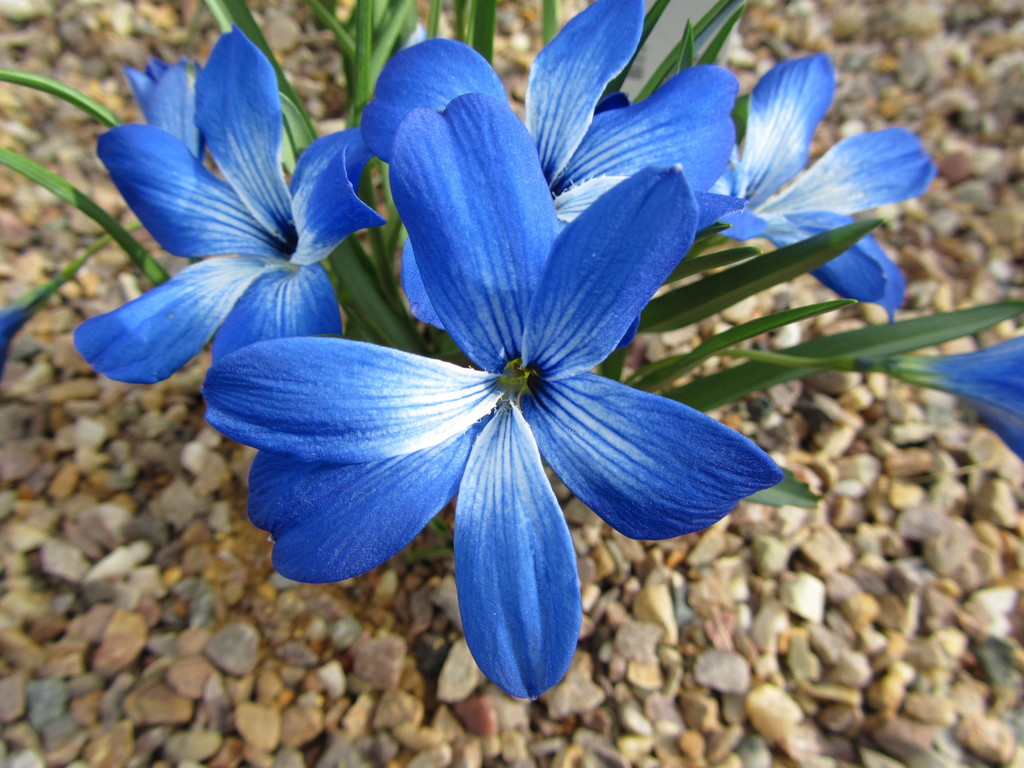
Chilean Blue Crocus
Tecophilaea cyanocrocus
Tecophilaea cyanocrocus, the Chilean blue crocus, is a flowering perennial plant that is native to Chile, growing at 2,000 to 3,000 m (6,600 to 9,800 ft) elevation on dry, stony slopes in the Andes mountains. Although it had survived in cultivation due to its use as a greenhouse and landscape plant, it was believed to be extinct in the wild due to overcollecting, overgrazing, and general destruction of habitat, until it was rediscovered in 2001.
From the article Tecophilaea cyanocrocus on Wikipedia (CC BY-SA), quoted section by section
Description
Both the specific epithet cyanocrocus and the common name "Chilean blue crocus" highlight the plant's passing resemblance to the true crocus. However, the two plants are not closely related, and there is no blue crocus, either in the wild or in cultivation. In its native habitat, the plant blooms from October to November, which is springtime in the Southern Hemisphere. In northern climates, it flowers from February to March. Tecophilaea cyanocrocus grows on stems up to 4 in (10 cm) tall, with 1-3 linear fleshy leaves. The single flowers are approximately 1 in (2.5 cm) across, goblet shaped, and are an unusual deep gentian blue color, with a whitish center. The root is a nearly spherical corm with a fibrous cover.
How it is grown
T. cyanocrocus is hardy in USDA Zones 9-10; in essentially frost-free mild climate areas (e.g. Northern New Zealand, Ireland, much of northern California) Tecophilaea cyanocrocus may be successfully grown in open rock gardens exposed to the weather. However, tecophilaea is somewhat frost-tender and cannot withstand hard freezes. Where winter freezes may occur, such as the Pacific Northwest, tecophilaea is best grown in containers that can be protected from very cold weather. Nonetheless, as long as the temperature does not drop much below freezing, tecophilaea is healthier for being kept in the open during winter. Tecohilaea grows best in a well-drained, circum-neutral (pH 6-7) soil. The corms go dormant during summer, and water should be entirely withheld once the foliage fades after the springtime period of active growth. However, tecophilaea does not benefit from the summer baking that most tulips and many crocuses benefit from. On the contrary, tecophilaea prefers dry, but rather cool soil in summer. Putting the pots in which it is grown in the shade, out of direct sun, is desirable. Water should be withheld until new growth appears in the fall as the soil cools, then increased. …
Wikipedia: “Cultivation”
Where it lives
Recorded sightings
—
geo-referenced records in GBIF, from museums, herbaria and field observers.
Drag the globe to turn it. Dots are where records exist, not a range map; darker means more records.
In the stacks
Searching the stacks…
Every page naming Tecophilaea cyanocrocus in the Biodiversity Heritage Library →
This page is assembled live from iNaturalist, GBIF, Wikipedia, the Source Library and the Internet Archive. It is not yet part of the hand-edited codex. iNaturalist taxon 482881.