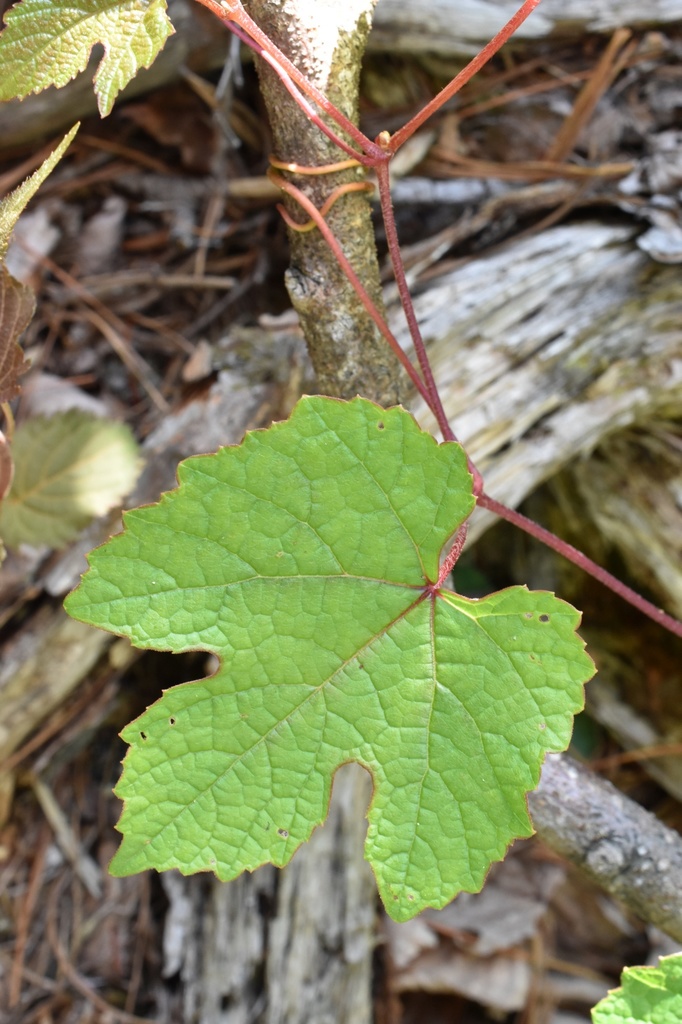
Amur grape
Vitis amurensis
Vitis amurensis, the Amur grape, is a species of grape native to the Asian continent. Its name comes from the Amur Valley in Russia and China.
It is very resistant to frost, but is not tolerant to drought. Selections vary, but as a species it has strong resistance to anthracnose and ripe rot, and moderately strong resistance to downy mildew and powdery mildew.
From the article Vitis amurensis on Wikipedia (CC BY-SA), quoted section by section
Range & habitat
Vitis amurensis is a relic of pre-glacial subtropical vegetation of the Far East, it reaches the continental latitude Lake Kizi (about fifty-first parallel). Along the coast of the Sea of Japan to the north it reaches the mouth of the Muli river, and the Amur region to the west - to the river Zeya. It grows in the forests of Manchuria, Amur Oblast, Primorsky Krai, North East China (Anhui, Hebei, Heilongjiang, Jilin, Liaoning, Shandong, Shanxi, Zhejiang), and Korea. Amur grapes are classified into three varieties:
V. amurensis var. amurensis V. amurensis var. dissecta V. amurensis var. yanshanensis It is most common in the valleys of rivers and streams, in clearings, forest edges, forests, the lower and middle slopes of mountains, where they climb to trees and spread along the ground. It is the northernmost and most stable type of grape growing in the Far Eastern taiga. Most grapes species are found in much warmer climates. Only the Amur grape can tolerate winter temperatures down to −45 °C, and the root zone of the soil to −16 °C. Anthropogenic factors have adversely affected the number and status of the Amur grapes in their natural habitats, leading to a marked reduction in their range.
Wikipedia: “Distribution and ecology”
How it is grown
Samples of V. amurensis were made in the former USSR for studies into resistance to cold. Hybrid varieties from the cross V. amurensis x V.vinifera or V. labrusca x V. amurensis were obtained. The first crop of V. amurensis was during the Japanese occupation of Manchuria (1931-1945). In Jilin in northeast China, the Japanese created the first wineries producing wine from wild grapes V. amurensis. About 800 km to the south, the culture of the European vine (V. vinifera) is possible in the region of Beijing only if the vines are buried under a thick layer of earth in winter to protect them from extreme cold. Faced with this difficulty, the Japanese tried to take advantage of high resistance to cold of the wild vine in the region to produce wine. In 1936 the Changbaishan Winery Ltd was created and Tonghua Winery Ltd 1938. in the region of Jilin, west of Changbai Mountains near the North Korean border. The climate of this region can be characterized by long, cold winters and short, warm summers, with average January temperatures ranging from -14C to -40C. At the time, the basement of Changbaishan produced 40 tons of wine. In 1954, the Beijing Botanical Garden tried hybridizations of V. amurensis grape with the European vine. …
Wikipedia: “History of cultivation”
Where it lives
Recorded sightings
—
geo-referenced records in GBIF, from museums, herbaria and field observers.
Drag the globe to turn it. Dots are where records exist, not a range map; darker means more records.
In the stacks
Searching the stacks…
Every page naming Vitis amurensis in the Biodiversity Heritage Library →
This page is assembled live from iNaturalist, GBIF, Wikipedia, the Source Library and the Internet Archive. It is not yet part of the hand-edited codex. iNaturalist taxon 482937.