- Animals
- ›Arthropods
- ›Hexapods
- ›Insects
- ›Winged and Once-winged Insects
- ›Beetles
- ›Water, Rove, Scarab, Long-horned, Leaf, and Snout Beetles
- ›Cucujiform Beetles
- ›Leaf Beetles and Allies
- ›Leaf Beetles
- ›Chrysomelinae
- ›Chrysomelini
- ›Phratorina
- ›Phratora
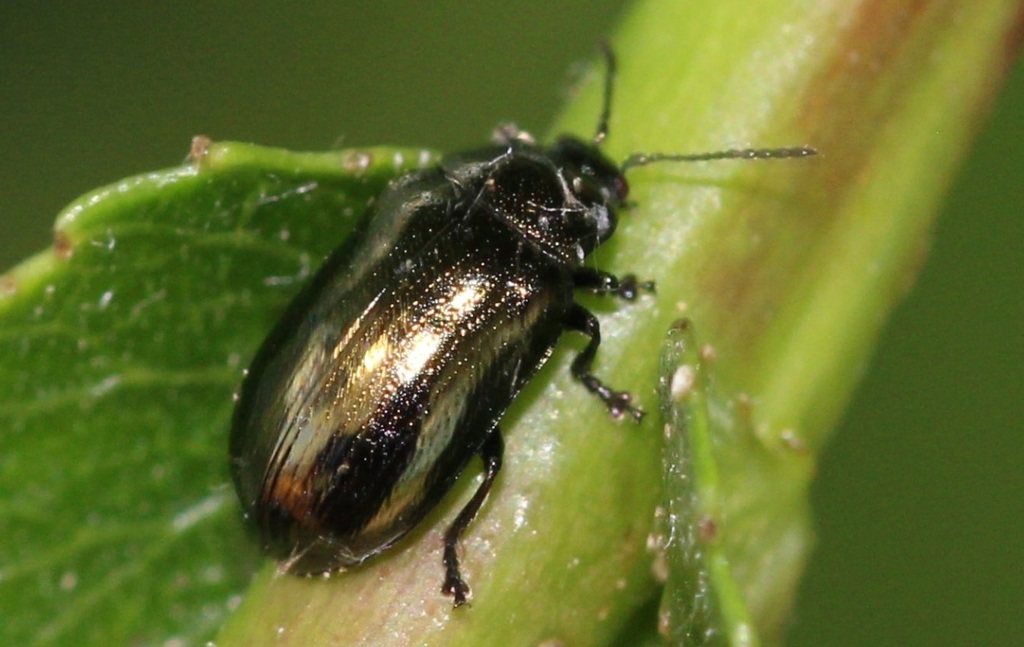
Brassy Willow Beetle
Phratora vitellinae
Phratora vitellinae, the brassy leaf beetle, formerly Phyllodecta vitellinae, is a beetle of the family Chrysomelidae found in Europe and Asia. It feeds on Populus and Salix species. The evolution of its host plant preferences and the mechanism by which it uses host plant chemicals to make a larval defensive secretion have been the subject of intense study by research groups in Europe and the Nordic countries.
From the article Phratora vitellinae on Wikipedia (CC BY-SA), quoted section by section
Description
Phratora vitellinae adults range from 3.5–5.2 mm long. The opaque forewings (elytra) show longitudinal rows of clearly visible dots. Adults typically show metallic blue, green, or bronze colors. Adults show copper or purple colors at high elevations or in Arctic regions. One way to distinguish among adult Phratora beetles co-occurring on the same host plant is to gently squeeze the abdomen of females until the morphology of the genitalia can be observed from the ventral side. Phratora vitellinae females possess a wide smooth sclerotized plate running parallel to the posterior of the abdomen.
Eggs are typically laid in clutches of 8–16, arranged in rows on the underside of the host leaf. Like other Phratora species, eggs are partially covered with a crusty secretion. Eggs are about 0.8–1.0 mm long and 0.4–0.5mm wide. Larvae feed in groups in early instars (molts). Phratora vitellinae beetles feeding on Populus may co-occur with two other Phratora species Phratora laticollis and Phratora atrovirens. The Brassy Willow Beetle is larger and more abundant than P. atrovirens and somewhat broader in body shape than P. laticollis. Phratora vitellinae populations on Salix purpurea sometimes co-occur with Phratora tibialis, which also has a thinner body than P. vitellinae.
Range & habitat
Phratora vitellinae is a wide spread species in Eurasia. In Europe, it is found in Arctic regions and the Nordic countries, the United Kingdom, Germany to Spain, Serbia and Bosnia. It is also found in China and elsewhere in Asia. Populations occur at high elevations in parts of central Europe and China. Phratora vitellinae was introduced to Iceland in 2005 and is considered an invasive species there.
Wikipedia: “Range”
In human culture
Urban (2006) described the life history of a population in the Czech Republic in detail, and his article contains a good review of older studies of P vitellinae natural history and host plant use. Like other Phratora species, P vitellinae adults overwinter under bark, within fissures of bark of trees found near summer host plants, or in leaf litter. In spring, after 8–10 months overwintering, adults disperse to host plants and consume new foliage for about a week before mating, and in another week they lay their eggs on the underside of basal leaves on basal shoots. They lay 200–500 eggs in small clutches for up to 8 weeks during the growing season. After 8–14 days, hatchlings emerge from eggs and begin to feed on the host plant, often forming a row of feeding larvae. Larvae grow for about 8–20 days and undergo two molts before they reach the pupal stage. Before pupating, they migrate to the soil near host plants and make a pupal chamber. They remain in the pupal chamber for about eight days before emerging as new adults. In central Europe, this species can experience multiple generations per growing season (multivoltine), but it undergoes only one generation per summer in the Nordic countries or at high elevations.
Wikipedia: “Life history”
Listen
Looking for field recordings…
Where it lives
Recorded sightings
—
geo-referenced records in GBIF, from museums, herbaria and field observers.
Drag the globe to turn it. Dots are where records exist, not a range map; darker means more records.
In the stacks
Searching the stacks…
Every page naming Phratora vitellinae in the Biodiversity Heritage Library →
This page is assembled live from iNaturalist, GBIF, Wikipedia, the Source Library and the Internet Archive. It is not yet part of the hand-edited codex. iNaturalist taxon 483637.