- Animals
- ›Arthropods
- ›Hexapods
- ›Insects
- ›Winged and Once-winged Insects
- ›Beetles
- ›Water, Rove, Scarab, Long-horned, Leaf, and Snout Beetles
- ›Cucujiform Beetles
- ›Leaf Beetles and Allies
- ›Leaf Beetles
- ›Chrysomelinae
- ›Chrysomelini
- ›Phratorina
- ›Phratora
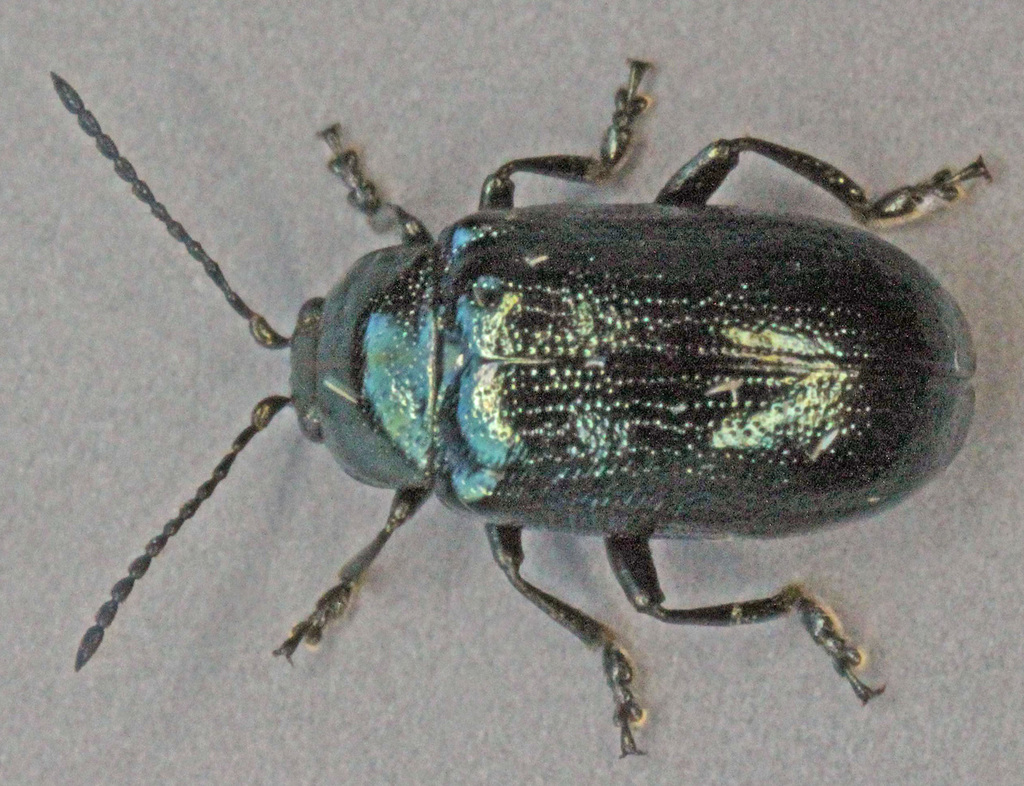
Blue Willow Beetle
Phratora vulgatissima
The blue willow beetle (Phratora vulgatissima), formerly Phyllodecta vulgatissima, is a herbivourous beetle of the family Chrysomelidae. It is dark with a metallic sheen that ranges from a blue color to bronze. It is distinguished from P. vitellinae by the latter more commonly displaying bronze coloration. European Phratora species can be distinguished based on morphology of female genitalia.
The larvae undergo three instar stages from hatching to pupation. This beetle is found throughout Europe and Scandinavia, and occurs in China.
From the article Blue willow beetle on Wikipedia (CC BY-SA), quoted section by section
What it does
The blue willow beetle is found on willow (Salix) species, whose leaves contain low levels of salicylates in fens, carrs and on river banks, but also often in willow short rotation coppice and other agricultural landscapes. It often aggregates on host plants. On Salix cinerea, it prefers and is more common on female than male trees despite higher egg predation exerted by the common flowerbug Anthocoris nemorum on female trees. It is univoltine in Sweden but can produce multiple generations per year in other parts of its distribution range. Proliferation of larvae and egg production varies with vegetation. It overwinters under lichens on trees and under tree bark. Predators of blue willow beetle eggs include A. nemorum and Orthotylus marginalis. Larval predators include A. nemorum, the bug Rhacognathus punctatus, a syrphid fly (possibly Parasyrphus nigritarsis) and the wasp Symmorphus bifasciatus. Adult beetles are parasitized by the wasp Perilitus brevicollis and consumed by R. punctatus.
Wikipedia: “Ecology”
Listen
Looking for field recordings…
Where it lives
Recorded sightings
—
geo-referenced records in GBIF, from museums, herbaria and field observers.
Drag the globe to turn it. Dots are where records exist, not a range map; darker means more records.
In the stacks
Searching the stacks…
Every page naming Phratora vulgatissima in the Biodiversity Heritage Library →
This page is assembled live from iNaturalist, GBIF, Wikipedia, the Source Library and the Internet Archive. It is not yet part of the hand-edited codex. iNaturalist taxon 483638.