- Fungi Including Lichens
- ›Ascomycete Fungi
- ›Sac Fungi and Lichens
- ›Operculate Ascomycetes
- ›Pezizales
- ›Rhizinaceae
- ›Rhizina
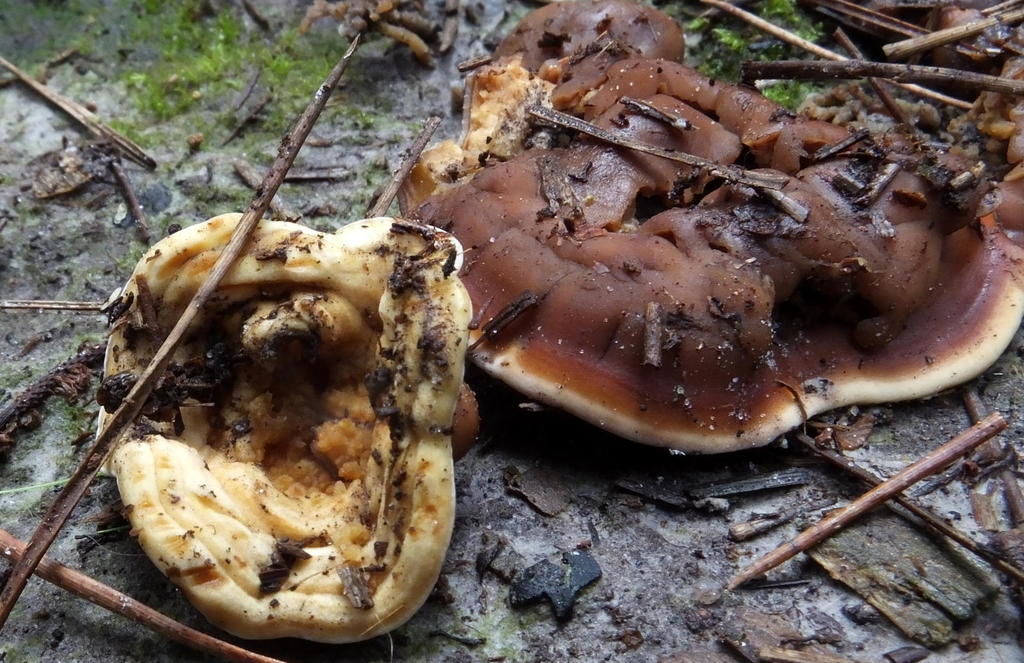
Doughnut Fungus
Rhizina undulata
Rhizina undulata, commonly known as the doughnut fungus or the pine firefungus, is a species of fungus in the family Rhizinaceae. The fruit bodies of the fungus are dark purple brown with a bright yellow margin, crust-like and attached to the growing surface by numerous root-like yellow rhizoids. R. undulata has a cosmopolitan distribution, and commonly occurs on clearings or burned areas throughout central and northern Europe, North America, northern Asia, and southern Africa. It is parasitic on conifer seedlings, and has caused considerable damage to tree plantations worldwide.
From the article Rhizina undulata on Wikipedia (CC BY-SA), quoted section by section
Description
Fruit bodies (apothecia), which may be up to 6 cm (2.4 in) wide, are flat, with irregular lobes, and are attached to the growing surface on the entire lower side by numerous whitish to yellowish rhizomorphs. The hymenium is dark purple brown to blackish, while the margin is a cream color(like the underside), and wavy and irregular. When moist, the surface is sticky. The fruit body has a leathery texture when old. In very young fruit bodies, the surface is white; the brown color initially appears in the center and expands rapidly thereafter. Later in the growing season, several of these apothecia may clump together and form irregularly-shaped structures up to 25 cm wide. They will lose their cream-colored ring and become black. These are the resting structures that will allow the fungus to survive unfavorable conditions until another fire occurs and the ascospores germinate. The spores of Rhizina undulata are fusiform (fuse-shaped), apiculate, minutely verricose at maturity, with one or two oil drops, and have dimensions of 30–40 by 8–11 μm. The asci are roughly cylindrical, and 250–280 by 14–18 μm. Like most other Pezizales, the asci open at maturity by means of an apical, lid-like flap of tissue termed an operculum. …
Range & habitat
This is a widespread fungus that grows on burned soil or conifer debris. The spores are activated by the heat of the fire, which is why the disease is present in burned soil. This is because the fire breaks the spore dormancy and also creates a competitive advantage and allows the fungus to thrive. It prefers growing in acidic soil. Although it is regarded as a saprobic species, it can also attack conifers of varying age parasitically. Its parasitic nature was recognized by scientists in the late 1800s and early 1900s, in particular, through several studies by German forestry scientist and mycologist Robert Hartig. He determined that the fungus can cause the death of four-year-old seedlings of several conifers, including European silver fir (Abies alba), eastern white pine (Pinus strobus), European larch (Larix decidua), Sitka spruce (Picea sitchensis), mountain hemlock (Tsuga mertensiana), Douglas fir Pseudotsuga menziesii, and sweet chestnut (Castanea vesca). Later research determined that the fungus also attacks conifers between 15 and 60 years old.
The roots of seedling attacked by R. undulata are matted together with a white mycelium that penetrates all parts of the cortical and bast tissues. Hartig grew the fungus in culture, and was able to follow the growth of the mycelium using light microscopy. …
Wikipedia: “Habitat and distribution”
Where it lives
Recorded sightings
—
geo-referenced records in GBIF, from museums, herbaria and field observers.
Drag the globe to turn it. Dots are where records exist, not a range map; darker means more records.
In the stacks
Searching the stacks…
Every page naming Rhizina undulata in the Biodiversity Heritage Library →
This page is assembled live from iNaturalist, GBIF, Wikipedia, the Source Library and the Internet Archive. It is not yet part of the hand-edited codex. iNaturalist taxon 484413.