- Animals
- ›Arthropods
- ›Hexapods
- ›Insects
- ›Winged and Once-winged Insects
- ›Ants, Bees, Wasps, and Sawflies
- ›Narrow-waisted Wasps, Ants, and Bees
- ›Ants, Bees, and Stinging Wasps
- ›Bees and Apoid Wasps
- ›Bees
- ›Miner, Fairy, Allied Panurgine, and Oxaeine Bees
- ›Typical Mining Bees
- ›Andrenini
- ›Andrena
- ›Chrysandrena
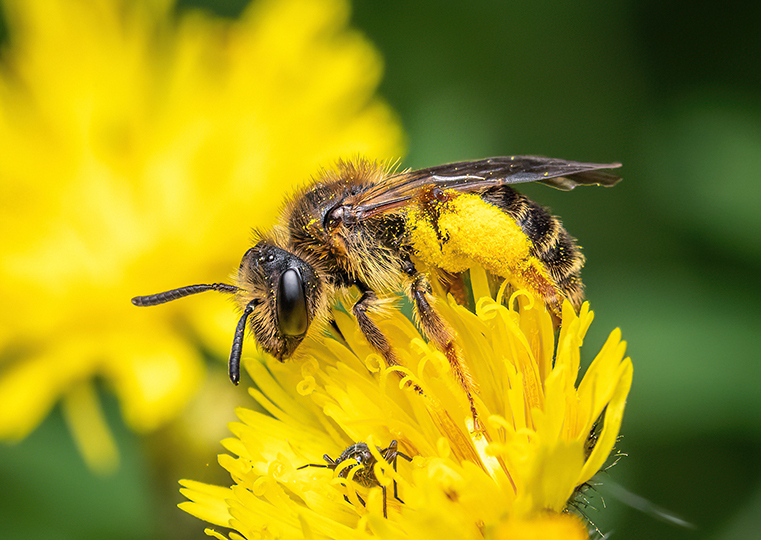
Hawk's-beard Mining Bee
Andrena fulvago
Andrena fulvago, also known as the hawk's-beard mining-bee, is a species of bee in the Andrenidae family. The scientific name of the species was first published in 1791 by Johann Ludwig Christ.
From the article Andrena fulvago on Wikipedia (CC BY-SA), quoted section by section
Description
The hawk's-beard mining-bee has a body length of nine to ten millimeters. The color is largely black, but the hind legs and middle body have an orange or golden yellow coat, which is seen as the most striking feature of the species. The males and females can only be kept apart with certainty by studying the genitals.
Range & habitat
The habitat of the bee consists of grasslands, such as dry meadows, which border forests. The species is monolectic, which means that it only goes to one genus or species to pollinate. The Hawk's-Beard Mining-Bee therefore collects only nectar and pollen from the species from the composite family. It prefers mouse ear, cat's ear, and hawksbeard. The Hawk's-Beard Mining-Bee is a solitary bee species and therefore does not live in a eusociality like some bee species. The nests are buried in few overgrown places, often alone or in small groups, and usually in sandy soils. The period during which the species can be found lasts from May to July.
Wikipedia: “Habitat”
Listen
Looking for field recordings…
Where it lives
Recorded sightings
—
geo-referenced records in GBIF, from museums, herbaria and field observers.
Drag the globe to turn it. Dots are where records exist, not a range map; darker means more records.
In the stacks
Searching the stacks…
Every page naming Andrena fulvago in the Biodiversity Heritage Library →
This page is assembled live from iNaturalist, GBIF, Wikipedia, the Source Library and the Internet Archive. It is not yet part of the hand-edited codex. iNaturalist taxon 484511.