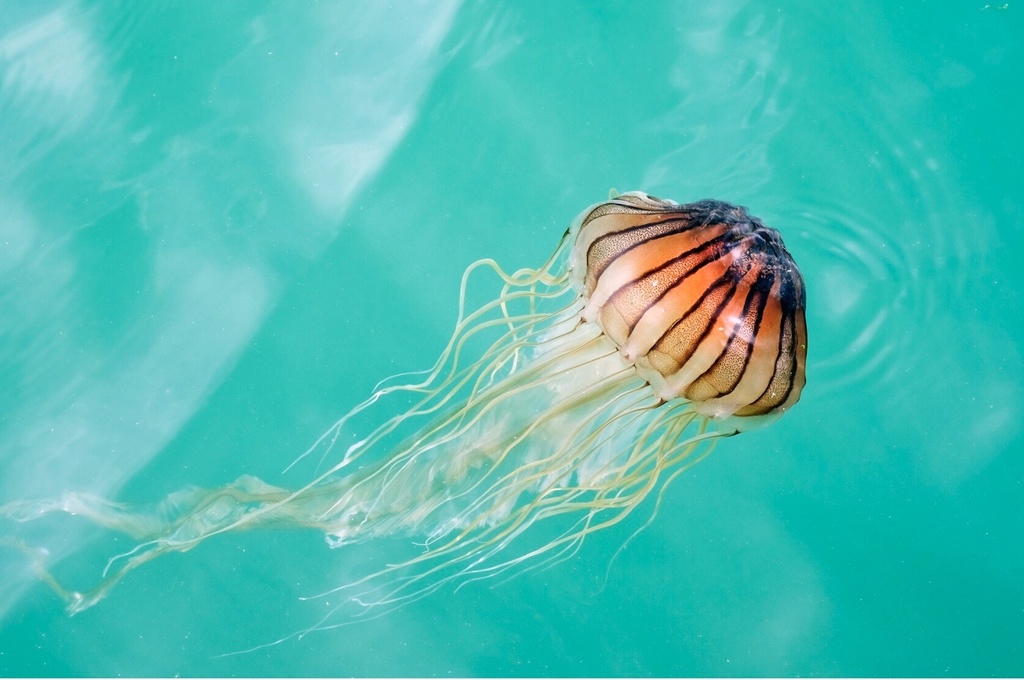
Japanese Sea Nettle
Chrysaora pacifica
Chrysaora pacifica, commonly named the Japanese sea nettle, is a jellyfish in the family Pelagiidae.
From the article Chrysaora pacifica on Wikipedia (CC BY-SA), quoted section by section
Description
The medusae of C. pacifica typically has a bell with a diameter of 15–21 cm (5.9–8.3 in). The bell is divided into eight sections. The outer exumbrella is finely granulated, with 32 reddish colored radial stripes. The inner mesoglea of the bell is translucent and thickest in the central portion, thinning around the edges. The central mouth of the jelly has four oral arms that are 2-3 times longer than the diameter of the bell. These delicate, curtain-like arms have finely fringed margins covered in nematocyst warts. Along the margin of the bell are 40 tentacles that are elastic and grow to be a similar length to the oral arms.
Range & habitat
C. pacifica is found across the northwest Pacific Ocean, including Japan, Korea, Taiwan, and China. This species was formerly confused with the larger and more northerly distributed C. melanaster. As a consequence, individuals kept in public aquariums have often been mislabeled as C. melanaster. Within C. pacifica's range, it surivives best in water temperatures from 20-24°C.
Wikipedia: “Distribution”
Where it lives
Recorded sightings
—
geo-referenced records in GBIF, from museums, herbaria and field observers.
Drag the globe to turn it. Dots are where records exist, not a range map; darker means more records.
In the stacks
Searching the stacks…
Every page naming Chrysaora pacifica in the Biodiversity Heritage Library →
This page is assembled live from iNaturalist, GBIF, Wikipedia, the Source Library and the Internet Archive. It is not yet part of the hand-edited codex. iNaturalist taxon 48481.