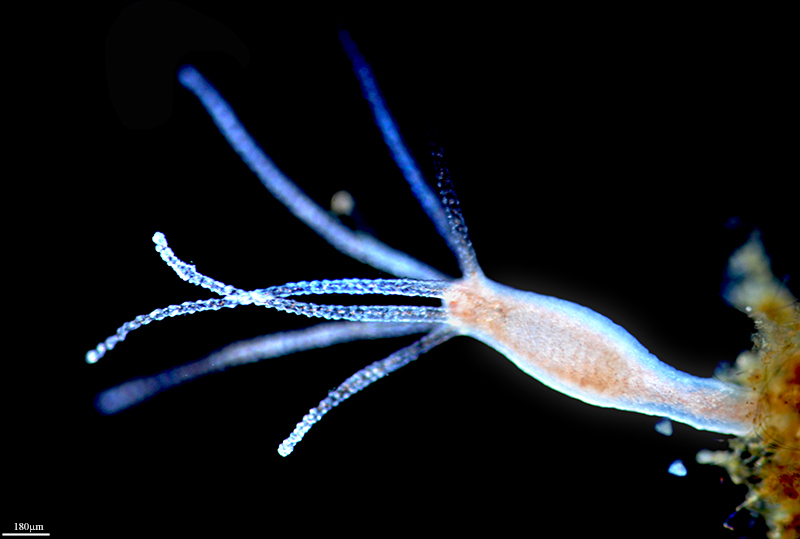
Common Hydra
Hydra vulgaris
Hydra vulgaris, the fresh-water polyp, is a small animal freshwater hydroid with length from 5mm to 15mm (0.2-0.6 inches).
From the article Hydra vulgaris on Wikipedia (CC BY-SA), quoted section by section
Description
The hydra have four to twelve tentacles that protrude from just outside the mouth. They feed by extending their tentacles and waiting for food to touch the tentacles. They then bring the food to their mouth, ingest and digest the organism. Anything that cannot be digested is egested. Ingestion and egestion occur through the mouth. Like other hydras, Hydra vulgaris cling to a base object with a "foot" pad, shaped like a disk. The Hydra moves by releasing its grip on its base and is carried away by the current. H. vulgaris can also move by bending over, grabbing a surface with its tentacles, releasing its grip with its "foot" and flipping over itself.
What it does
This species can reproduce in three ways: sexual reproduction, budding, and indirectly through regeneration. When hydra reproduce sexually, simple testes, ovaries, or both will develop on the bodies of an individual. Sperm released into the environment by the testes enters the egg within the ovary. The egg forms a chitinous exoskeleton and waits for favorable conditions before the organism will emerge. Budding occurs when conditions are favorable; proper water temperature and enough food are the major factors. A miniature adult hydra will grow out of the body of the parent hydra. Once fully developed, it will separate from the parent and continue the life cycle. Hydras use this kind of reproduction more often because it is easier and will create more hydras than other methods. The third method of reproduction is more of a survival mechanism than a reproduction mechanism. When a hydra is cut into segments, each segment, if large enough, will grow into an individual hydra sized relative to the size of the segment. This happens in other animals, such as the starfish.
== References ==
Wikipedia: “Reproduction”
Where it lives
Recorded sightings
—
geo-referenced records in GBIF, from museums, herbaria and field observers.
Drag the globe to turn it. Dots are where records exist, not a range map; darker means more records.
In the stacks
Searching the stacks…
Every page naming Hydra vulgaris in the Biodiversity Heritage Library →
This page is assembled live from iNaturalist, GBIF, Wikipedia, the Source Library and the Internet Archive. It is not yet part of the hand-edited codex. iNaturalist taxon 486293.