- Fungi Including Lichens
- ›Ascomycete Fungi
- ›Sac Fungi and Lichens
- ›Common Lichens
- ›wart lichens, script lichens, and allies
- ›Trapeliales
- ›Trapeliaceae
- ›Placopsis
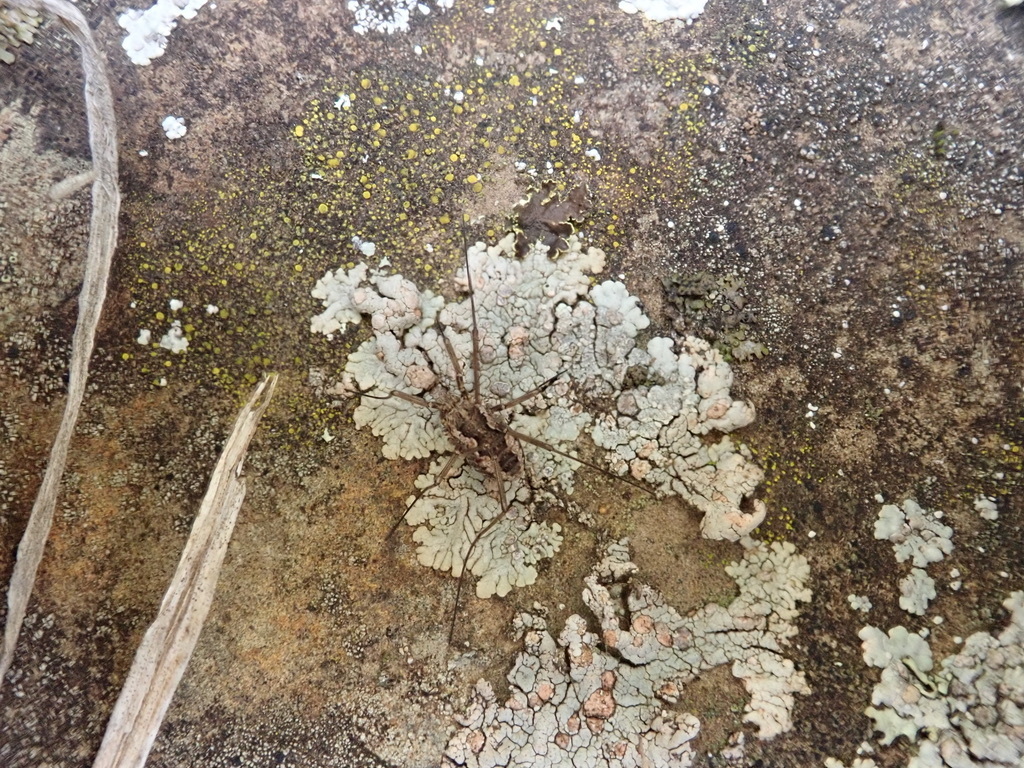
Placopsis subcribellans
Placopsis subcribellans is a species of lichen in the family Trapeliaceae. It forms neat, rounded rosettes with a distinctive glossy, ivory-like sheen, and develops small bud-like outgrowths along radiating cracks in its surface. The species occurs in wet, heavily glaciated regions of southern Chile and Argentina, as well as in southern New Zealand.
From the article Placopsis subcribellans on Wikipedia (CC BY-SA), quoted section by section
Description
Placopsis subcribellans is a crustose lichen that typically forms neat, round rosettes about 2–5 (sometimes up to 8) cm across, tightly attached to the substrate. The margin is continuous, flat, and gently scalloped, and the upper surface has a distinctive glossy sheen, similar to polished ivory. As the thallus expands it becomes cut by long, narrow cracks that radiate inwards, while the marginal lobes remain contiguous rather than breaking apart. Small isidia develop mainly along these fissures, appearing as rounded to slightly flattened outgrowths that can break away and help the lichen spread. Shallow, dome-like cephalodia (structures housing the cyanobacterial partner) are usually concentrated towards the centre and may also form in concentric arcs. When fertile, the lichen produces rather sparse, sessile apothecia with pale pinkish to rusty-brown discs. The disc surface is often minutely roughened and may become cracked with age, sometimes with a light dusting of white pruina. Under the microscope, the spore-bearing layer (the hymenium) is about 190–210(–240) μm tall and contains scattered oil droplets. The colourless ascospores are oval to ellipsoid, about 15–24 × 8.5–12 μm, and the asexual propagules are curved, thread-like conidia around 21–24 × 1 μm.
Range & habitat
In southern South America Placopsis subcribellans is known from wet, heavily glaciated districts of southern Chile (about 44°S–55°S), with additional records from neighbouring Argentina (including Tierra del Fuego and Isla de los Estados) and from southern New Zealand. Collections have been made in coastal shrubland (including Hebe scrub) as well as in shoreline habitats and on open, disturbed slopes.
== References ==
Wikipedia: “Habitat and distribution”
Where it lives
Recorded sightings
—
geo-referenced records in GBIF, from museums, herbaria and field observers.
Drag the globe to turn it. Dots are where records exist, not a range map; darker means more records.
In the stacks
Searching the stacks…
Every page naming Placopsis subcribellans in the Biodiversity Heritage Library →
This page is assembled live from iNaturalist, GBIF, Wikipedia, the Source Library and the Internet Archive. It is not yet part of the hand-edited codex. iNaturalist taxon 486322.