- Fungi Including Lichens
- ›Basidiomycete Fungi
- ›Higher Basidiomycetes
- ›Mushrooms, Bracket Fungi, Puffballs, and Allies
- ›Agaricomycetidae
- ›boletes and allies
- ›Suillineae
- ›Suillaceae
- ›Suillus
- ›Suillus
- ›Suillus
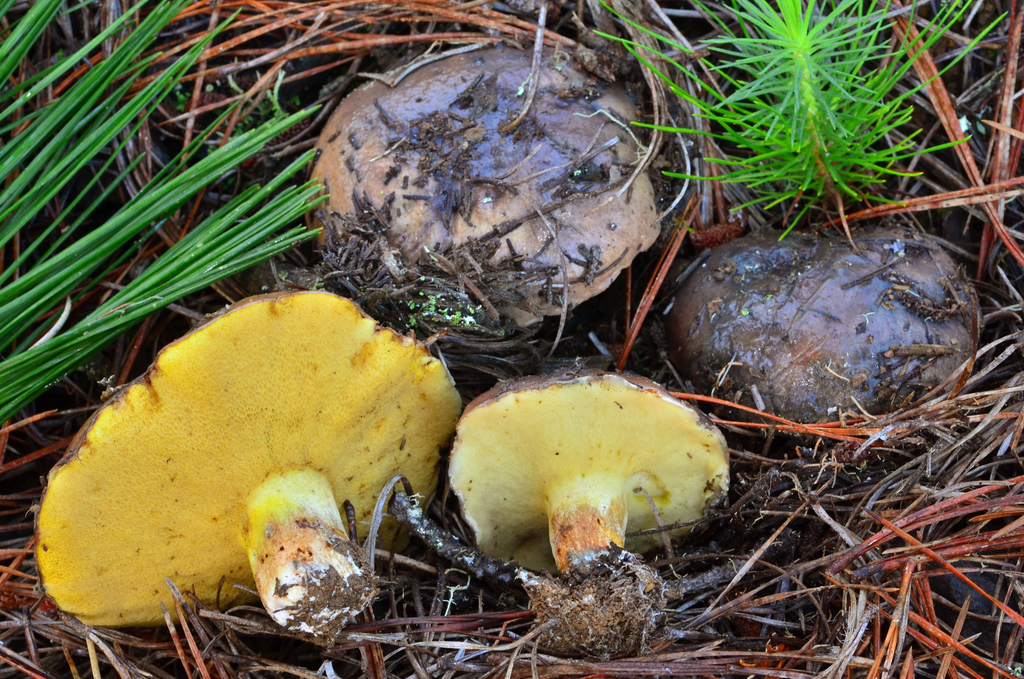
Quiet Jack
Suillus quiescens
Suillus quiescens is a pored mushroom in the genus Suillus (family Suillaceae) that forms ectomycorrhizae with pines. It was first collected in 2002 on Santa Cruz Island off the coast of California in association with bishop pine (Pinus muricata), and was formally described in 2010. The species has been recorded from coastal and montane sites in California and Oregon, and has also been introduced to New Zealand in association with non-native Monterey pine (Pinus radiata). It may be under-reported because it can persist in soil as a dormant spore bank, and because it can be mistaken for the look-alike Suillus brevipes. Although similar in general appearance, it can be distinguished by its paler immature cap and by the tiny glandular dots on the stipe that darken with age. The species is assessed as least concern on the IUCN Red List.
From the article Suillus quiescens on Wikipedia (CC BY-SA), quoted section by section
Description
The cap ranges in shape from hemispheric to broadly convex, and has a diameter of 6 to 12 cm (2.4 to 4.7 in). The cap color is deep brown in mature specimens and lighter shades of brown in younger mushrooms. Young specimens have a sticky layer of gluten on the cap that dries out in maturity. The edge of the cap is rolled inwards in young specimens. The flesh of the cap is whitish and does not change color when bruised or cut. The tubes on the underside of the cap are light yellow to bright orange-yellow; the tube mouths are usually less than 1 mm wide. The stipe is usually between 2 and 4 cm (0.8 and 1.6 in) long, less frequently reaching up to 8 cm (3.1 in). It is either the same width throughout or slightly larger (bulbous) at the base. The color of the upper portion of the stipe is pale to light yellow, while the lower portion may be light brown or covered with streaks of glutinous material like that on the cap. The stipe surface is covered with fine glands that are initially slightly darker than the color of the stipe surface, but deepen to brown or nearly black after drying. …
Range & habitat
Fruit bodies grow together in small groups on the ground in association with bishop pine (Pinus muricata). In a multigene phylogenetic study of Suillus, S. quiescens was also sampled in California in association with Monterey pine (Pinus radiata), in addition to bishop pine. The IUCN Red List assessment reports that it is ectomycorrhizal with two- and three-needle pines and also occurs with lodgepole pine (Pinus contorta) on the northern California and Oregon coast; based on environmental samples, the assessment considers it likely to occur with Ponderosa pine (P. ponderosa) and Jeffrey pine (P. jeffreyi) as well, while noting that more data are needed on the species' ecology. S. quiescens is the most common Suillus species on Santa Cruz Island, its type locality, and it has also been collected at Santa Rosa Island and Point Reyes National Seashore in California. Santa Cruz and Santa Rosa, two of the four islands that make up the northern Channel Islands, have a Mediterranean climate with cool, wet winters and warm, dry summers. Most species of Suillus do not have spores that survive in the soil for extended periods of time, but the spores of S. quiescens can tolerate the dry conditions and heat typical of California. Another study showed that viable S. quiescens spores were present in steam-pasteurized soil planted in Oregon fields. The original description suggested that S. …
Wikipedia: “Habitat and distribution”
Where it lives
Recorded sightings
—
geo-referenced records in GBIF, from museums, herbaria and field observers.
Drag the globe to turn it. Dots are where records exist, not a range map; darker means more records.
In the stacks
Searching the stacks…
Every page naming Suillus quiescens in the Biodiversity Heritage Library →
This page is assembled live from iNaturalist, GBIF, Wikipedia, the Source Library and the Internet Archive. It is not yet part of the hand-edited codex. iNaturalist taxon 486593.