- Animals
- ›Arthropods
- ›Hexapods
- ›Insects
- ›Winged and Once-winged Insects
- ›Beetles
- ›Water, Rove, Scarab, Long-horned, Leaf, and Snout Beetles
- ›Cucujiform Beetles
- ›Lady, Fungus, Scavenger, and Bark Beetles
- ›Lady Beetles
- ›Common Lady Beetles
- ›Black-spotted Lady Beetles
- ›Aphidecta
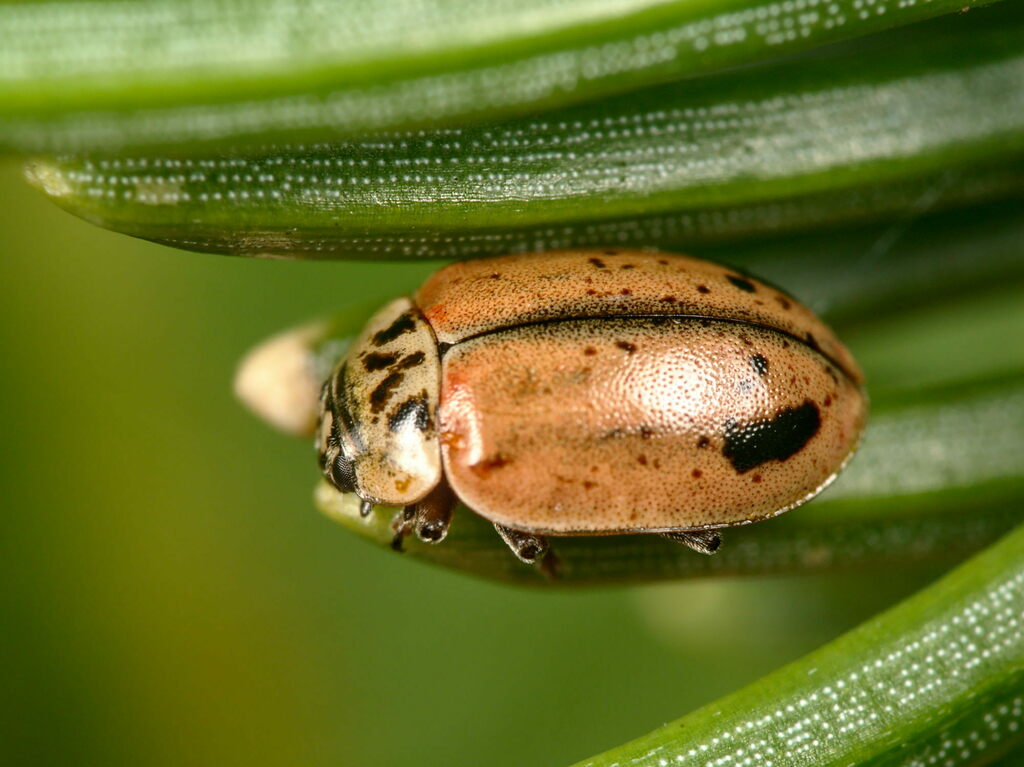
Larch Lady Beetle
Aphidecta obliterata
Aphidecta obliterata, commonly known as the larch ladybird, or larch ladybug, is a species of Coccinellidae, a flying beetle.
From the article Aphidecta obliterata on Wikipedia (CC BY-SA), quoted section by section
Description
Aphidecta obliterata can reach approximately a size of 3.5–5 millimetres (0.14–0.20 in). These tiny beetles have an elongate oval body, with strongly convex elytra, smooth, shiny and densely, finely punctured. Head shows a black arch-shaped marking. Antennae are club-shaped, with 9-11 segments. The larch ladybirds are beetles with a great variability in color and markings, with several varietas. For example, Aphidecta obliterata v. fenestrata has entirely black elytra, while usually they range from tan to brown, often with a pink tinge. They have a dark suture and usually a dark oblique line posteriorly. The pronotum is beige, with four dark brown lines forming a M mark. While other species of ladybugs have prominent spots, this insect has smaller, less distinct spots, or small blotches, if any.
Range & habitat
This species is present in Europe, European Russia, the Caucasus, Belarus, Ukraine, Transcaucasia, Asia Minor, North America (Virginia and South Carolina), and Newfoundland.
Wikipedia: “Distribution”
Listen
Looking for field recordings…
Where it lives
Recorded sightings
—
geo-referenced records in GBIF, from museums, herbaria and field observers.
Drag the globe to turn it. Dots are where records exist, not a range map; darker means more records.
In the stacks
Searching the stacks…
Every page naming Aphidecta obliterata in the Biodiversity Heritage Library →
This page is assembled live from iNaturalist, GBIF, Wikipedia, the Source Library and the Internet Archive. It is not yet part of the hand-edited codex. iNaturalist taxon 488056.