- Animals
- ›Arthropods
- ›Hexapods
- ›Insects
- ›Winged and Once-winged Insects
- ›Beetles
- ›Water, Rove, Scarab, Long-horned, Leaf, and Snout Beetles
- ›Cucujiform Beetles
- ›Lady, Fungus, Scavenger, and Bark Beetles
- ›Lady Beetles
- ›Scymninae
- ›Dusky Lady Beetles
- ›Sasajiscymnus
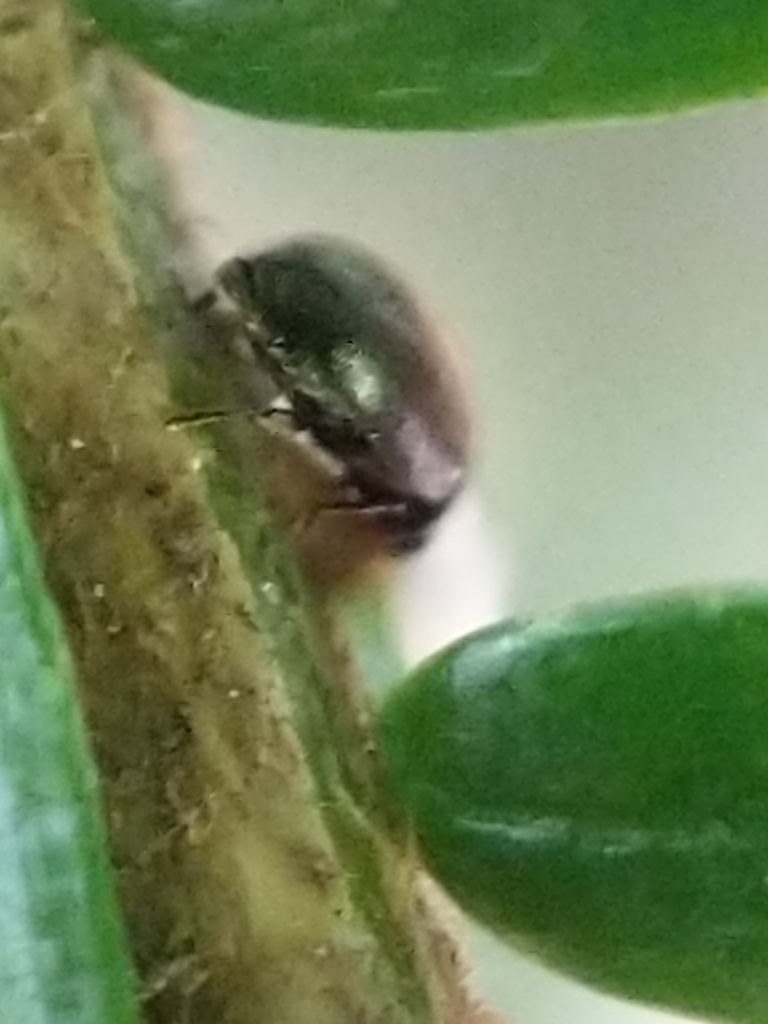
Sasajiscymnus tsugae
Sasajiscymnus tsugae, formerly Pseudoscymnus tsugae, is a species of insect in the family Coccinellidae. It feeds on the hemlock woolly adelgid.
From the article Sasajiscymnus tsugae on Wikipedia (CC BY-SA), quoted section by section
Description
Adult S. tsugae are oval-shaped and are about 1.1 mm wide by 1.7 mm long. They are entirely black and are pubescent on their upper surface. Eggs are reddish-orange in color, oval-shaped, and 0.25 mm wide by 0.48 mm long inside an opalescent chorion. The eggs are usually laid individually or in small groups in bark crevices and in the scales of buds. The larvae grow from about 1.1 mm to 2.7 mm during their four developmental instars. They change color from reddish-brown to gray as they mature. The pupa is about 1.1 mm wide and 1.9 mm long and is reddish-brown color. The adults emerge as a light golden brown color and then to jet black after about one day.
== References ==
In human culture
The species is a biological control method for the hemlock woolly adelgid, Adelges tsugae, in North America, an invasive species that threatens the eastern hemlock, Tsuga canadensis and the Carolina hemlock, Tsuga caroliniana. S. tsugae is a black lady beetle that is relatively host-specific, feeding only on three known aldegid species, including hemlock woolly adelgid. This beetle was discovered in 1992 while feeding on hemlock woolly adelgid in its natural range of Japan. Since 1995, the Pennsylvania Department of Conservation and Natural Resources's Bureau of Forestry has released hundreds of thousands of adult S. tsugae beetles into affected hemlock forests of the eastern United States to determine its effectiveness at controlling the spread of the adelgid. From 1995 to 1997, experiments in Connecticut and Virginia found that releasing adult Sasajiscymnus tsugae beetles into infested hemlock stands resulted in a 47 to 88 percent reduction in adelgid densities within five months of introduction. The beetle's lifecycle is in parallel to the lifecycle of the hemlock woolly adelgid. Both lay eggs in the spring and hatching occurs nearly simultaneously. When hatched, S. tsugae larvae are highly mobile and feed on hemlock woolly adelgid eggs and larvae. Each S. tsugae larva can effectively consume about 500 adelgid eggs or nearly 100 developing adelgid nymphs.
Wikipedia: “History”
Listen
Looking for field recordings…
Where it lives
Recorded sightings
—
geo-referenced records in GBIF, from museums, herbaria and field observers.
Drag the globe to turn it. Dots are where records exist, not a range map; darker means more records.
In the stacks
Searching the stacks…
Every page naming Sasajiscymnus tsugae in the Biodiversity Heritage Library →
This page is assembled live from iNaturalist, GBIF, Wikipedia, the Source Library and the Internet Archive. It is not yet part of the hand-edited codex. iNaturalist taxon 488097.