- Fungi Including Lichens
- ›Basidiomycete Fungi
- ›Higher Basidiomycetes
- ›Mushrooms, Bracket Fungi, Puffballs, and Allies
- ›Agaricomycetidae
- ›Common Gilled Mushrooms and Allies
- ›Marasmiineae
- ›Physalacriaceae
- ›Armillaria
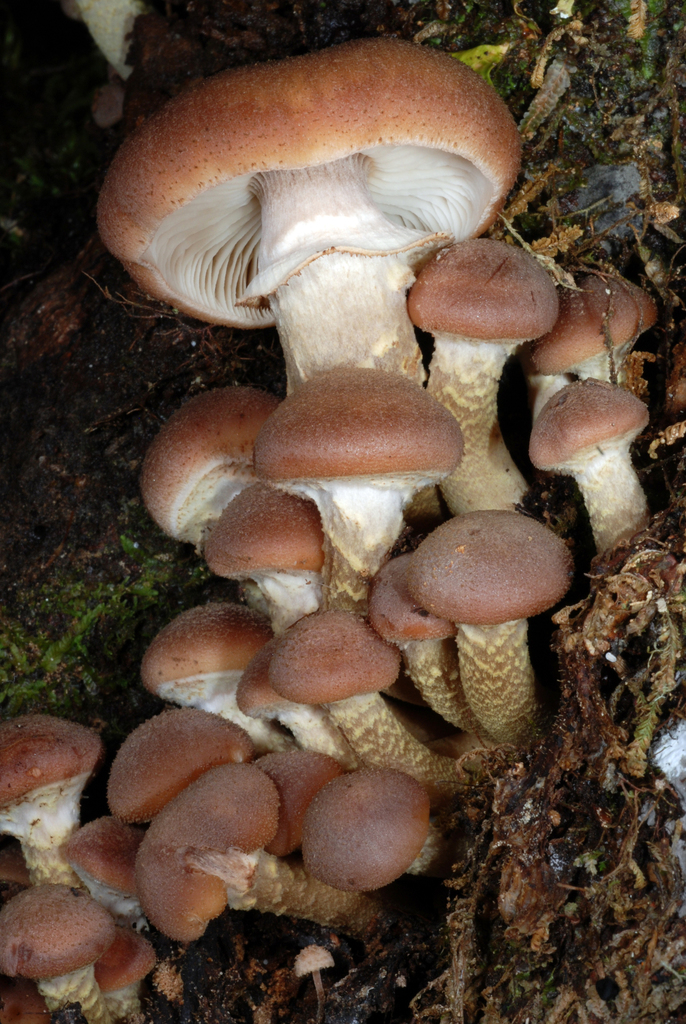
Armillaria aotearoa
Armillaria aotearoa is a species of mushroom-forming fungus in the family Physalacriaceae. This plant pathogen species is one of four Armillaria species that have been identified in New Zealand, the others being A. novae-zelandiae, A. limonea, and A. hinnulea.
From the article Armillaria aotearoa on Wikipedia (CC BY-SA), quoted section by section
Description
Armillaria aotearoa produces fruiting bodies (basidiomata) that grow in clusters (caespitose), with centrally positioned stalks supporting the caps. The cap, or pileus, measures between 35 and 60 mm across and is pinkish-brown to brown. The surface is dry and moderately smooth, scattered with small, dark granular scales that are more concentrated toward the centre. Initially convex, the cap flattens over time but retains a distinctive broad zone at the edges that darkens when it absorbs moisture (hygrophanous) but does not become sticky. The flesh of the cap is off-white to pale pink. The gills are attached near the top of the stalk (adnexed), moderately packed, and pale pink in colour. The stalk, or stipe, ranges from 35 to 90 mm in length, with a bulbous base and pale pinkish-brown colour that may show faint green or yellowish tones. It is dry, with tiny, scattered fibrils, and eventually hollows out as it matures. The flesh of the stipe is also off-white to pale pink. A partial veil forms a ring (annulus) around the stalk, with the underside matching the colour of the stipe and featuring concentrically arranged darker flecks. Armillaria aotearoa has rhizomorphs—root-like structures typical of the genus—that are black and show uneven branching. …
Range & habitat
The species is known from the Taupo region of the North Island and Mid-Canterbury region of the South Island of Aotearoa New Zealand.
Wikipedia: “Range”
What it does
Fruiting occurs between late April and mid-June. Its pathogenicity to introduced and native plants is unknown. Most Armillaria species live have a saprophytically contributing to decomposition of organic material, generally as wood-decay fungi, in forest ecosystems. They become pathogenic when environmental conditions are favourable for infection causing "white rot" root disease.
Wikipedia: “Ecology”
Where it lives
Recorded sightings
—
geo-referenced records in GBIF, from museums, herbaria and field observers.
Drag the globe to turn it. Dots are where records exist, not a range map; darker means more records.
In the stacks
Searching the stacks…
Every page naming Armillaria aotearoa in the Biodiversity Heritage Library →
This page is assembled live from iNaturalist, GBIF, Wikipedia, the Source Library and the Internet Archive. It is not yet part of the hand-edited codex. iNaturalist taxon 488353.