- Plants
- ›Vascular Plants
- ›flowering plants
- ›Dicots
- ›Gentians, Dogbanes, Madders, and Allies
- ›Dogbane Family
- ›Periplocoideae
- ›Camptocarpus
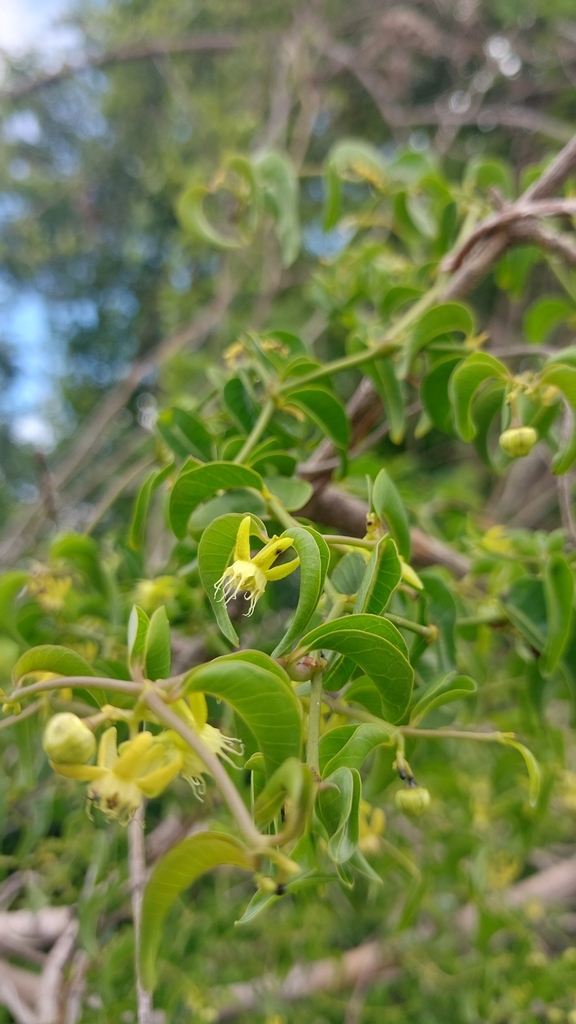
Camptocarpus mauritianus
Camptocarpus mauritianus is a species of plant in the Apocynaceae family. It is native to Comoros, Madagascar and Réunion. Jean-Baptiste Lamarck, the naturalist who first formally described the species named it, using the synonym Cynanchum mauritianum, after the region of the Indian Ocean that includes the island of Mauritius, although the type specimen he examined did not list a specific location.
From the article Camptocarpus mauritianus on Wikipedia (CC BY-SA), quoted section by section
Description
It is a climbing plant. Its hairless, oval to egg-shaped to lance-shaped leaves are 5–6 by 1.6–1.8 centimeters. The tips of its leaves sometimes come to a long, tapering point. The leaves have 4–16 pairs of secondary veins emanating from their midribs. Its petioles are 6 millimeters long. At the junction between the petioles and the stem are tufts of red hairs that remain after the leaves have fallen. Its Inflorescences occur at the junction between the leaves and stem, or at the ends of stems and branches. The inflorescences have peduncles that are 1 millimeters long, and pedicels, including secondary and tertiary pedicels, that 5 millimeters long. Its flowers are 9 millimeter wide when open. Its flowers have 5 sepals that are 1.5 millimeters long. Inside, but alternating with the sepals are 5 flattened glandular scales, about as wide as the sepals. Three of the five scales are larger than the other two. The 5 slightly firm petals form a bell-shaped structure with free lobes about halfway up their length that overlap from left to right. The flowers have a ring-like structure between the petals and its stamen called a corona. The foot of the corona is fused to the base of the petals. Its corona has thread-like lobes that are bent backwards, and occur in pairs that alternate with the petals. …
At the table
It has been reported as being used as a medicinal plant in Mauritius.
== References ==
Wikipedia: “Uses”
Where it lives
Recorded sightings
—
geo-referenced records in GBIF, from museums, herbaria and field observers.
Drag the globe to turn it. Dots are where records exist, not a range map; darker means more records.
In the stacks
Searching the stacks…
Every page naming Camptocarpus mauritianus in the Biodiversity Heritage Library →
This page is assembled live from iNaturalist, GBIF, Wikipedia, the Source Library and the Internet Archive. It is not yet part of the hand-edited codex. iNaturalist taxon 488370.