- Animals
- ›Arthropods
- ›Crustaceans
- ›Typical Crustaceans
- ›Malacostracans
- ›Decapods, Isopods, and allies
- ›Decapods and Krill
- ›Decapods
- ›Crabs, Lobsters, Shrimps, and Allies
- ›True Crabs
- ›Eubrachyuran Crabs
- ›Thoracotrematan Crabs
- ›Shore and marsh crabs
- ›Varunid crabs
- ›Varuninae
- ›Hemigrapsus
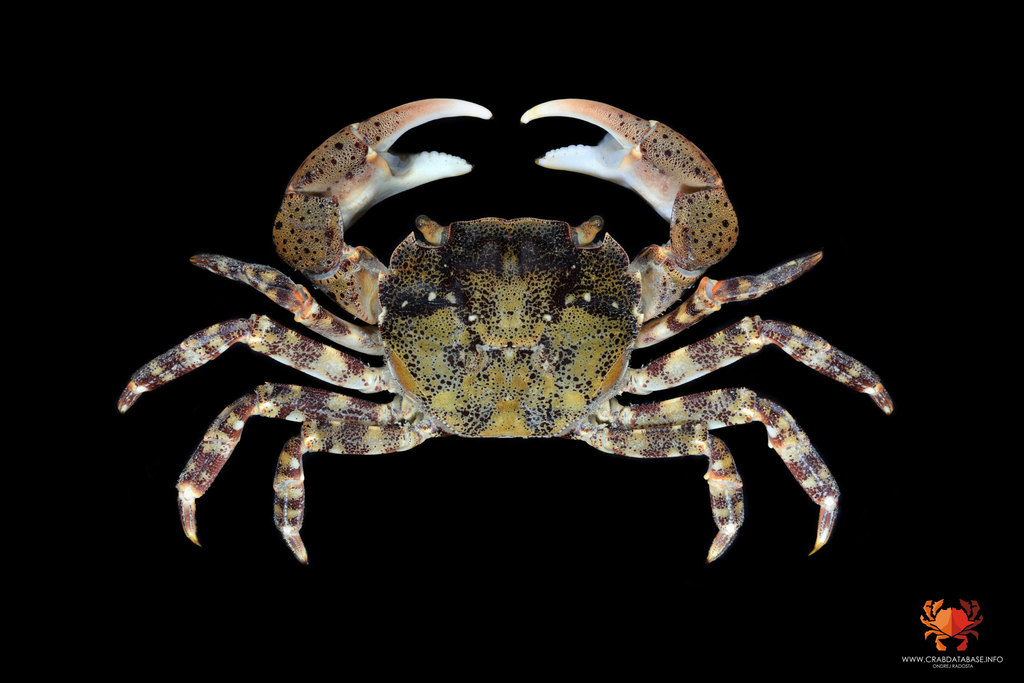
Asian Shore Crab
Hemigrapsus sanguineus
Hemigrapsus sanguineus, the Japanese shore crab or Asian shore crab, is a species of crab from East Asia. It has been introduced to several other regions, and is now an invasive species in North America and Europe. It was introduced to these regions by ships from Asia emptying their ballast tanks in coastal waters.
From the article Hemigrapsus sanguineus on Wikipedia (CC BY-SA), quoted section by section
Description
H. sanguineus has a squarish carapace, 2 inches (50 mm) in width, with three teeth along the forward sides; its pereiopods are marked with alternating light and dark bands. The males have a bulb-like structure at the base of the movable finger on their claws. Other distinguishing features include three spines on each side of the carapace. Adult sizes range from 35–42 mm width. These crabs are opportunistic omnivores that tend to favor other animals over algae. As crab density in an invaded area increases, so does the breadth of the species' diet, which suggests that competition alters selection of food. There currently is no mitigation against these crabs. A natural enemy of H. sanguineus is Sacculina polygenea, a parasite that attacks adult shore crabs and is specific to H. sanguineus.
Range & habitat
Typically, the crabs live in areas with large rocks, such as between boulders on rocky shores. Hemigrapsus sanguineus inhabits many artificial structures such as on oyster reefs. H. sanguineus can tolerate other habitats, such as salt marshes.
Wikipedia: “Habitat”
What it does
Hemigrapsus sanguineus is an "opportunistic omnivore" that prefers to eat other animals, especially molluscs, when possible. It tolerates a wide range of salinities (euryhaline) and temperatures (eurythermic). Females produce up to 50,000 eggs at a time, and can produce 3–4 broods per year. The eggs hatch into zoea larvae, which develop through four further zoea stages, and one megalopa stage, over the course of 16–25 days. The eggs typically hatch in late summer or fall, into larvae, and the juvenile crabs molt in five stages to become megalopae, which typically takes about a month. Once in this stage, the crabs settle and metamorphize into full-grown crabs. The larvae are planktonic, can be transported for long distances during their development into benthic adults.
Habitat. Typically, the crabs live in areas with large rocks, such as between boulders on rocky shores. Hemigrapsus sanguineus inhabits many artificial structures such as on oyster reefs. H. sanguineus can tolerate other habitats, such as salt marshes.
Wikipedia: “Ecology and life cycle”
Where it lives
Recorded sightings
—
geo-referenced records in GBIF, from museums, herbaria and field observers.
Drag the globe to turn it. Dots are where records exist, not a range map; darker means more records.
In the stacks
Searching the stacks…
Every page naming Hemigrapsus sanguineus in the Biodiversity Heritage Library →
This page is assembled live from iNaturalist, GBIF, Wikipedia, the Source Library and the Internet Archive. It is not yet part of the hand-edited codex. iNaturalist taxon 48904.