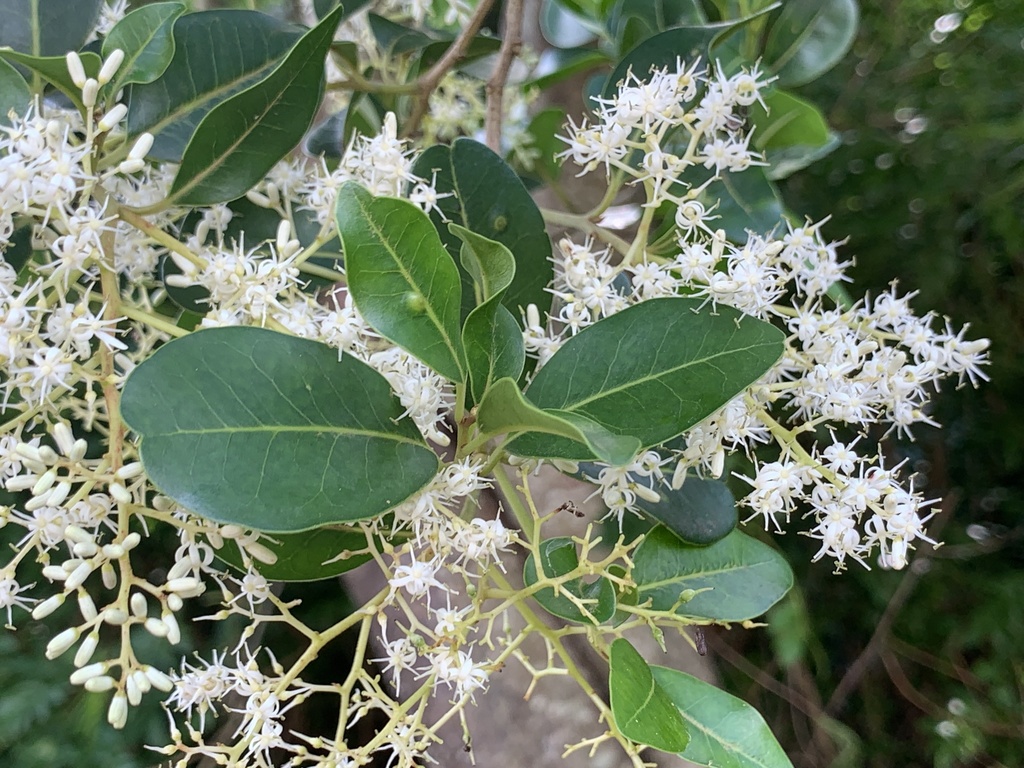
White Pear
Apodytes dimidiata
Apodytes dimidiata (white pear or umDakane) is a bushy tree with white flowers bearing a fragrance reminiscent of fresh coconut, and small black and red fruits. It is usually about 5 m tall (but reaches a height of 20 m when growing in deep forest), and it is indigenous to Southern Africa. The taxonomical family placement for this and other Apodytes was uncertain; it is now placed in the Metteniusaceae. Its English common name is in reference to the timber which is similar in appearance to that of the European pear tree of the northern hemisphere.
From the article Apodytes dimidiata on Wikipedia (CC BY-SA), quoted section by section
Description
In the open, this evergreen species grows as a tall shrub or small tree of about 5 m in height. However, in a more shady environment, such as deep afro-montane forest, it can reach a height of over 20 m. Its dense, shiny foliage is bright-green and it has smooth, gray bark. It frequently produces masses of tiny, white, bisexual blossoms which have a sweet fragrance. These are followed by strangely curved, black and scarlet berries. In South Africa this is officially a protected tree. This is a very difficult tree to identify at first. In particular, it is often confused with Pterocelastrus rostratus, including at the First International Forestry Exhibition. The best identifying characteristics of Apodytes dimidiata are its petiole and young terminal branchlets which are a unique reddish colour.
Range & habitat
Apodytes dimidiata is a prominent and common tree in South African forests. It grows naturally from Cape Town in the south, all the way along the east coast of southern Africa as far north as Kenya and inland as far as Gauteng. It is usually found in coastal thicket, afro-montane forest and mountainous bushveld. The actual distribution has been difficult to determine due to large number of synonyms (about 30+) used for this particular species in various countries. According to the synonyms usage, it is thought that the species has much broader distribution than was thought earlier, and may spread towards the Indian subcontinent as well.
Wikipedia: “Distribution”
How it is grown
This tree's characteristics (evergreen attractive foliage; fruits that are not fleshy and therefore will not cause a mess; and a gentle non-invasive root system that will not damage paving) mean that Apodytes dimidiata is an ideal tree to plant around paved areas, near swimming pools, next to buildings, in small gardens and also anywhere that may need shade throughout the year. The white pear is best propagated by seed, though germination is extremely slow. The seed takes about half a year to germinate and the young plants are also relatively slow growing. However, these trees grow very much faster as they become larger and more established.
Wikipedia: “Cultivation”
Where it lives
Recorded sightings
—
geo-referenced records in GBIF, from museums, herbaria and field observers.
Drag the globe to turn it. Dots are where records exist, not a range map; darker means more records.
In the stacks
Searching the stacks…
Every page naming Apodytes dimidiata in the Biodiversity Heritage Library →
This page is assembled live from iNaturalist, GBIF, Wikipedia, the Source Library and the Internet Archive. It is not yet part of the hand-edited codex. iNaturalist taxon 489301.