- Plants
- ›Vascular Plants
- ›flowering plants
- ›monocots
- ›grasses, sedges, cattails, and allies
- ›grasses
- ›Panicums, Bluestems, Paspalums, and Allies
- ›Tristachyideae
- ›Loudetia
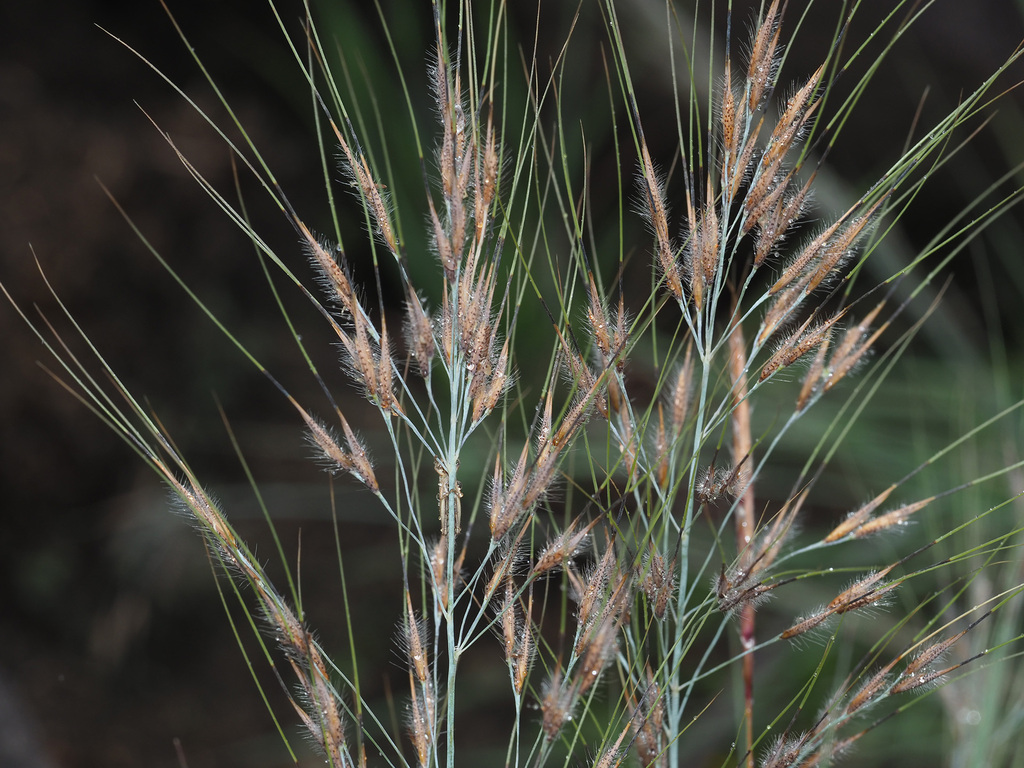
Common Russet Grass
Loudetia simplex
Loudetia simplex is a grass species found in tropical and Southern Africa and Madagascar. It was originally described as a Tristachya species by Christian Gottfried Daniel Nees von Esenbeck in 1841 and was transferred to Loudetia by Charles Edward Hubbard in 1934.
The species is a perennial bunch grass, with culms erect and 30–150 cm (12–59 in) long. Leaves are mostly basal, with flat, convolute blades 10–30 cm (3.9–11.8 in) long and 2–5 mm wide. The inflorescence is a 10–30 cm (3.9–11.8 in) long panicle of spikelets, each containing one sterile and one fertile flower. The lemma carries a 25–50 mm long awn.
Where it lives
Recorded sightings
—
geo-referenced records in GBIF, from museums, herbaria and field observers.
Drag the globe to turn it. Dots are where records exist, not a range map; darker means more records.
In the stacks
Searching the stacks…
Every page naming Loudetia simplex in the Biodiversity Heritage Library →
This page is assembled live from iNaturalist, GBIF, Wikipedia, the Source Library and the Internet Archive. It is not yet part of the hand-edited codex. iNaturalist taxon 489495.