- Plants
- ›Vascular Plants
- ›flowering plants
- ›Dicots
- ›Buttercups, Poppies, and Allies
- ›barberry family
- ›Berberidoideae
- ›Berberideae
- ›Berberis
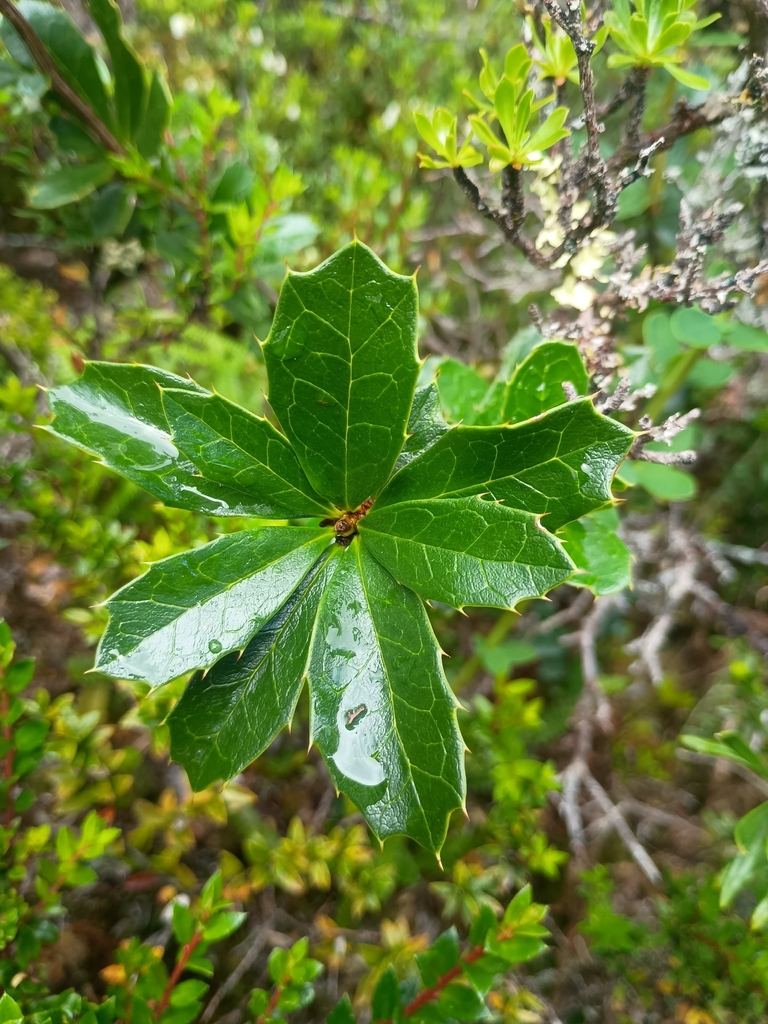
holly barberry
Berberis ilicifolia
Berberis ilicifolia, sometimes called holly barberry or holly-leaved barberry is a medium to high, spiny shrub belonging to the barberries in the family Berberidaceae. The local name in Chile is michay. It has ovate leaves with a few teeth that end in spines, reminiscent of holly leaves. Its orange flowers grow with three to seven together, which later produce globose blue-black berries. The species is native to south of 40ºS in Argentina and Chile, where it grows in Nothofagus woods. Flowers are present from August to December, while ripe berries are available between November and March.
From the article Berberis ilicifolia on Wikipedia (CC BY-SA), quoted section by section
Description
The holly barberry is an evergreen shrub of between 1–4 m high. Branches develop from reddish brown, with ridges lengthways and very fine grains when young, to yellowish gray, circular in cross-section with persistent half circle-shaped leaf scars, and often with corky outgrowths. The spines are mostly split at base into three arms of 4–12 mm long, often somewhat curved outward, and almost at a straight angle to each other. Bracts are narrowly triangular and about 1 cm long. The leaf blades are approximately elliptic, 20-50 × 12–22 mm, with the largest width before, at or beyond midlength, stiff and leathery, shiny danker green on top, but sometimes prone to patchy reddish brown or golden discoloration, and whitish green underneath. The margin mostly has few teeth (zero to six, mostly one to four) at each side that end in spines of 1–4 mm long, and with a truncated or pointed and spined tip. The base can be rounded or pointed more or less blending with the leafstem of up to 4 mm long. The midvein is slightly sunken above but sticks out underneath, the three to five pairs of secondary veins that partially reach the leaf margin, partially curve back on their neighbours. The inflorescens is a raceme of tree to seven flowers on a common inflorescens stem 0.7–2 or exceptionally 3.5 cm long, and stems of the individual flower mostly a bit shorter. …
What it does
Holly barberry comprises the understory of lenga Nothofagus pumilio and ñire Nothofagus antarctica woods, together with hard log mayten Maytenus magellanica, Fuchsia magellanica and the smaller barberry species B. microphylla. The filaments are tactile, i.e. they suddenly jerk upright when touched, with the result that visiting insects will be showered with pollen. Stems have been used to make bows by the inhabitants of Tierra del Fuego, because the wood is sufficiently pliant and does not branch over sufficient length.
== References ==
Wikipedia: “Ecology and use”
Where it lives
Recorded sightings
—
geo-referenced records in GBIF, from museums, herbaria and field observers.
Drag the globe to turn it. Dots are where records exist, not a range map; darker means more records.
In the stacks
Searching the stacks…
Every page naming Berberis ilicifolia in the Biodiversity Heritage Library →
This page is assembled live from iNaturalist, GBIF, Wikipedia, the Source Library and the Internet Archive. It is not yet part of the hand-edited codex. iNaturalist taxon 489502.