- Plants
- ›Vascular Plants
- ›flowering plants
- ›Dicots
- ›pinks, cactuses, and allies
- ›didierea family
- ›Alluaudia
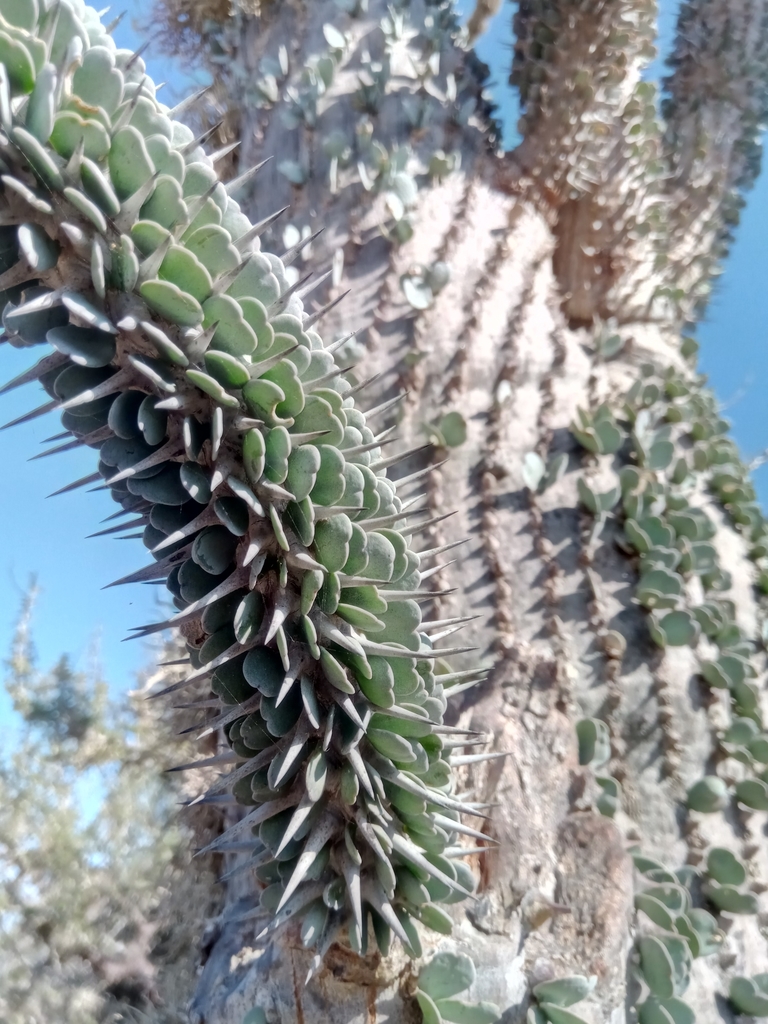
Alluaudia montagnacii
Alluaudia montagnacii is a rare species of flowering plants belonging to the family Didiereaceae.
From the article Alluaudia montagnacii on Wikipedia (CC BY-SA), quoted section by section
Description
Alluaudia montagnacii can reach a height of 2.4–6 m (7 ft 10 in – 19 ft 8 in). The tall columnar central trunk sprouts strong vertical branches. Stem and branches have symmetrically arranged leaves, about 1.5 cm (0.59 in) long, and black-tipped thorns, 2–2.5 cm (0.79–0.98 in) long. Leaves are deciduous in the long dry season. Photosynthesis is carried on by the stems. This plant is well adapted to live where water is a limiting environmental factor. The flowers are small, green or yellow.
Range & habitat
Alluaudia montagnacii is endemic to the Mahafaly Plateau of southwestern Madagascar. It grows in small arid and subarid areas on a narrow belt of the coast. It is part of the Madagascar spiny forests, where it forms a specific plant community with species such as Cedrelopsis grevei and Ficus marmorata.
== References ==
Wikipedia: “Distribution and habitat”
Where it lives
Recorded sightings
—
geo-referenced records in GBIF, from museums, herbaria and field observers.
Drag the globe to turn it. Dots are where records exist, not a range map; darker means more records.
In the stacks
Searching the stacks…
Every page naming Alluaudia montagnacii in the Biodiversity Heritage Library →
This page is assembled live from iNaturalist, GBIF, Wikipedia, the Source Library and the Internet Archive. It is not yet part of the hand-edited codex. iNaturalist taxon 489633.