- Animals
- ›Arthropods
- ›Crustaceans
- ›Typical Crustaceans
- ›Malacostracans
- ›Decapods, Isopods, and allies
- ›Decapods and Krill
- ›Decapods
- ›Crabs, Lobsters, Shrimps, and Allies
- ›Anomurans
- ›Hermit Crabs
- ›Pagurid Hermit Crabs
- ›Pagurus
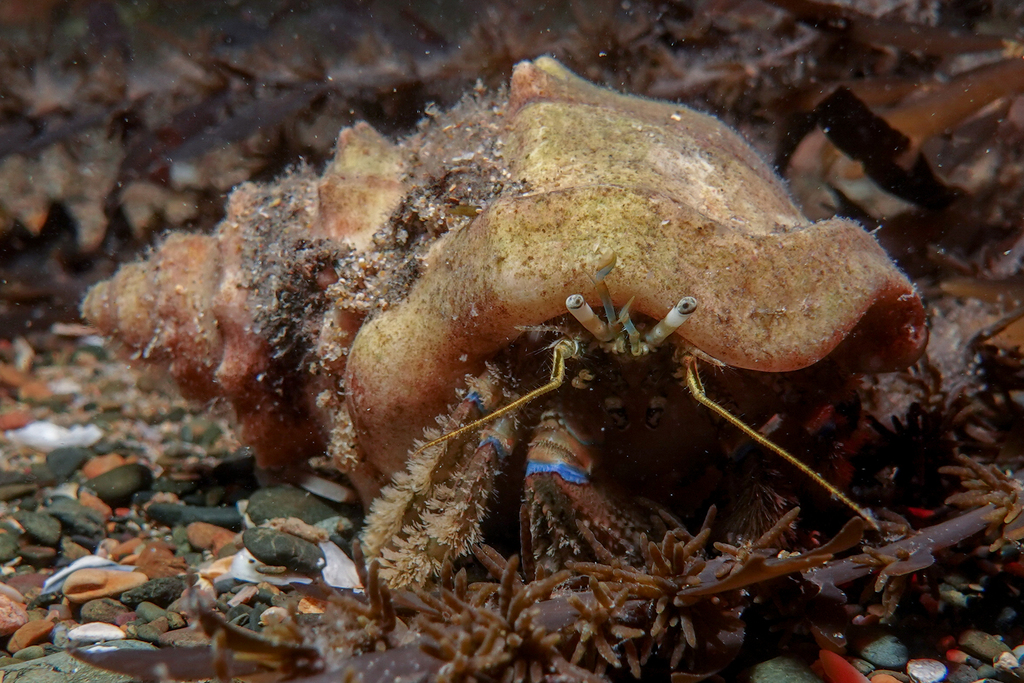
New Zealand Hermit Crab
Pagurus novizealandiae
Pagurus novizealandiae, or the New Zealand hermit crab is a hermit crab of the family Paguridae, endemic to New Zealand. Its body is up to 16 millimetres (0.63 in) wide.
From the article Pagurus novizealandiae on Wikipedia (CC BY-SA), quoted section by section
Description
Hermit crabs can be identified by the colouration of their antenna and their antennules (a small structure resembling antennae which sits in front of the actual antennae). The hermit crab is approximately the size of a coin and on average 56mm in length, but this is slightly limited by the size of the shells available. Its body is up to 16 millimetres (0.63 in) wide. The crab's abdomen is spiral shaped, and can twist, so they can fit easily into the different shells they take on throughout their life. The crab protects itself from danger by contracting rapidly back into its shell. It uses its large chela as a door which protects it once it has retreated back into the safety of its shell. Throughout their lifetime hermit crabs adopt empty mollusk and gastropod shells to protect their soft and vulnerable abdomens. The crabs carry their shells around on their backs with small legs which are modified so that their back end can grip into the shell; they use their abdominal muscles to hold themselves securely in place. As hermit crabs grow they must switch shells to accommodate their expanding bodies.
Range & habitat
Pagurus novizealandiae is widespread on the eastern coast of New Zealand, throughout both North and South Island. It is also found on the Auckland Islands 465 km south-east of New Zealand. In Australia, the species has been reported in northern and eastern Tasmania from 2013, eastern Victoria, and southern New South Wales. Its identity was confirmed by specimens collected and examined at Museums Victoria. The New Zealand hermit crab is presumed translocated and established.
Wikipedia: “Distribution”
What it does
Moulting is a vital part of the Pagurus novizealandiae life cycle in order to grow and develop, for the repair of any damaged limbs or other body parts on its abdomen and in the process of preparing for reproduction. Moulting has to occur so that the crab can mature, the hermit crab sheds its exoskeleton, while the crab is still inside of the small, enclosed space of its shell. Underneath is its new soft shell, it must wait until this has hardened so that it can protect its abdomen for when it leaves to find a new shell. The hardening and thickening process only takes a few days. After the moult this results in an increase in the hermit crabs size so it must find a larger shell to house its body. Their shells also just wear out naturally over time, are damaged by predators or become overgrown. During the searching process there is very high demand for shells as the crabs want to find a new home as quickly as they can so that they are safe from predators. Timing and location is a very important part in determining where to go to undergo the moulting procedure. Both the male and female hermit crab produce inviting sex pheromones. The males are very aggressive during breeding and are known do be quite dominant over the females. …
Wikipedia: “Life cycle/phenology”
Where it lives
Recorded sightings
—
geo-referenced records in GBIF, from museums, herbaria and field observers.
Drag the globe to turn it. Dots are where records exist, not a range map; darker means more records.
In the stacks
Searching the stacks…
Every page naming Pagurus novizealandiae in the Biodiversity Heritage Library →
This page is assembled live from iNaturalist, GBIF, Wikipedia, the Source Library and the Internet Archive. It is not yet part of the hand-edited codex. iNaturalist taxon 489920.