- Plants
- ›Vascular Plants
- ›flowering plants
- ›Dicots
- ›Sunflowers, Bellflowers, Fanflowers, and Allies
- ›Sunflowers, Daisies, Asters, and Allies
- ›Asteroideae
- ›groundsels and allies
- ›Senecioninae
- ›Dendrosenecio
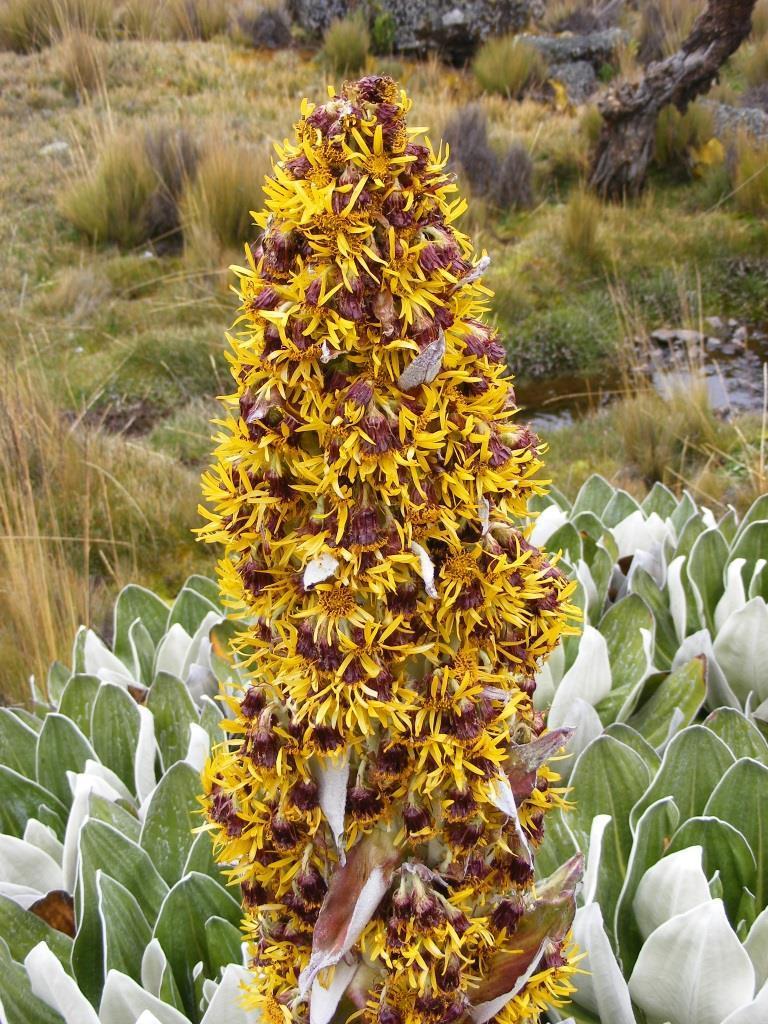
Dendrosenecio keniensis
Dendrosenecio keniensis (syn. Senecio keniensis and S. brassica) is one of the giant groundsels endemic the higher altitudes of Mount Kenya. It is in the family Asteraceae and the genus Dendrosenecio (previously a Senecio). Dendrosenecio keniodendron occurs the upper alpine zone of Mount Kenya and D. keniensis in the wetter areas of the lower alpine or the moorlands.
From the article Dendrosenecio keniensis on Wikipedia (CC BY-SA), quoted section by section
Description
Leaves and stems Prostrate (even subterranean) trunks of soft brittle wood, with trunk to 5 centimetres (2.0 in) in diameter; which branch repeatedly at or below ground level, forming a large prostrate clone. The branches each support a great cabbage-like, densely packed leaf-rosettes of 30–40 leaves; each branch cloaked with older, dead foliage. Branches produced near ground-level are capable of rooting that supports a "creeping" horizontal growth-form. The leaves are oblong and narrow slightly where they attach to the rosette; they can be up to 56 centimetres (22 in) long and 18 centimetres (7.1 in) wide. The leaves are capable of secreting limited quantities of a mucilaginous fluid containing polysaccharides. The upper leaf surface has a hair cushion which is also often coated with dried mucilage. The lower surface is covered densely with a thick, white felty covering of lantate hairs. Growth rates are very slow. S. keniensis is frost resistant to −10 °C (14 °F) This ability to withstand the colder temperatures that occur in the upper altitudes of Mount Kenya is in part due (at least in Lobelias) to the large amounts of mucilage which are contained by the rosettes of leaves which that might assist in preventing the leaf bud from freezing and the reservoir of fluid from evaporating. …
Range & habitat
Dendrosenecio keniensis makes its home mostly in the lower alpine or moorland zone located at altitudes of 2,900 metres (9,500 ft) to 3,800 metres (12,500 ft) that can be characterized by high soil moisture, a thick humus layer, similar terrain and not a lot of different species present. The upper alpine zone, 3,800 metres (12,500 ft) to 4,500 metres (14,800 ft), is more topographically diverse, and contains a more varied flora, including the giant rosette plants Lobelia telekii and L. keniensis, Senecio keniodendron and Carduus spp.. S. keniensis can be found in both the lower and upper alpine zone, although it is less common above 4,000 metres (13,000 ft) where it can regularly hybridise with S. keniodendron.
Wikipedia: “Distribution”
Where it lives
Recorded sightings
—
geo-referenced records in GBIF, from museums, herbaria and field observers.
Drag the globe to turn it. Dots are where records exist, not a range map; darker means more records.
In the stacks
Searching the stacks…
Every page naming Dendrosenecio keniensis in the Biodiversity Heritage Library →
This page is assembled live from iNaturalist, GBIF, Wikipedia, the Source Library and the Internet Archive. It is not yet part of the hand-edited codex. iNaturalist taxon 489940.