- Plants
- ›Vascular Plants
- ›flowering plants
- ›Dicots
- ›Mustards, Capers, and Allies
- ›mustard family
- ›Brassicoideae
- ›Heliophilodae
- ›Anastaticeae
- ›Anastatica
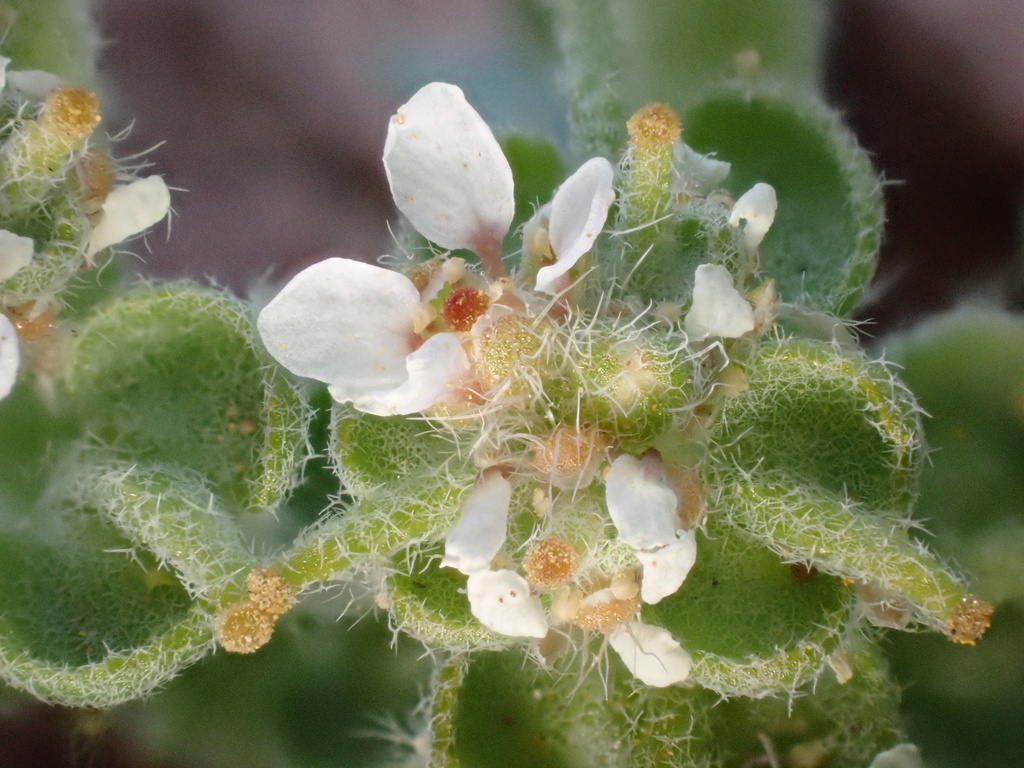
true rose of Jericho
Anastatica hierochuntica
Anastatica is a monotypic genus of flowering plants in the family Brassicaceae containing the single species Anastatica hierochuntica or the true rose of Jericho. The plant is a small gray annual herb that rarely grows above 15 centimetres (6 in) high, and bears minute white flowers. It is a capable of hygroscopic expansion and retraction. However, it is not a true resurrection plant, because the plant's dead tissues do not revive and turn green.
This species is not to be confused with Selaginella lepidophylla, also sometimes referred to as "rose of Jericho", or "false rose of Jericho", which is a true resurrection plant that can revive from a dried state and regain the processes of respiration and photosynthesis.
From the article Anastatica on Wikipedia (CC BY-SA), quoted section by section
Description
A plant with great resistance to desiccation. Despite it being an annual, the plant lignifies after completing its life cycle, turning into a persistent woody skeleton. Its branches have the property of contracting with dryness into the shape of a closed fist, maintaining its seed bank. The dead skeletal form can remain in situ for many years, reopening with moisture or contact with water. After the rainy season, the plant dries up, dropping leaves and curling branches into a tight ball, and aestivates. Within the ball, the fruits remain attached and closed, protecting the seeds and preventing them from being dispersed prematurely. The seeds are very hardy and can remain dormant for years. Moistened again in a later rainy season, the ball uncurls and the plant wakes up from its dormant state, which causes the capsular fruits to open to disperse the seeds. If water is sufficient, the dispersed seeds germinate within hours. After it curls, it is easy for the wind itself to lift and drag it large distances, making them obligatory travelers through steppes and deserts crossing the borders of various countries in Asia and disseminating their seeds for all of them. A fraction of the seeds are dispersed in the vicinity of the parent plant by raindrops hitting a spoon-like appendix on the seeds. …
Range & habitat
Anastatica is found in arid areas in the Middle East and the Sahara Desert, including parts of North Africa and regions of Iran, Egypt, Israel, Saudi Arabia, Iraq, Jordan and Pakistan.
Wikipedia: “Range”
In human culture
Since ancient times it was used as an element to guess the climate, since being a vegetable hygrometer, the wise man or shaman, predicted it with success. In dry weather the plant remains completely closed; in wet weather, it opens slowly; if it threatens rain, it opens in a very showy way and with more or less speed according to the proximity of discharge of the clouds.
Wikipedia: “Culture”
Where it lives
Recorded sightings
—
geo-referenced records in GBIF, from museums, herbaria and field observers.
Drag the globe to turn it. Dots are where records exist, not a range map; darker means more records.
In the old herbals & bestiaries

In the stacks
Searching the stacks…
Every page naming Anastatica hierochuntica in the Biodiversity Heritage Library →
This page is assembled live from iNaturalist, GBIF, Wikipedia, the Source Library and the Internet Archive. It is not yet part of the hand-edited codex. iNaturalist taxon 490035.