- Fungi Including Lichens
- ›Basidiomycete Fungi
- ›Higher Basidiomycetes
- ›Mushrooms, Bracket Fungi, Puffballs, and Allies
- ›Agaricomycetidae
- ›Common Gilled Mushrooms and Allies
- ›Pluteineae
- ›amanita mushrooms and allies
- ›Amaniteae
- ›Amanita
- ›Amanita
- ›Caesareae
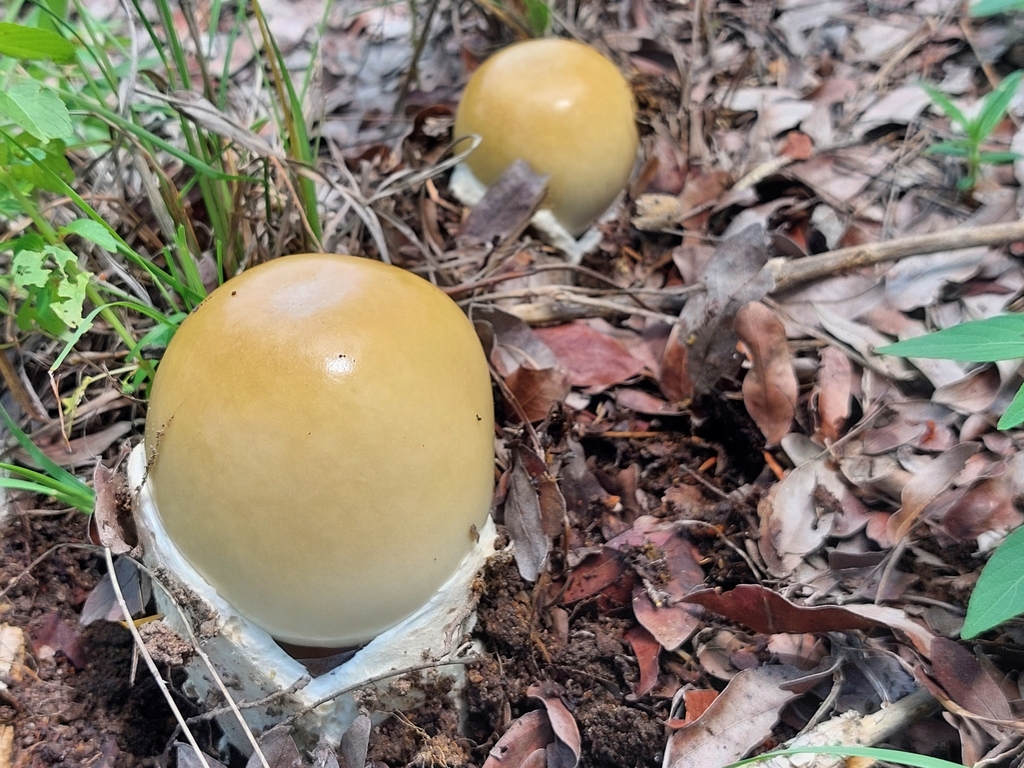
Zambian Slender Caesar
Amanita zambiana
Amanita zambiana, commonly known as the Zambian slender Caesar, is a basidiomycete fungus in the genus Amanita. An edible mushroom, it is found in Africa, where it is commonly sold in markets.
From the article Amanita zambiana on Wikipedia (CC BY-SA), quoted section by section
Description
The cap attains a diameter of 10 to 20 centimetres (4 to 8 inches). It is initially spherical to egg-shaped and uniformly olivaceous brown in color, but later becomes flattened and uniformly white from the center. The sticky cap surface is smooth and shiny, and does not retain any fragments of the partial veil; the cap margin has fine radial grooves. Gills are free from attachment to the stem, white, and up to 1.5 cm (1⁄2 in) broad (measuring from the top to the bottom of the gill). Crowded closely together, they are interspersed with three tiers of lamellulae (short gills that do not extend fully from the cap margin to the stem). The gill edges are finely notched and have a woolly appearance. The stem is 10 to 15 cm (4 to 6 in) long by 1.5 to 2 cm (1⁄2 to 3⁄4 in) thick, cylindrical, stout, and hollow. Its surface is whitish, fibrillose, and ringed. An ample membrane-like ring is finely grooved and attached to the upper part of the stem. At the base of the stem lies a broad sac-like volva, which has dimensions of 5 to 10 cm (2 to 4 in) by 3 to 5 cm (1+1⁄4 to 2 in). Initially black-brown in color, the outer layer of the volva eventually breaks up into large warts. The soft cap flesh is up to 1.5 cm (1⁄2 in) thick in the center, white, and does not change color when cut. …
Range & habitat
Like all Amanita species, A. zambiana is mycorrhizal. It typically associates with trees in the genus Brachystegia. Fruit bodies are often found in small groups at the side of gravel roads. Its distribution includes Zimbabwe, Zambia, Malawi, and southern Tanzania. In Zambia, it is known locally as tente in the Bemba language, or ndelema in Kaonde, Tumbuka and Nyanja. It is also known as the Christmas mushroom, as it is most abundant around December and early January. A popular edible, it contributes significantly to Zimbabwean household food security when it is in season. It is widely marketed at roadside stalls and markets, but only the cap is sold. Occasionally, the mushroom is dried for storage, but only after first boiling it and draining the water. According to a 2002 publication, the average price paid to mushroom harvesters in Zambia was about US$3 per kg.
Wikipedia: “Distribution and habitat”
Where it lives
Recorded sightings
—
geo-referenced records in GBIF, from museums, herbaria and field observers.
Drag the globe to turn it. Dots are where records exist, not a range map; darker means more records.
In the stacks
Searching the stacks…
Every page naming Amanita zambiana in the Biodiversity Heritage Library →
This page is assembled live from iNaturalist, GBIF, Wikipedia, the Source Library and the Internet Archive. It is not yet part of the hand-edited codex. iNaturalist taxon 490454.