- Plants
- ›Vascular Plants
- ›flowering plants
- ›monocots
- ›lilies, supplejacks, and allies
- ›Chilean bellflowers
Philesia
Philesia is a South American genus of flowering plants in the monocot family Philesiaceae first described as a genus in 1789. The native name is Coicopihue.
There is only one known species in this genus, Philesia magellanica, which is native to southern Chile (from Los Ríos to Magallanes regions) and southern Argentina. This species is, unusually for a monocot, a suckering shrub, growing to 1.2 metres (3 ft 11 in) tall and spreading by stolons. The leaves are linear, 15–35 mm long and 3–8 mm broad, glossy green above, and with two white stomatal bands below. The flowers have six tepals, the outer three short, 15–22 mm long, the inner three long, 45–65 mm long; they are mostly pink, but some darker, more purple variations have been recorded.
1 branches of this genus, most-observed first
See this branch on the Wheel of Life →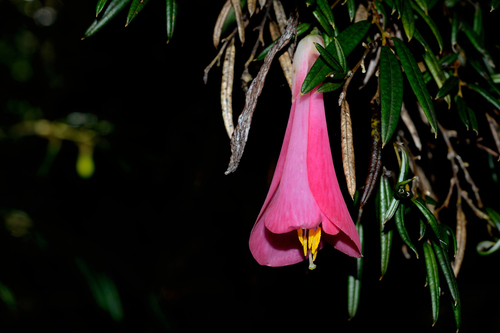
Where it lives
Recorded sightings
—
geo-referenced records in GBIF, from museums, herbaria and field observers.
Drag the globe to turn it. Dots are where records exist, not a range map; darker means more records.
In the stacks
Searching the stacks…
Every page naming Philesia in the Biodiversity Heritage Library →
This page is assembled live from iNaturalist, GBIF, Wikipedia, the Source Library and the Internet Archive. It is not yet part of the hand-edited codex. iNaturalist taxon 492338.