- Plants
- ›Vascular Plants
- ›flowering plants
- ›monocots
- ›grasses, sedges, cattails, and allies
- ›grasses
- ›Pooideae
- ›Wheats, ryes, barleys and relatives
- ›barleys, ryes, and relatives
- ›Hordeum
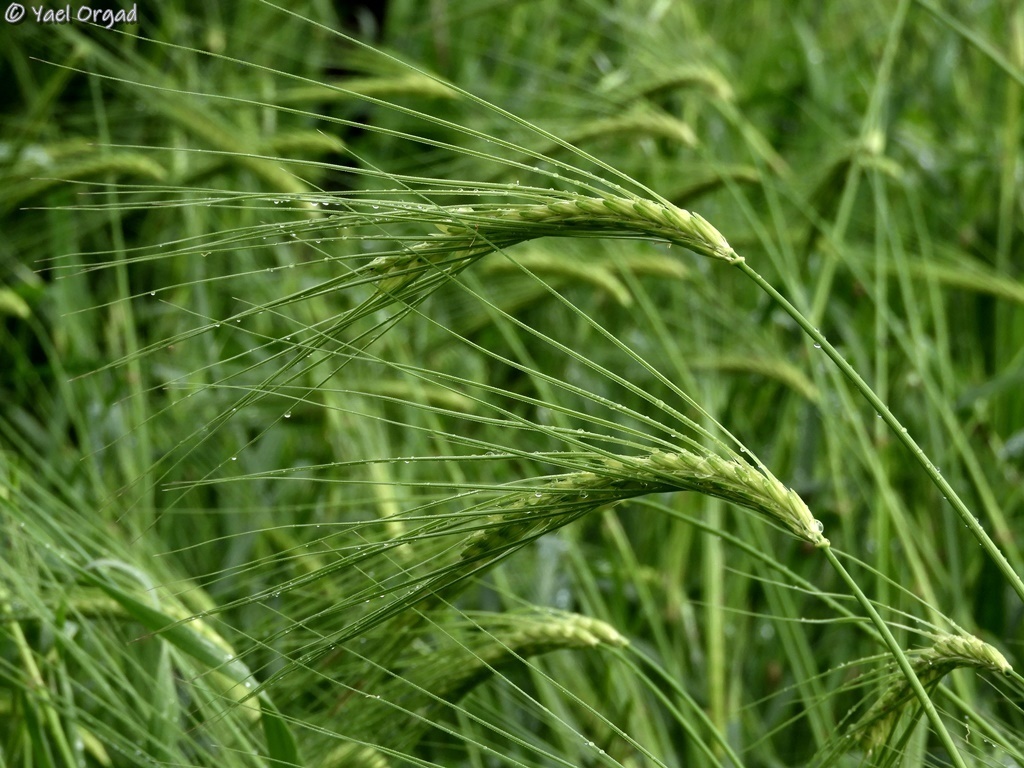
wild barley
Hordeum spontaneum
Hordeum spontaneum, commonly known as wild barley or spontaneous barley, is the wild form of the grass in the family Poaceae that gave rise to the cereal barley (Hordeum vulgare). Domestication is thought to have occurred on two occasions, first about ten thousand years ago in the Fertile Crescent and again later, several thousand kilometres further east.
From the article Hordeum spontaneum on Wikipedia (CC BY-SA), quoted section by section
Description
Wild barley is an annual grass and is very similar in form to cultivated barley (Hordeum vulgare) but has slightly narrower leaves, longer stems, longer awns, a brittle rachis, a longer, more slender seed spike and smaller grains. Characteristics of the wild plant that enhance its survival and dispersal include the brittle rachis (the central part of the seed head), which breaks when the grain is ripe, and the hulled seeds, which are arranged in two rows. In cultivated varieties, the rachis is more durable and the seeds are usually arranged in two or six rows. In the east, barley is usually grown for human consumption and the naked form of the grain is preferred, while in the west, the hulled form is mainly grown. It is used for animal feed and for the production of malt for brewing.
Range & habitat
Wild barley is native to North Africa, the Middle East, parts of the Indian subcontinent and south-west China. Its range includes Libya, Egypt, Israel, Lebanon, Jordan, Syria, Crete, Cyprus, Turkey, Iran, Iraq, Afghanistan, Armenia, Azerbaijan, Kyrgyzstan, Turkmenistan, Uzbekistan, Pakistan, India and the Sichuan and Xizang provinces of China. Wild barley is found in a wide range of locations varying from deserts to Mediterranean-type habitats and highland habitats, growing in both cultivated and uncultivated fields. It is exposed to many environmental stresses including high temperatures, drought and high soil salinity and there are local adaptations to the microclimates in which it grows. This wild plant is potentially a genetic resource useful for the breeding of stress-tolerant varieties of the cultivated crop.
Wikipedia: “Distribution and habitat”
Where it lives
Recorded sightings
—
geo-referenced records in GBIF, from museums, herbaria and field observers.
Drag the globe to turn it. Dots are where records exist, not a range map; darker means more records.
In the stacks
Searching the stacks…
Every page naming Hordeum spontaneum in the Biodiversity Heritage Library →
This page is assembled live from iNaturalist, GBIF, Wikipedia, the Source Library and the Internet Archive. It is not yet part of the hand-edited codex. iNaturalist taxon 492871.