- Animals
- ›Chordates
- ›Vertebrates
- ›Birds
- ›Cranes, Rails, and Allies
- ›Rails, Gallinules, and Coots
- ›Dryolimnas
On eBird ↗
White-throated Rail
Live sightings near you, the range map, bar charts of when it is seen, and Macaulay Library photos and recordings.
White-throated Rail
Dryolimnas cuvieri
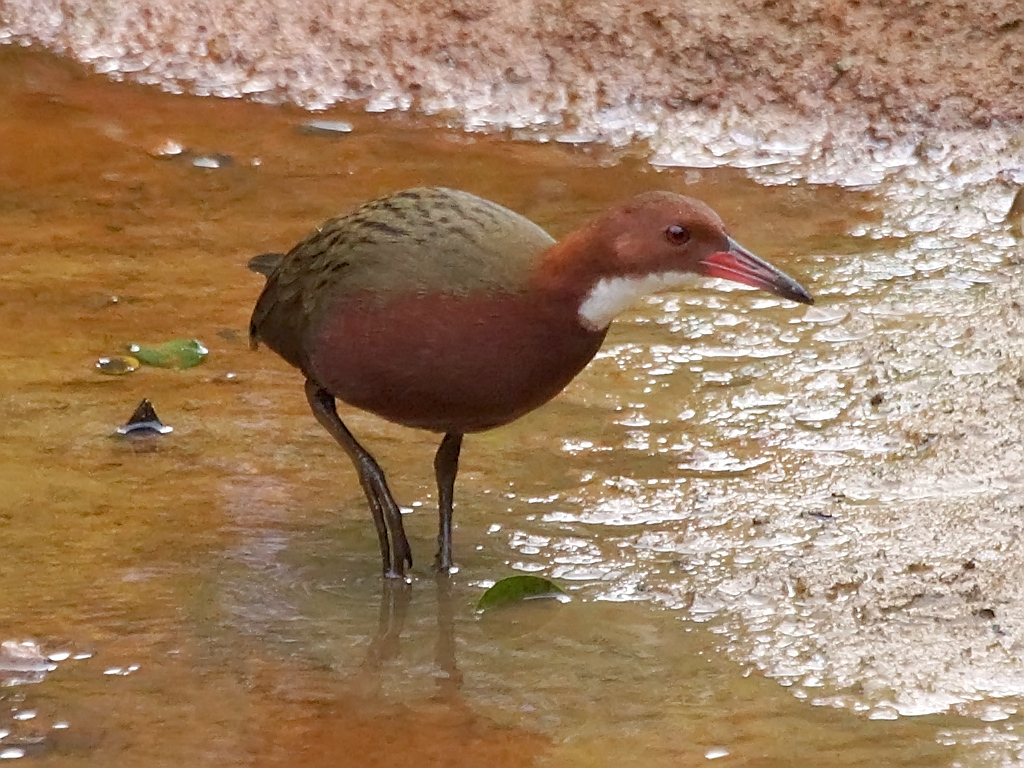
The white-throated rail (Dryolimnas cuvieri) or Cuvier's rail is a species of bird in the family Rallidae. It is found in Comoros, Madagascar, Mayotte, and Seychelles. A flightless subspecies, Dryolimnas cuvieri aldabranus (Aldabra rail), inhabits Aldabra, while another, D. c. abbotti (Assumption rail), from Assumption went extinct in the early 20th century due to introduced predators.
From the article White-throated rail on Wikipedia (CC BY-SA), quoted section by section
Description
The white-throated rail measures 30–33 cm (12–13 in) in length. Males are larger than females. In the nominate subspecies, D. c. cuvieri, males weigh 276 g (9.7 oz) while the female weighs 258 g (9.1 oz). Another subspecies, D. c. aldabranus, is smaller and paler in coloration, weighing 176 g (6.2 oz) in females and 189 g (6.7 oz) in males. This subspecies is flightless. Generally, the white-throated rail is a fairly large rail with a dusky abdomen and thighs with white on its throat and undertail-coverts.
Range & habitat
It is resident in Madagascar and breeds in the Seychelles, particularly on Aldabra Island.
Wikipedia: “Distribution”
What it does
The white-throated rail feeds primarily on invertebrates, as well as eggs and hatchlings of the green turtle. In coastal areas, it is also known to drink salt water. In Madagascar, it breeds mostly during times of rain. They are monogamous and territorial, forming strong permanent pair bonds. 3–4 eggs are typically laid. Chicks hatch covered in olive-black down. Both parents care for the young, which becomes independent at 12–15 weeks of age, after which parents become aggressive to them.
Wikipedia: “Behavior”
Listen
Looking for field recordings…
Where it lives
Recorded sightings
—
geo-referenced records in GBIF, from museums, herbaria and field observers.
Drag the globe to turn it. Dots are where records exist, not a range map; darker means more records.
In the stacks
Searching the stacks…
Every page naming Dryolimnas cuvieri in the Biodiversity Heritage Library →
This page is assembled live from iNaturalist, GBIF, Wikipedia, the Source Library and the Internet Archive. It is not yet part of the hand-edited codex. iNaturalist taxon 493.