- Plants
- ›Vascular Plants
- ›flowering plants
- ›Dicots
- ›Legumes, Milkworts, and Allies
- ›Legumes
- ›Faboideae
- ›Trifolieae
- ›Trigonella
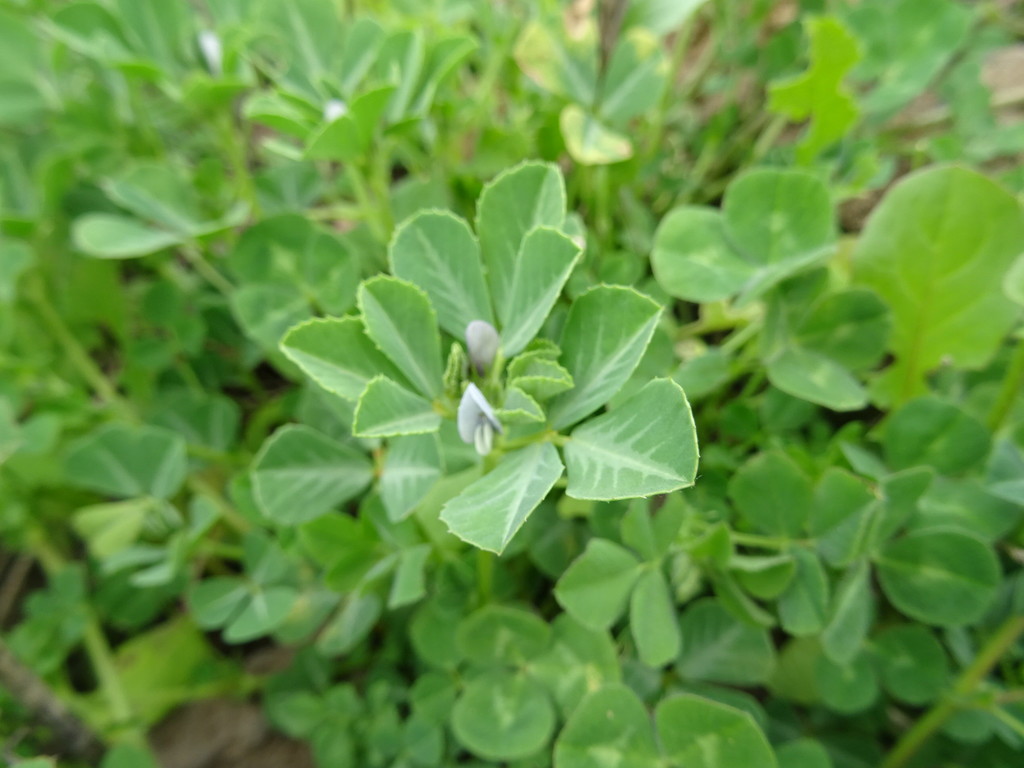
Trigonella berythea
Trigonella berythea (Beirut fenugreek, Arabic: حلبة بيروت) is a plant species in the legume family. Its natural habitat is the subtropical biome and endemic to the Eastern Mediterranean.
From the article Trigonella berythea on Wikipedia (CC BY-SA), quoted section by section
Description
First published in Pierre Edmond Boissier's Diagnoses plantarum Orientalium novarum in 1856. The plant is annual with white hairs sparsely scattered on the branches and petioles, especially hairy on the upper side. The stems are erect or ascending, sparsely branched. The stipules are ovate, with a very short, acuminated tip, attached to the petiole at the lower part of the stipule. The petiole is equal in length to or longer than the leaflets, which are obovate, with a cuneate base, and have the upper side slightly obtuse and only obscurely dentate. The sepal is tubular, cylindrical, with lanceolate-subulate teeth that are almost subequal. The petal is almost double the length of the sepal, the legumes are straight, linear, subcompressed, longitudinally pressed parallel, and slightly wrinkled, with a beak about half its length, abruptly shortened at the end. This species is closely related to Trigonella foenum-graecum but differs from it in the narrower and longer stipules, the oblong-spathulate leaflets with ciliate teeth, the legumes which are less compressed and have a more strongly marked reticulated surface, traversed by fine nerves that are somewhat distant from each other.
Range & habitat
The plant grows in the subtropical biome, and is endemic to Cyprus, Lebanon, Syria, Palestine, and the Sinai Peninsula. The species was discovered by Emmanuel-Louis Blanche, observed in April 1843 and 1850 near the promontory of Ras Beirut, and in the hills and foothills of the Lebanon mountains above Sidon.
Wikipedia: “Distribution and habitat”
In human culture
Berythea refers to Beirut, specifically to Ras Beirut, where the plant was first described.
Wikipedia: “Etymology”
Where it lives
Recorded sightings
—
geo-referenced records in GBIF, from museums, herbaria and field observers.
Drag the globe to turn it. Dots are where records exist, not a range map; darker means more records.
In the stacks
Searching the stacks…
Every page naming Trigonella berythea in the Biodiversity Heritage Library →
This page is assembled live from iNaturalist, GBIF, Wikipedia, the Source Library and the Internet Archive. It is not yet part of the hand-edited codex. iNaturalist taxon 493073.