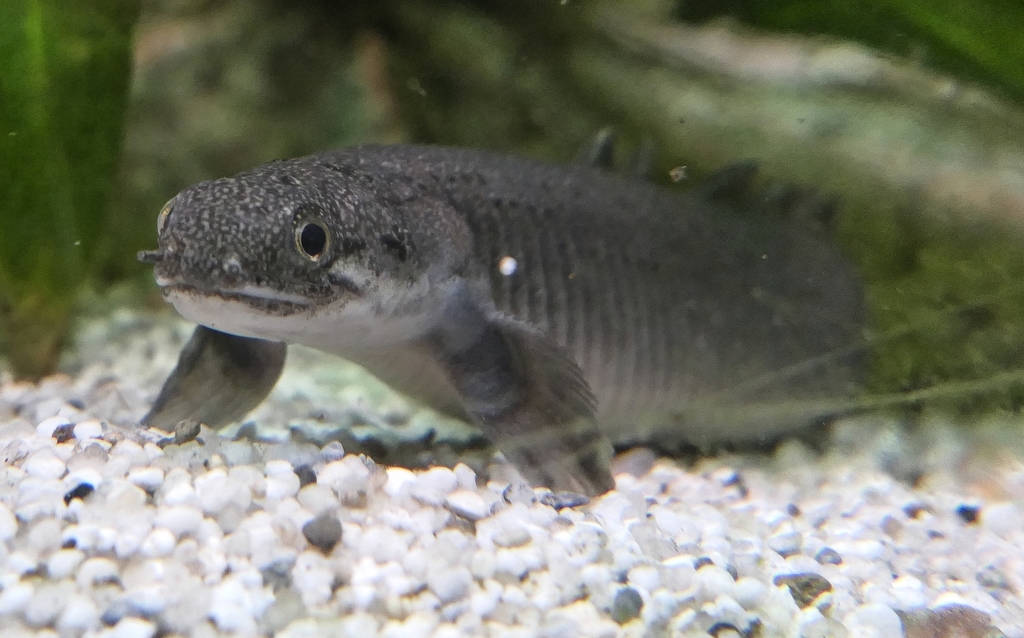
Senegal Bichir
Polypterus senegalus
Polypterus senegalus, commonly known as the Senegal bichir, gray bichir or Cuvier's bichir, is an African species of ray-finned fish in the bichir family, Polypteridae. It is a typical example of polypterid fishes, as most of its defining physical features are common across the genus, such as its ancient, lungfish- or arowana-like appearance, the ability to breathe atmospheric oxygen, and its armor-like scales. These factors have influenced the species' popularity in captivity, and it is commonly kept by aquarists and other hobbyists.
P. senegalus is sometimes, confusingly, called the "dinosaur eel" or "dragon fish", among other misnomers; however, the bichir is not an eel, nor is it a reptile or dinosaur.
From the article Polypterus senegalus on Wikipedia (CC BY-SA), quoted section by section
Description
Polypterus senegalus is an elongated fish, usually grey or beige in color, though sometimes displaying shades of white, pink or blueish; albino individuals also occur. Its body is covered in rhomboid-shaped, multilayered scales, with very subtle patterns and occasional darker blotches or dots. At the nose, the face is smooth and rounded, with larger scales than the rest of the fish. External nostrils protrude from the front. Eyes are on either side of the head, and they are usually pale yellow with a black pupil. P. senegalus has poor eyesight, and relies largely on sense of smell and subtle movements when detecting prey. The mouth is large and appears to grin when closed. The dentary, premaxilla, and maxilla each carry one row of large, slightly recurved teeth. There are multiple rows of smaller teeth between these rows of large teeth, on the prearticular and coronoids of the lower jaw, and on the bones forming the roof of the mouth. The body is long and vaguely cylindrical; a serrated dorsal fin runs along most of the body until it meets the caudal fin, which is pointed and flat. There are 8–11 dorsal spines and 14–17 anal spines. The large, paddle-like pectoral fins attach just behind and below the gill openings, and are their primary means of locomotion, providing a slow, graceful appearance. P. senegalus is smaller than other bichirs, reaching about 35.5 cm (14 in). …
Wikipedia: “Appearance”
Range & habitat
This species of bichir is found in lakes, river margins, swamps, and floodplains of tropical Africa and the Nile river system, it occurs in at least twenty-six African countries which include Senegal, Egypt, Democratic Republic of Congo, Cameroon, Chad, Ethiopia, Kenya, Mali, Ivory Coast, Tanzania, Sudan, Nigeria, Gambia, Uganda, and others. Its distribution is widespread, detailed to include the Nile basin and West Africa (Senegal, Gambia, Niger, Volta, and Lake Chad basins, and Congo River Basin. Provided the skin remains moist, P. senegalus can remain out of the water indefinitely – it can even be raised on land, where it uses its large pectoral fins to walk.
Wikipedia: “Distribution and habitat”
What it does
Polypterus senegalus breed during the rainy season in nature. During courtship, the male chases and nudges the female. The females lays 100–300 eggs within a few days. The male receives the eggs from the female by cupping his anal and caudal fins around her genitals. The male then fertilizes the eggs and scatters them in the vegetation. Egg hatching can take 3–4 days.
Wikipedia: “Reproduction”
Where it lives
Recorded sightings
—
geo-referenced records in GBIF, from museums, herbaria and field observers.
Drag the globe to turn it. Dots are where records exist, not a range map; darker means more records.
In the stacks
Searching the stacks…
Every page naming Polypterus senegalus in the Biodiversity Heritage Library →
This page is assembled live from iNaturalist, GBIF, Wikipedia, the Source Library and the Internet Archive. It is not yet part of the hand-edited codex. iNaturalist taxon 493799.