- Plants
- ›Vascular Plants
- ›conifers
- ›conifers
- ›cypress family
- ›Cypresses, Cedars, Junipers, and Allies
- ›Juniperus
- ›Sabina
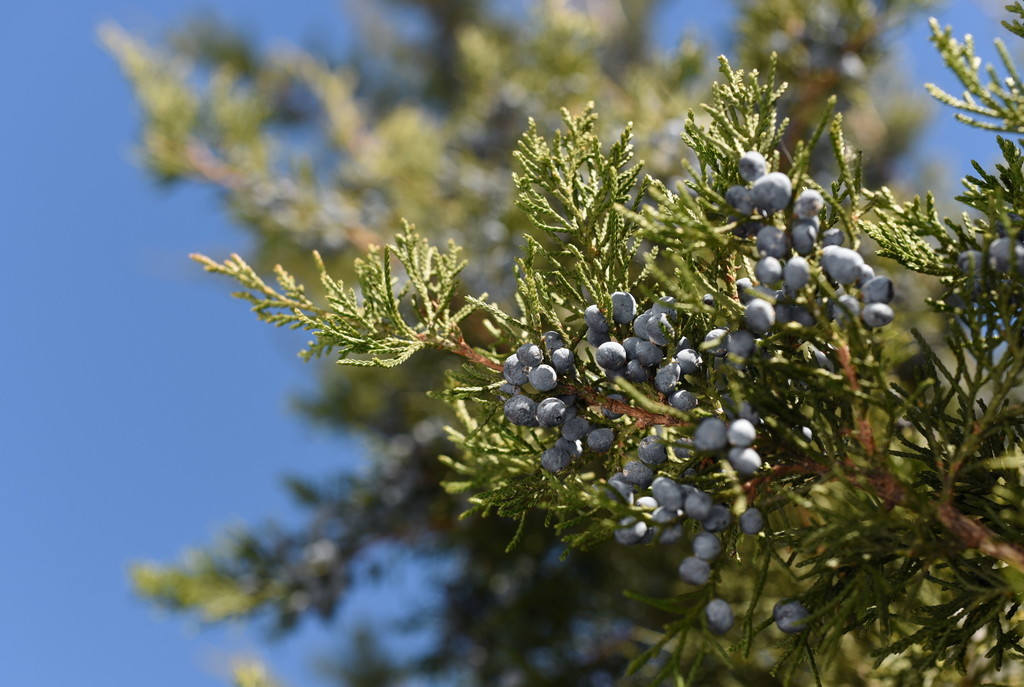
eastern redcedar
Juniperus virginiana
Juniperus virginiana, also known as eastern red cedar, red cedar, Virginian juniper, eastern juniper, red juniper, and other local names, is a species of juniper native to eastern North America from southeastern Canada to the Gulf of Mexico and east of the Great Plains. Farther west it is replaced by the related Juniperus scopulorum (Rocky Mountain juniper) and to the southwest by Juniperus ashei (Ashe juniper). It is not to be confused with Thuja occidentalis (eastern white cedar).
From the article Juniperus virginiana on Wikipedia (CC BY-SA), quoted section by section
Description
Juniperus virginiana is a dense slow-growing coniferous evergreen tree with a conical or subcylindrical shaped crown that may never become more than a bush on poor soil, but is ordinarily from 5–20 metres (16–66 feet) tall, with a short trunk 30–100 centimetres (12–39 inches) in diameter, rarely to 3 m (9.8 ft) in height and 170 cm (67 in) in diameter. The oldest tree reported, from West Virginia, was 940 years old. The bark is reddish-brown, fibrous, and peels off in narrow strips. The leaves are of two types; sharp, spreading needle-like juvenile leaves 5–10 millimetres (3⁄16–3⁄8 in) long, and tightly adpressed scale-like adult leaves 2–4 mm (1⁄16–3⁄16 in) long; they are arranged in opposite decussate pairs or occasionally whorls of three. The juvenile leaves are found on young plants up to 3 years old, and as scattered shoots on adult trees, usually in shade. The seed cones are 3–7 mm (1⁄8–1⁄4 in) long, berry-like, dark purple-blue with a white wax cover giving an overall sky-blue color (though the wax often rubs off); they contain one to three (rarely up to four) seeds, and are mature in 6–8 months from pollination. The juniper berry is an important winter food for many birds, which disperse the wingless seeds. The pollen cones are 2–3 mm (1⁄16–1⁄8 in) long and 1.5 mm (1⁄16 in) broad, shedding pollen in late winter or early spring. …
What it does
Eastern red cedar is a pioneer species, meaning that it is one of the first trees to repopulate disturbed sites. It is unusually long lived among pioneer species, with the potential to live over 900 years. It is commonly found in prairies or oak barrens, old pastures, or limestone hills, often along highways and near recent construction sites. It is an alternate host for cedar–apple rust, an economically significant fungal disease of apples, and some management strategies recommend the removal of J. virginiana near apple orchards Eastern red cedar grows in a wide range of climatic and soil conditions. The tree is extremely tolerant of drought due to its extensive, fibrous root system and reduced leaf area. It can be found from droughty, rocky soils with few nutrients to rich alluvial soils with abundant moisture. However, eastern red cedar is almost never dominant on such rich mesic sites due to intense competition with faster growing, more shade tolerant hardwood trees. Outside of its native range it is considered an invasive species, and it can be aggressive even within its range. It is fire-intolerant, and was previously controlled by periodic wildfires. Low branches near the ground burn and provide a ladder that allows fire to engulf the whole tree. Grasses recover quickly from low severity fires that are characteristic of prairies that kept the trees at bay. …
Wikipedia: “Ecology”
At the table
The fragrant, finely grained, soft, brittle, very light, pinkish to brownish red heartwood is very durable, even in contact with soil. Because of its resistance to decay, the wood is often used for fence posts. Moths avoid the aromatic wood, and therefore it is in demand as lining for clothes chests and closets, which are often denominated "cedar closets" and "cedar chests". If correctly prepared, excellent English longbows, flatbows, and Native American sinew-backed bows can be made from it. It is marketed as "eastern red cedar" and "aromatic cedar". The best portions of the heartwood are one of the few woods that are suitable for making pencils, however the supply had so diminished by the 1940s that the wood of the incense-cedar largely replaced it.
Part of the commercially available cedar oil is produced by steam distillation from wood shavings. It contains a wide variety of terpenes. The three major components, alpha-cedrene, thujopsene and cedrol, constitute more than 60% of the essential oil. The fruits also yield an essential oil which contains mostly D-Limonene. The oil derived from foliage and twigs has two main constituents: safrole and limonene. One minor compound is the podophyllotoxin, a non-alkaloid toxin lignan. Native American tribes have historically used poles of eastern red cedar wood to demarcate agreed tribal hunting territories. …
Wikipedia: “Uses”
Where it lives
Recorded sightings
—
geo-referenced records in GBIF, from museums, herbaria and field observers.
Drag the globe to turn it. Dots are where records exist, not a range map; darker means more records.
In the stacks
Searching the stacks…
Every page naming Juniperus virginiana in the Biodiversity Heritage Library →
This page is assembled live from iNaturalist, GBIF, Wikipedia, the Source Library and the Internet Archive. It is not yet part of the hand-edited codex. iNaturalist taxon 49399.