- Plants
- ›Vascular Plants
- ›flowering plants
- ›Dicots
- ›Sunflowers, Bellflowers, Fanflowers, and Allies
- ›Sunflowers, Daisies, Asters, and Allies
- ›chicories, dandelions, and allies
- ›Lettuce, Chicory, Dandelion and Salsify Tribe
- ›Scolyminae
- ›Scolymus
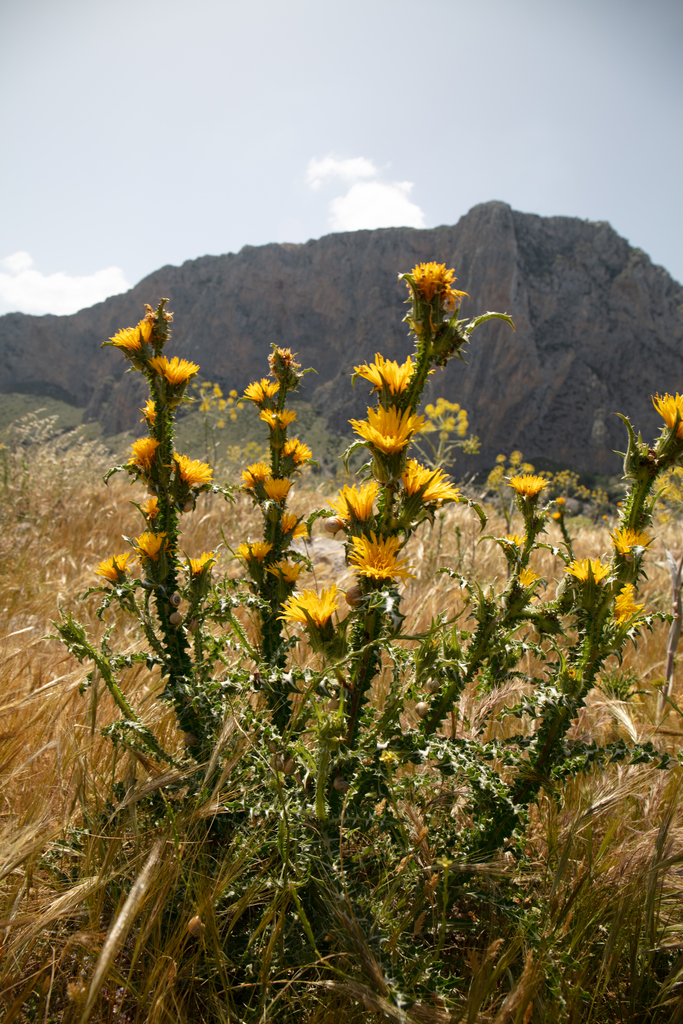
Large-flowered Golden Thistle
Scolymus grandiflorus
Scolymus grandiflorus is a spiny annual or biennial plant in the family Asteraceae, native to the Mediterranean region. With up to 75 cm high stems, it is the smallest of the species of Scolymus. Its stems are lined with uninterrupted spiny wings. It also has the largest flowerheads in the genus, of approximately 5 cm wide. It has yellow, sometimes yolk-yellow ligulate florets. Its vernacular name in Maltese is xewk isfar kbir, meaning "large yellow fin", cardogna maggiore in Italian, scoddi on Sicily, and scolyme à grandes fleurs in French.
From the article Scolymus grandiflorus on Wikipedia (CC BY-SA), quoted section by section
Description
Scolymus grandiflorus is a spiny herbaceous annual or biennial of up to ¾ m high, that contains a milky latex. It has twenty chromosomes (2n=20).
Root, stem and leaves. The stems carry uninterrupted spiny wings along their lengths. The rosette leaves are usually 10-16, exceptionally up to 24 cm long and ovate to oblong in shape, pinnately incised, with a wavy, spiny and dentate margin. The leaves on the stem are alternately set and are smaller but comparable to the rosette leaves.
Inflorescence, flowers and fruits. The flowerheads are seated at the end of the stem or in the limbs of the higher leaves, and are arranged in a spike, which are subtended by two or three leaflike bracts. Each flowerhead is circled by an involucre that consists of many spine-tipped bracts of usually between 9 and 15 mm long, in several rows, the outer papery and shorter than the inner ones, which are leaflike in consistency and have a white papery margin. These surround the common floral base (or receptacle), which is mostly 13–18 mm in diameter conical in shape and is set with ovate papery bracts called chaff or paleae. Inplanted are dorsally compressed cypselas, each enclosed by a palea, the outer rows higher than the inner ones. There are three to seven pappus bristles on top of the cypselas in the centre, three to five with bordering the involucre. …
Range & habitat
The species is most widely present in Morocco, Algeria, Tunisia, Malta, Libya, and on Sicily. It further occurs in Lebanon, Turkey, Italy (Sicily, Sardinia, Lombardia, Tuscany, Basilicata, Calabria, Puglia and Abruzzo), and in France (the coast of the Languedoc-Roussillon region, the departement Bouches-du-Rhône and on southern Corsica), but has a patchy distribution in these parts. Remarkable is its absence from the east of Spain and the Balears and from the south of the Balkans.
Wikipedia: “Distribution”
What it does
S. grandiflorus has a preference for coastal areas, and can mostly be found on sandy soils. It grows on wastelands, often in the company of Carduus spp., Carthamus spp. and Onopordum spp.
Wikipedia: “Ecology”
Where it lives
Recorded sightings
—
geo-referenced records in GBIF, from museums, herbaria and field observers.
Drag the globe to turn it. Dots are where records exist, not a range map; darker means more records.
In the stacks
Searching the stacks…
Every page naming Scolymus grandiflorus in the Biodiversity Heritage Library →
This page is assembled live from iNaturalist, GBIF, Wikipedia, the Source Library and the Internet Archive. It is not yet part of the hand-edited codex. iNaturalist taxon 494055.