- Animals
- ›Arthropods
- ›Hexapods
- ›Insects
- ›Winged and Once-winged Insects
- ›Cockroaches and Termites
- ›Giant and Wood Cockroaches
- ›Giant Cockroaches
- ›Blaberinae
- ›Blaberini
- ›Blaberus
- ›Blaberus atropos
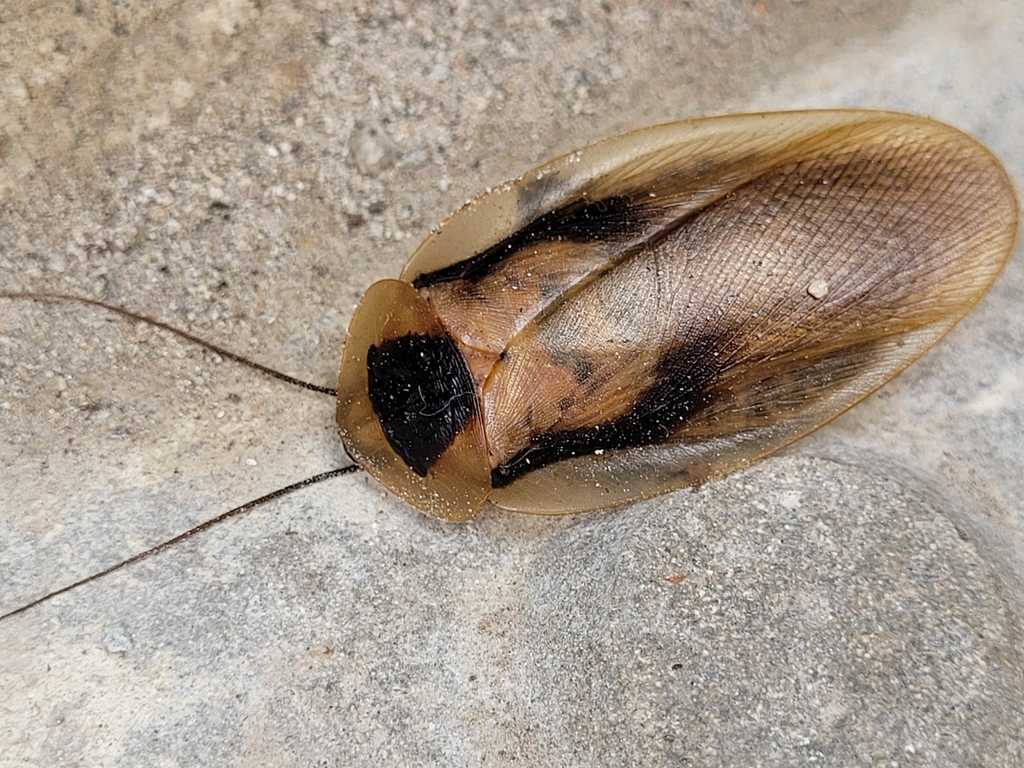
Discoid Roach
Blaberus discoidalis
Blaberus discoidalis, commonly known as the discoid cockroach, tropical cockroach, West Indian leaf cockroach, false death's head cockroach, Haitian cockroach, and drummer, is a cockroach native to Central America of the "giant cockroach" family, Blaberidae.
The adult is around 35–45 mm (1.4–1.8 in) in length, and is tan with a dark brown to black patch on its pronotum. The juvenile is brown with tan speckles, and matures to adulthood in 4–5 months. Adults have wings but are not active fliers, and they can not climb smooth vertical surfaces, simplifying their care in captivity.
From the article Blaberus discoidalis on Wikipedia (CC BY-SA), quoted section by section
Range & habitat
Blaberus discoidalis is found in Jamaica, Cuba, Hispaniola, Puerto Rico, Puerto Rico (Vieques Island), Panama, Colombia, Venezuela, Trinidad and Tobago, and Florida.
Wikipedia: “Distribution”
At the table
They are very easy to raise in captivity, so make good feed for insectivorous pets such as tarantulas, bearded dragons, and other lizards. These animals breed readily in captivity. They reach breeding age in about 6 months if kept warm, with 85–90 °F recommended for more productive breeding. Females carry their eggs inside a brooding pouch having genital chamber and vestibulum until they are fertilised by male spermatophore.
Wikipedia: “Pet food”
Listen
Looking for field recordings…
Where it lives
Recorded sightings
—
geo-referenced records in GBIF, from museums, herbaria and field observers.
Drag the globe to turn it. Dots are where records exist, not a range map; darker means more records.
In the stacks
Searching the stacks…
Every page naming Blaberus discoidalis in the Biodiversity Heritage Library →
This page is assembled live from iNaturalist, GBIF, Wikipedia, the Source Library and the Internet Archive. It is not yet part of the hand-edited codex. iNaturalist taxon 494430.