- Animals
- ›Molluscs
- ›Cephalopods
- ›Octopuses, Squids, and Cuttlefishes
- ›Squids and Cuttlefishes
- ›Inshore Squids
- ›Pencil Squids
- ›Uroteuthis
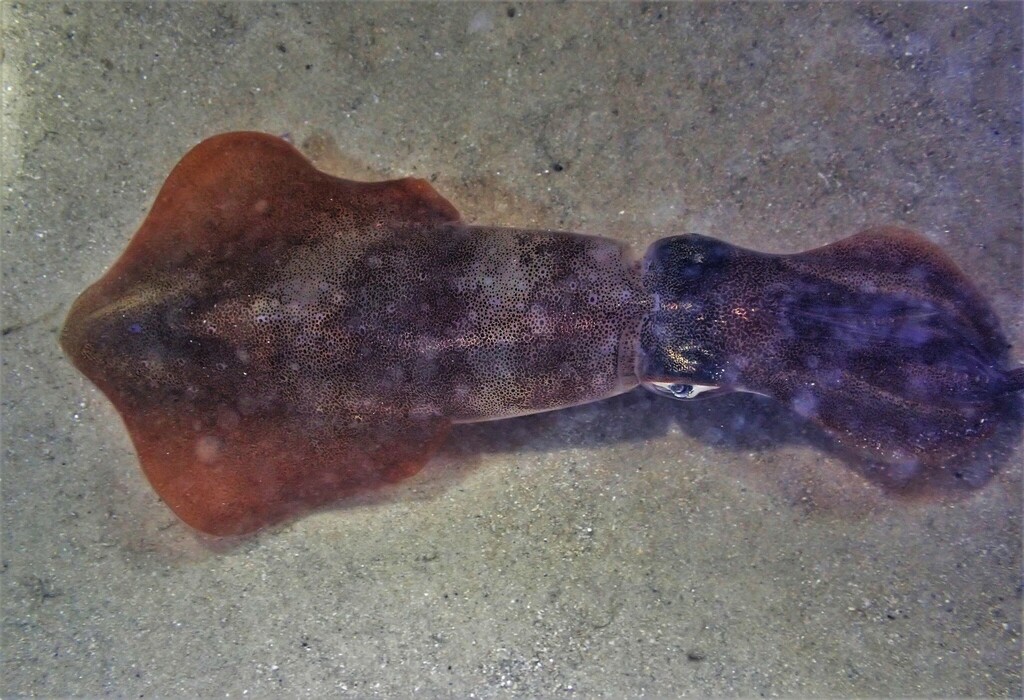
Mitre Squid
Uroteuthis chinensis
Uroteuthis chinensis, also known as the Hanchi (Korean:한치),Taiwanese squid (Mandarin Chinese:台灣槍烏賊) or mitre squid, is a species of squid in the west Pacific Ocean, including the China Sea.
From the article Uroteuthis chinensis on Wikipedia (CC BY-SA), quoted section by section
Description
U. chinesis is a cephalopod which means that it feeds by using tentacles to pull food into its sharp beak. Cephalopods have radulas which are similar to tongues that help them grind up the food they eat so they can digest it. Reproduction occurs once in a lifetime because cephalopods die shortly after reproducing. During mating the male squid uses a specialized arm called a hectocotylus to fertilize the female with his sperm. The body is elongated, tapered, and the end of the tail is tapered. There is no longitudinal midline on the ventral surface. The average carcass length of mature specimens is 30 cm and the aspect ratio is 7:1. There are two fins on the side of the tube, the fins are diamond-shaped, and the length of the carcass is greater than 2/3, making the carcass of the spear look like a rocket, hence the name. Like other calamari species, two of the ten tentacles of this species are longer, the wrist style is generally 3>4>2>1, and there are 2 rows of suckers. There are about 12 large horned rings in the horned tentacles group with an average diameter of 1/2 times larger than that of the small horned rings at the edge. The diameter of the largest horned ring is 2 times larger. The horned ring of the largest tentacle has 20-30 sharp teeth, and the arrangement is 6-12 large teeth interspersed with 1-4 small teeth. U. …
Wikipedia: “Characteristics”
Range & habitat
The main fishing grounds of this species are located in the Penghu Islands on both sides of the Taiwan Strait and the South Fujian Sea, but it can also be seen in the northern part of the Beibu Gulf in Guangxi, around Hainan Island, Nanpeng Islands, and the South China Sea. The peak period of fishing is from May to June, but in Hong Kong sometimes they can be caught in April. Compared with other cuttlefish or squid, its taste is thinner and sweeter, and it is generally used to stir-fry, stir-fry or eat as sashimi. U. chinesis when compared to other squid species like U. edulis seems to grow faster and have larger mantles. This could attribute to people preferring U. chinesis over other squid species for eating.
Wikipedia: “Distribution”
Where it lives
Recorded sightings
—
geo-referenced records in GBIF, from museums, herbaria and field observers.
Drag the globe to turn it. Dots are where records exist, not a range map; darker means more records.
In the stacks
Searching the stacks…
Every page naming Uroteuthis chinensis in the Biodiversity Heritage Library →
This page is assembled live from iNaturalist, GBIF, Wikipedia, the Source Library and the Internet Archive. It is not yet part of the hand-edited codex. iNaturalist taxon 495401.