- Animals
- ›Arthropods
- ›Hexapods
- ›Insects
- ›Winged and Once-winged Insects
- ›Beetles
- ›Ground and Water Beetles
- ›Ground beetles and allies
- ›Ground Beetles
- ›Lebiinae
- ›Lebiini
- ›Calleidina
- ›Calleida
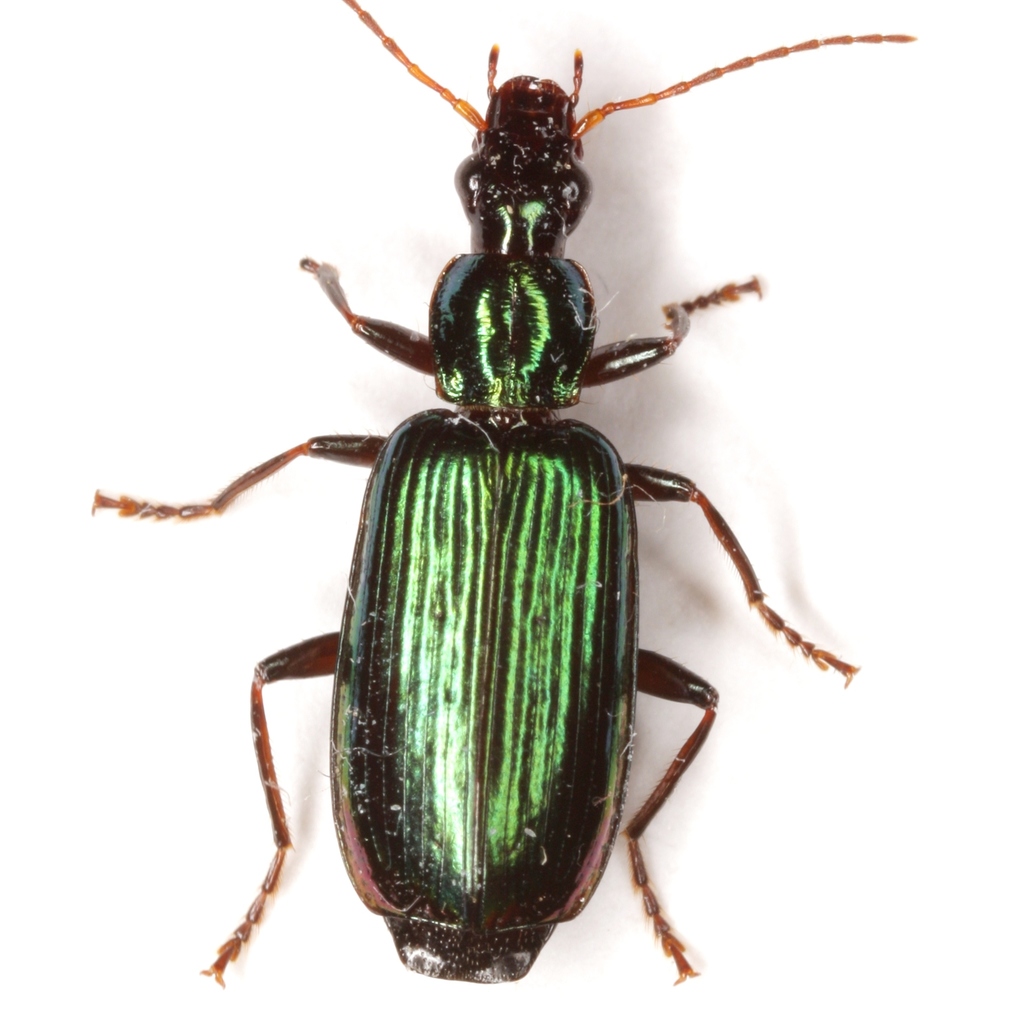
Calleida viridipennis
The Calleida viridipennis is a species of ground beetle belonging to the Carabidae family, and are referred to as carabid beetles. It is found in various states, including New York, New Mexico, Louisiana, and Florida. Habitat preferences include forests and swamps. C. virdipennis is a particular carabid beetle that is, on average, 10 mm long. Recognizable by a green-black metallic exoskeleton, it has a trapezoidal head shape. Its large eyes are also characteristic of the species. Below the exoskeleton reside functional wings, giving the beetle flight capacity.
C. viridipennis is a spring breeder, rather than an autumn breeder. Therefore, they give rise to summer larvae and overwinter in the adult state. The female to male sex ratio does not differ significantly from the expected 1:1 ratio.
From the article Calleida viridipennis on Wikipedia (CC BY-SA), quoted section by section
Range & habitat
The C. viridipennis beetle has a distribution that ranges from northern to southern America. The beetle has been observed to reside in southwestern New York to eastern Mexico, including southwestern Iowa. C. viridipennis has also been seen in Texas, Louisiana, and Florida. Research studies interested in investigating the predation of C. viridipennis have focused on the beetle populations found in Louisiana and Florida. Possible sightings of the beetle have been noted in Utah, Arizona, and California. It has also been found inhabiting Saint Martin, an island in the Caribbean.
Wikipedia: “Distribution”
What it does
The life cycle of a beetle consists of 4 different stages: egg, larval, pupal and adult. Carabid eggs are distributed among foliage and host webs. C. viridipennis is a spring beetle, thus larvae occur from late-March to early- or mid-October. Overwintering occurs in the adult state underneath tree bark. Conversely, autumn breeders lay eggs in the fall and overwinter in the larval stage. Adults survive approximately one year.
Eggs. The length of the egg ranges between 1.0 and 1.3 mm. It is white to gray, and is oval shaped. The egg is enclosed in a purse that has been observed to be made of bark, silk, leaves, and grass. They are suspended from the leaves by a silk stalk.
Larvae. The average length of the beetle larva is 7.99 to 14.11 mm long, and is characterized by its metallic black to green tergites. The head is trapezoidal and differs in color as it is yellow to reddish-brown. The antennae is composed of 4 segments. The mandibles are longer than the antennae. The widest part of the beetle are the thoracic segments. The beetle typically bears 4 blunt teeth.
Pupa. The length measured from the crest of the head to the apex of the abdomen is recorded to be 6.6 to 7.7 mm.
Wikipedia: “Life cycle”
Listen
Looking for field recordings…
Where it lives
Recorded sightings
—
geo-referenced records in GBIF, from museums, herbaria and field observers.
Drag the globe to turn it. Dots are where records exist, not a range map; darker means more records.
In the stacks
Searching the stacks…
Every page naming Calleida viridipennis in the Biodiversity Heritage Library →
This page is assembled live from iNaturalist, GBIF, Wikipedia, the Source Library and the Internet Archive. It is not yet part of the hand-edited codex. iNaturalist taxon 495798.