- Plants
- ›Vascular Plants
- ›flowering plants
- ›Dicots
- ›Soapberries, Cashews, Mahoganies, and Allies
- ›mahogany family
- ›Dysoxylum
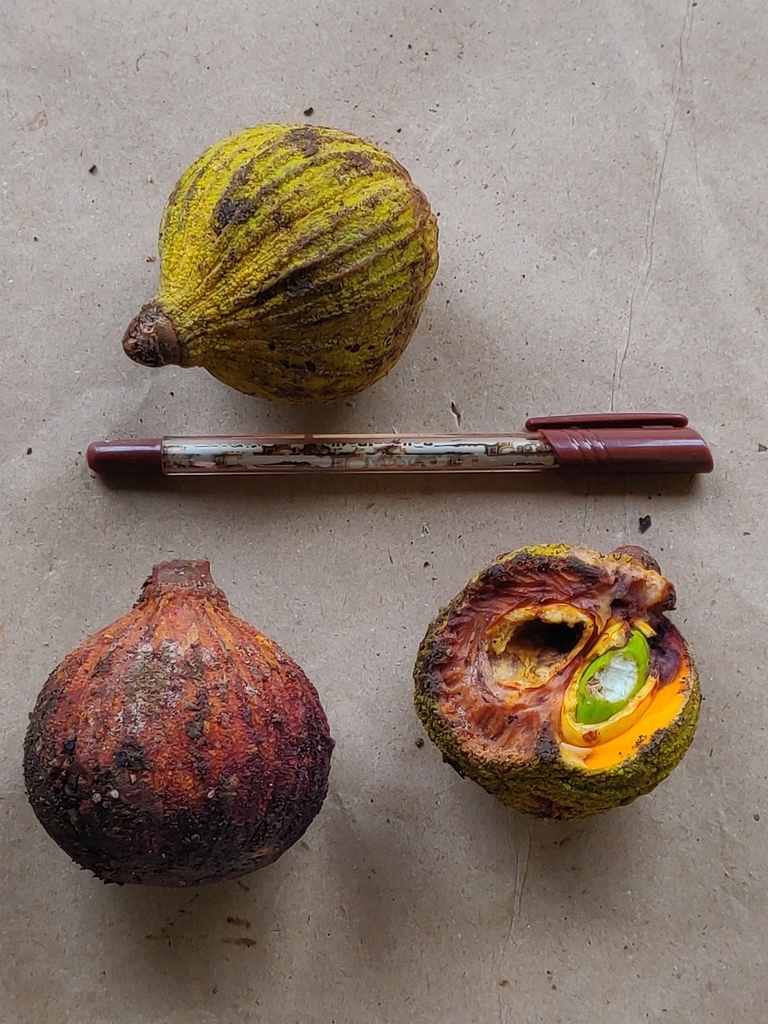
Dysoxylum malabaricum
Dysoxylum malabaricum, or white cedar, is a species of tree endemic to the Western Ghats, India. The species is considered Endangered under the IUCN Red List of Threatened Species.
From the article Dysoxylum malabaricum on Wikipedia (CC BY-SA), quoted section by section
Description
These are tall canopy trees with a straight bole, growing to a height of about 35 m (115 ft). The bark, about 5–8 mm (0.20–0.31 in) thick, is greyish brown and covered densely with large, corky lenticels. The bark exfoliates in large rectangular scales. When the bark is cut, the blaze appears yellow and white. The young branchlets are angular and minutely hairy. The compound leaves are paripinnate (ending in a pair of leaflets), up to 30 cm (12 in) (occasionally 40 cm (16 in)) long, arranged alternate, spiral, and clustered at twig ends. The petiole is pulvinate (swollen at base). The rachis is angular, 17–20 cm (6.7–7.9 in) long. The leaves have 4-6 pairs of leaflets with petiolules about 0.5–0.9 cm (0.20–0.35 in) long. The leaflets are alternate or subopposite, about 9–22 cm (3.5–8.7 in) in length by 4–7 cm (1.6–2.8 in) wide. Leaflets are coriaceous, elliptic-lanceolate in shape and have an acuminate apex, asymmetric base, and an entire margin. The midrib is raised above the dorsal surface of the leaf. Leaflets have 12-20 pairs of prominent secondary nerves, with hairy domatia in the axils of the secondary nerves. Tertiary nerves are obscurely visible and reticulo-percurrent. Prominent inter-secondary veins are seen between secondary nerves. The inflorescence is a panicled raceme, shorter than leaves. …
Range & habitat
It is found in the mountains of the central and southern Western Ghats, between 200 and 1,200 m (660 and 3,940 ft) elevation.
Wikipedia: “Range”
What it does
A rare tree found in low and mid-elevation tropical wet evergreen forests of the Western Ghats. The fruits of this tree were dispersed by wood pigeons and Malabar grey hornbills. A study found that the hornbills ability to disperse the seeds of this plant to long distance is supposedly helping maintain the genetic diversity of this tree species.
Wikipedia: “Ecology”
In human culture
The etymology of Dysoxylum derives from the Greek word 'Dys' meaning "bad", referring to "ill-smelling", and 'Xylon' meaning "wood". The specific epithet 'malabaricum' refers to the Malabar region of south-western India. The species is also known by many local names in the region of its distribution: Vellaiyagil, Purippa (Tamil), Akil, Kana mulla, Purippa, Vellakil (Malayalam), Bili agilu (Kannada).
== References ==
Wikipedia: “Etymology”
Where it lives
Recorded sightings
—
geo-referenced records in GBIF, from museums, herbaria and field observers.
Drag the globe to turn it. Dots are where records exist, not a range map; darker means more records.
In the stacks
Searching the stacks…
Every page naming Dysoxylum malabaricum in the Biodiversity Heritage Library →
This page is assembled live from iNaturalist, GBIF, Wikipedia, the Source Library and the Internet Archive. It is not yet part of the hand-edited codex. iNaturalist taxon 498387.