- Animals
- ›Molluscs
- ›Gastropods
- ›Heterobranchs
- ›Euthyneura
- ›Tectipleura
- ›Sea Hares and Akera Snails
- ›Aplysioidea
- ›Seahares
- ›Phyllaplysia
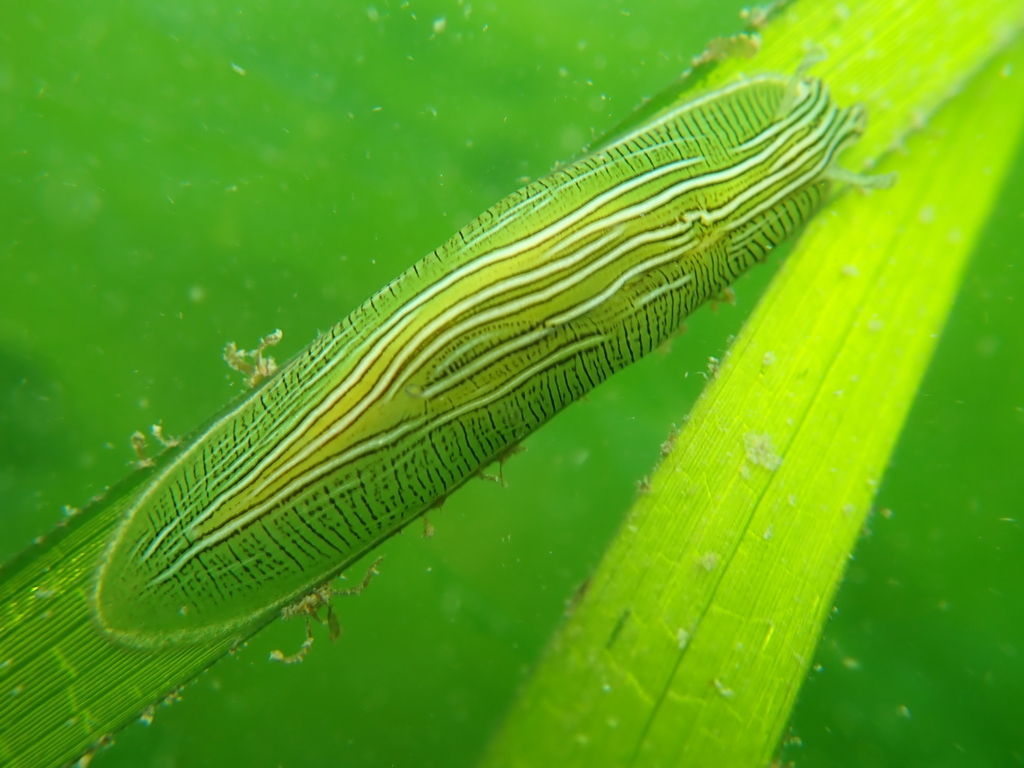
Taylor's Seahare
Phyllaplysia taylori
Phyllaplysia taylori, synonym Phyllaplysia zostericola, common names the "eelgrass sea hare" and "Taylor's sea hare", is a species of sea slug, specifically a sea hare, a marine gastropod mollusc in the family Aplysiidae, the sea hares.
Some authors place this genus in a separate family, Dolabriferidae.
From the article Phyllaplysia taylori on Wikipedia (CC BY-SA), quoted section by section
Description
Two color morphs of this sea hare have been observed, bright green, and yellow, with characteristic black and white stripes (see Beeman 1970 for more complete description) Phyllaplysia taylori has a dorsally flattened body, being well camouflaged on Zostera marina, the eelgrass it is found almost exclusively on. It grazes on epiphytes that settle on Zostera blades - sponges and diatoms.
Range & habitat
Phyllaplysia taylori inhabit the intertidal photic zone on the Pacific Coast of North America, occurring from British Columbia, Canada, to San Diego, CA, US. They live in estuarine habitats and complete their life cycles entirely on Zostera marina. As such, they are euryhaline and eurythermal to accommodate changing conditions of estuaries.[1] They are weak osmoregulators, which allows them to thrive best in low saline environments above 25 ppt.[2] Population density depends heavily on landscape and temperature. Thus, local terrestrial runoff has a greater impact on their distribution than ocean processes.[3] Acclimation to warmer temperatures may lead to a lower ability of sea hares to adapt to temperature changes, namely cold shocks.[1]
Wikipedia: “Distribution and habitat”
What it does
Phyllaplysia taylori have limited mobility all throughout their life cycles due to direct development in their larval stage and a lack of swimming mechanism in their adult stage. Limited dispersal may lead to high levels of isolation in individual populations and potentially phenotypic differences.[3] Phyllaplysia taylori feed on epiphytes that live and feed on eelgrass, which can block the eelgrass from having access to sunlight and nutrients. Thus, as they clear away the epiphytes, eelgrass populations are able to grow more substantially.[2] Phyllaplysia taylori therefore may play an important part in eelgrass community restoration efforts.[3] Possible predators include sunfish and sea stars of the genus Solaster.
Wikipedia: “Ecology”
Where it lives
Recorded sightings
—
geo-referenced records in GBIF, from museums, herbaria and field observers.
Drag the globe to turn it. Dots are where records exist, not a range map; darker means more records.
In the stacks
Searching the stacks…
Every page naming Phyllaplysia taylori in the Biodiversity Heritage Library →
This page is assembled live from iNaturalist, GBIF, Wikipedia, the Source Library and the Internet Archive. It is not yet part of the hand-edited codex. iNaturalist taxon 49864.