- Plants
- ›Vascular Plants
- ›flowering plants
- ›Dicots
- ›beeches, oaks, walnuts, and allies
- ›birch family
- ›Betula
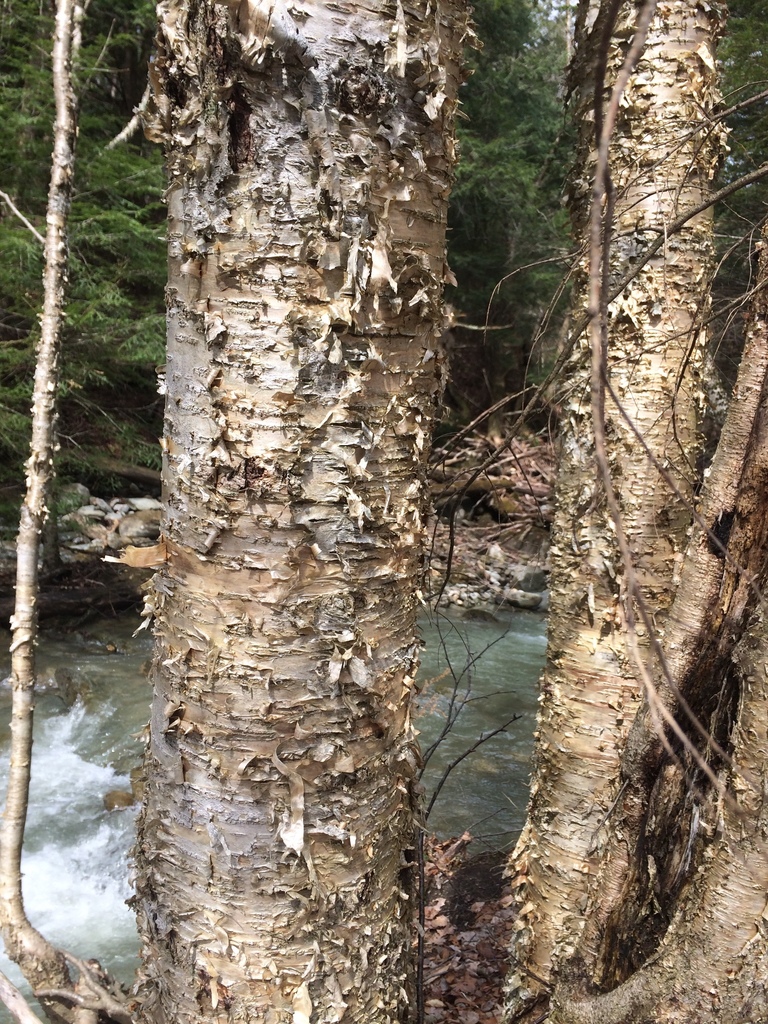
yellow birch
Betula alleghaniensis
Betula alleghaniensis, the yellow birch, golden birch, or swamp birch, is a large species of birch native to northeastern North America. Its vernacular names refer to the golden color of the tree's bark. In the past its scientific name was Betula lutea, the yellow birch.
It is an important lumber species and the sap can be used to make syrup. Additionally, it is the provincial tree of Quebec.
From the article Betula alleghaniensis on Wikipedia (CC BY-SA), quoted section by section
Description
Betula alleghaniensis is a medium-sized, typically single-stemmed, deciduous tree reaching 60–80 feet (18–24 m) tall (exceptionally to 100 ft (30 m)) with a trunk typically 2–3 ft (0.61–0.91 m) in diameter, making it the largest North American species of birch. Yellow birch is long-lived, typically 150 years and some old growth forest specimens may last for 300 years. It mostly reproduces by seed. Mature trees typically start producing seeds at about 40 years but may start as young as 20. The optimum age for seed production is about 70 years. Good seed crops are not produced every year, and tend to be produced in intervals of 1–4 years with the years between good years having little seed production. The seeds germinate best on mossy logs, decaying wood or cracks in boulders since they cannot penetrate the leaf litter layer. This can lead to odd situations such as yellow birches with their roots growing around a tree stump, which when it eventually rots away leaves the birch standing atop stilt-like roots. Yellow birch saplings will not establish in full shade (under a closed canopy) so they typically need disturbances in a forest in order to establish and grow. The tree is fairly deep-rooted and sends out several long lateral roots.
The bark on mature trees is a shiny yellow-bronze which flakes and peels in fine horizontal strips. …
Range & habitat
Its native range extends from Newfoundland to Prince Edward Island, Nova Scotia, New Brunswick, southern Quebec and Ontario, and the southeast corner of Manitoba in Canada, west to Minnesota, and south in the Appalachian Mountains to northern Georgia. While its range extends as far south as Georgia, it is most abundant in the northern part of its range. In southern Pennsylvania, it is rare and generally only found along bodies of water in cool, mature woods, and it only occurs at high elevations from Maryland southward. It grows in USDA zones 3–7. B. alleghaniensis prefers to grow in cooler conditions and is often found on north facing slopes, swamps, stream banks, and rich woods. It does not grow well in dry regions or regions with hot summers and will often last only 30–50 years in such conditions. It grows in soil with pH ranging 4–8.
Wikipedia: “Distribution and habitat”
What it does
The twigs are browsed on by whitetail deer, moose and cottontails Deer eat many saplings and may limit regeneration of the species if the deer population is too great. Ruffed grouse and various songbirds feed on the seeds and buds. Due to the thin bark of the tree yellow bellied sapsuckers feed on this tree by drilling holes in the tree and collecting the sap. Broad-winged hawks show a preference for nesting in yellow birch in New York. Several species of Lepidoptera including the mourning cloak (Nymphalis antiopa) and dreamy duskywing (Erynnis icelus) feed on B. alleghaniensis as caterpillars. Yellow birch is often associated with eastern hemlock throughout its range due to their similar preferences in habitat. It mostly grows at 0–500 m (0–1,640 ft) in elevation but may grow up to 1,000 m (3,300 ft). It reaches its maximum importance in the transition zone between low elevation deciduous forests and high elevation spruce and fir forests. Due to the thin bark and lack of ability to resprout, it is easily killed by wildfire. Sugar maple (Acer saccharum) exerts allelopathic effects on seedlings of yellow birch and decreases their growth ability. The inhibitory chemical is exuded from the roots of the sugar maple and has a very short soil half-life, it no longer has effects on birch after 5 days.
Wikipedia: “Ecology”
At the table
Yellow birch is considered the most important species of birch for lumber and is the most important hardwood lumber tree in eastern Canada; as such, the wood of B. alleghaniensis is extensively used for flooring, furniture, doors, veneer, cabinetry, gun stocks and toothpicks. It was once popular for wagon wheels. Most wood sold as birch in North America is from this tree. Its wood is relatively strong, close grained, and heavy. The wood varies in color from reddish brown to creamy white and accepts stain and can be worked to a high polish. Like most birches, yellow birch wood rots quickly due to its tendency to trap moisture. The cellulose from rotting birch logs was collected by Native Americans and used as a quick fire starter. In the past, yellow birch has been used for distilling wood alcohol, acetate of lime and for tar and oils. Oil of wintergreen can be distilled from the bark. The papery, shredded bark, is very flammable due to its oil content and can be peeled off and used as a fire starter even in wet conditions. Yellow birch can be tapped for syrup similarly to sugar maple, and although the sap has less sugar content, it flows in greater quantity than sugar maple. When the sap is boiled down, the wintergreen evaporates and leaves a syrup not unlike maple syrup. The sap can also be used as is in birch syrup or may be flavored. …
Wikipedia: “Uses”
In human culture
Betula alleghaniensis is the provincial tree of Quebec, where it is commonly called merisier, a name which in France is used for the wild cherry.
Wikipedia: “In culture”
Where it lives
Recorded sightings
—
geo-referenced records in GBIF, from museums, herbaria and field observers.
Drag the globe to turn it. Dots are where records exist, not a range map; darker means more records.
In the stacks
Searching the stacks…
Every page naming Betula alleghaniensis in the Biodiversity Heritage Library →
This page is assembled live from iNaturalist, GBIF, Wikipedia, the Source Library and the Internet Archive. It is not yet part of the hand-edited codex. iNaturalist taxon 49882.