- Plants
- ›Vascular Plants
- ›flowering plants
- ›Dicots
- ›Gentians, Dogbanes, Madders, and Allies
- ›Dogbane Family
- ›Apocynoideae
- ›Malouetieae
- ›Pachypodiinae
- ›Pachypodium
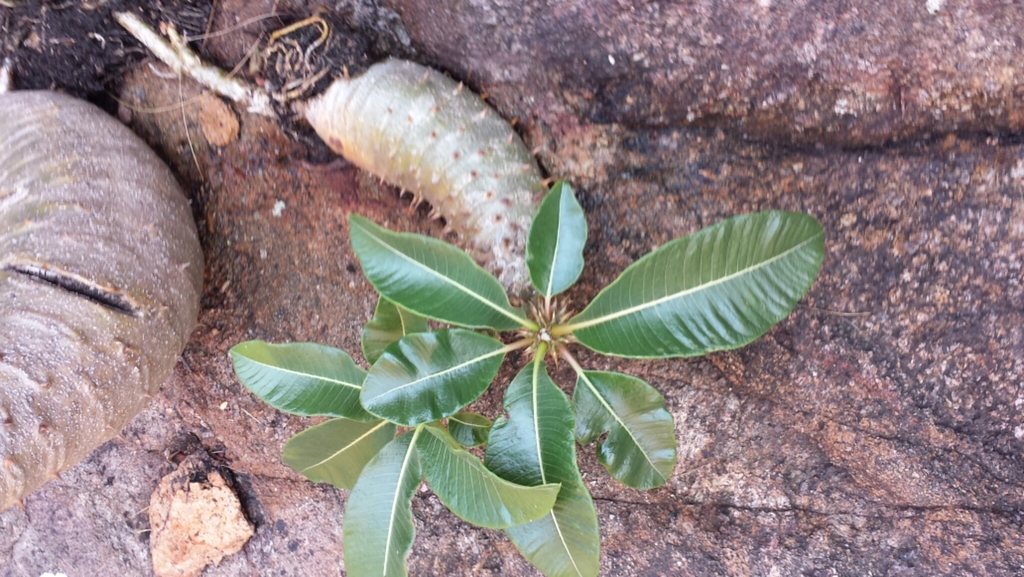
Madagascar palm
Pachypodium baronii
Pachypodium baronii, the Madagascar palm or bontaka, is a flowering plant in the family Apocynaceae. It has the habit of a robust shrub with a spherical or bottle-shaped trunk. It has several cylindrical branches at the top.
This plant is endemic to Madagascar, where it grows in open deciduous forest on Mesozoic calcareous rock and granite or gneiss on the western side of the island at low elevations. It is known in Madagascar as "Bontaka". It is also endemic from Befandriana Nord to Mandritsara.
From the article Pachypodium baronii on Wikipedia (CC BY-SA), quoted section by section
What it does
Pachypodium baronii is found on three different substrate, where two are similar and one is not. It can be located on mainly steep gneiss but sometimes granite rocks (metamorphic basement) and Mesozoic calcareous rock. "metamorphic basement" means a geological complex of undifferentiated igneous and metamorphic rocks where the rocks themselves have altered their composition, texture, or internal structure through extreme heat, pressure, and the introduction of a chemical. Granite and gneiss, in this condition of being undifferentiated, tend to have an acidi pH level; whereas calcareous rock tends to be more basic. This flexibility in substrate demonstrates a less specialized geological environment. These steep rocks are often located in low open dry, xeric deciduous western forests where they take advantage of micro-environments suitable for succulents. Micro-environments means a delimited convergence of very localize landscape and climate conditions that are in stark contrast to the larger vegetative climatic environmental zone. Pachypodium baronii prefers open sunlight but will tolerate some indirect light conditions because they inhabit open deciduous forests. They grow at an altitude between 300 m (feet) to 1200 m (feet) . Other vegetative types, often site indicators of micro-environments, are associated with P. …
Wikipedia: “Ecology”
Where it lives
Recorded sightings
—
geo-referenced records in GBIF, from museums, herbaria and field observers.
Drag the globe to turn it. Dots are where records exist, not a range map; darker means more records.
In the stacks
Searching the stacks…
Every page naming Pachypodium baronii in the Biodiversity Heritage Library →
This page is assembled live from iNaturalist, GBIF, Wikipedia, the Source Library and the Internet Archive. It is not yet part of the hand-edited codex. iNaturalist taxon 499013.