- Plants
- ›Vascular Plants
- ›flowering plants
- ›Dicots
- ›proteas, lotuses, planes, and allies
- ›Protea family
- ›Paired Proteas
- ›Embothrieae
- ›Hakeinae
- ›Hakea
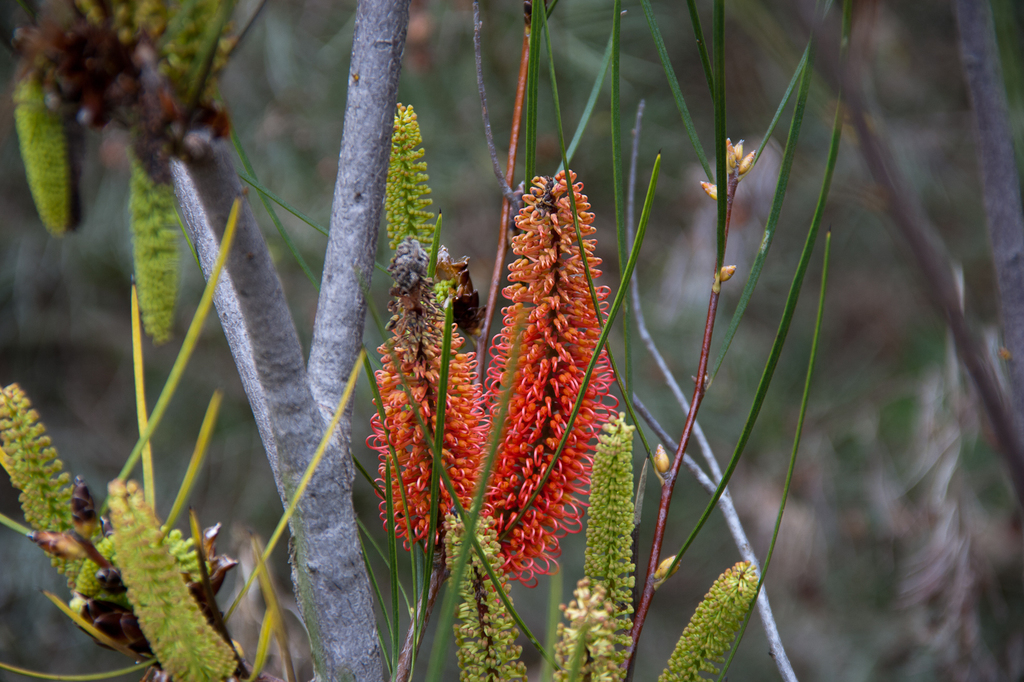
Red Pokers
Hakea bucculenta
Hakea bucculenta, commonly known as red pokers, is a large shrub in the family Proteaceae endemic to Western Australia. It is an ornamental shrub with red or orange flowers that appear in rod-like blooms in leaf axils for an extended period from May to November.
From the article Hakea bucculenta on Wikipedia (CC BY-SA), quoted section by section
Description
Hakea bucculenta is non-lignotuberous upright, rounded, bushy shrub that typically grows to a height of 1.5 to 4.5 metres (5 to 15 ft) but can reach as high as 7 m (23 ft). Smaller branches have irregular patches of flattened silky hairs becoming smooth at flowering. The leaves are a narrowly linear shape with a slight curve and 90 to 200 millimetres (4 to 8 in) long and 1 to 3 millimetres (0.039 to 0.118 in) wide. Each leaf has fine ribbing, conspicuous veins with an obvious mid-vein on both sides and ending with a sharp point. Each inflorescence is made up of 250 to 450 showy orange or bright red flowers in racemes up to 15 cm (6 in) long on a smooth stem 8.5–13.5 cm (3–5 in) long. Flowers appear from May to November, the main flush in spring. The pedicel is smooth and perianth a bright red. The style 18–21 mm (0.7–0.8 in) long. The woody fruit are egg-shaped 1.7–2.5 cm (0.7–1 in) long and 1–1.5 cm (0.4–0.6 in) wide. The grey smooth fruit appear in clusters of 3–16 on a long stem or attached directly onto the branch. Each fruit is divided into a thick body ending a blunt beak. The blackish or brown seeds are obliquely obovate with a length of 16 to 18 mm (0.63 to 0.71 in) and a width of 7 to 9 mm (0.28 to 0.35 in) with a single wing.
Range & habitat
Hakea bucculenta is endemic to coastal areas in the Gascoyne and Mid West regions between Shark Bay and Geraldton in Western Australia. It grows on coastal sand plain heath or mallee, roadsides verges in sandy, loam or clay-based soils.
Wikipedia: “Distribution”
How it is grown
Hakea bucculenta is sensitive to dieback and thus difficult to keep alive in areas of high humidity. It can be successfully grafted onto Hakea salicifolia and it may hybridise with H. francisiana. It is most commonly propagated from seeds which germinate in about three to four weeks. Cuttings can also be used but usually have a low rate of success. It grows well in a sunny position out of the wind in well-drained soils and it will tolerate both drought and frost.
== References ==
Wikipedia: “Use in horticulture”
Where it lives
Recorded sightings
—
geo-referenced records in GBIF, from museums, herbaria and field observers.
Drag the globe to turn it. Dots are where records exist, not a range map; darker means more records.
In the stacks
Searching the stacks…
Every page naming Hakea bucculenta in the Biodiversity Heritage Library →
This page is assembled live from iNaturalist, GBIF, Wikipedia, the Source Library and the Internet Archive. It is not yet part of the hand-edited codex. iNaturalist taxon 499444.