- Fungi Including Lichens
- ›Basidiomycete Fungi
- ›Higher Basidiomycetes
- ›Mushrooms, Bracket Fungi, Puffballs, and Allies
- ›Agaricomycetidae
- ›Common Gilled Mushrooms and Allies
- ›Agaricineae
- ›Bolbitiaceae
- ›Conocybe
- ›Conocybe
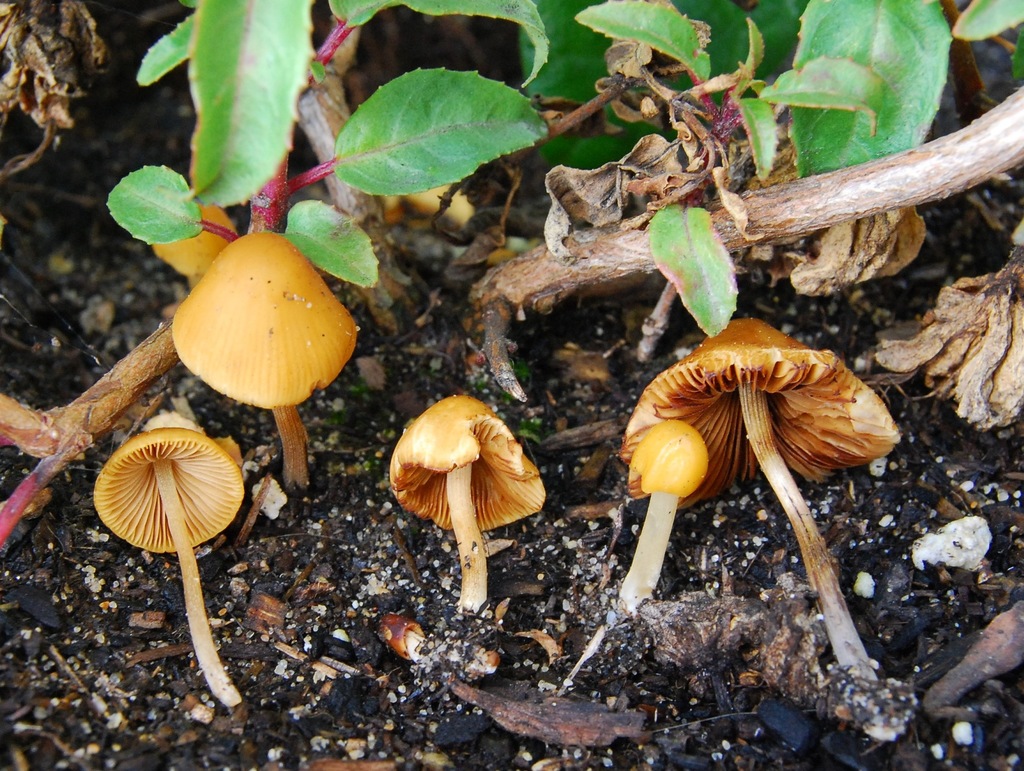
Golden Conecap
Conocybe aurea
Conocybe aurea, commonly known as the golden dunce cap, is a basidiomycete fungus in the family Bolbitiaceae.
From the article Conocybe aurea on Wikipedia (CC BY-SA), quoted section by section
Description
The cap is orangish yellow, and up to 5 cm in diameter. The gills and stipe are beige, the former browning with age. Cap: 0.8-2.2 cm wide or more, starting globose to campanulate before expanding to convex. The surface is smooth but not sticky and is golden yellow to orangy yellow with a deeper colour in the centre of the cap. The cap dries to a chrome yellow colour with paler centre flesh when dry. Gills: Adnate and subdistant with a ventricose bulge. 1.5-3mm wide. They start whitish before developing a cinnamon colour. Stem: 2.5-6.5 cm long and 2-3mm thick and equal across its length or tapering slightly upwards with a slightly bulbous 4-6mm thick base. The interior is hollow and the exterior surface is pruinose with striations and pale yellowish but often discolours to a brownish yellow (fulvous). Flesh: Thin, soft and the same colour as the surface of the cap. Smell: Slight. Taste: Mild. Spores: 10.5-13.5 x 6-7 μm. Elliptical and smooth with a hyaline, apical germ pore. Under the microscope they are yellow. Basidia: 29-37 x 11-12 μm. Four spored. Cheilocystidia: 22-30 x 8-11 μm. Pin-headed and hyaline with a thin wall. Caulocystidia: 22-30 x 7.5-10 μm. Similar to the cheilocystidia.
Range & habitat
Conocybe aurea is a saprobic fungus that prefers to grow in nitrate-rich soils, fields, woodchip mulch, old compost, and greenhouses. A rare but widespread species, it is found in Europe, Asia, North America, South America, and New Zealand.
Wikipedia: “Habitat and distribution”
Where it lives
Recorded sightings
—
geo-referenced records in GBIF, from museums, herbaria and field observers.
Drag the globe to turn it. Dots are where records exist, not a range map; darker means more records.
In the stacks
Searching the stacks…
Every page naming Conocybe aurea in the Biodiversity Heritage Library →
This page is assembled live from iNaturalist, GBIF, Wikipedia, the Source Library and the Internet Archive. It is not yet part of the hand-edited codex. iNaturalist taxon 499601.