- Fungi Including Lichens
- ›Basidiomycete Fungi
- ›Higher Basidiomycetes
- ›Mushrooms, Bracket Fungi, Puffballs, and Allies
- ›Agaricomycetidae
- ›Common Gilled Mushrooms and Allies
- ›Agaricineae
- ›Hymenogastraceae
- ›Psilocybe
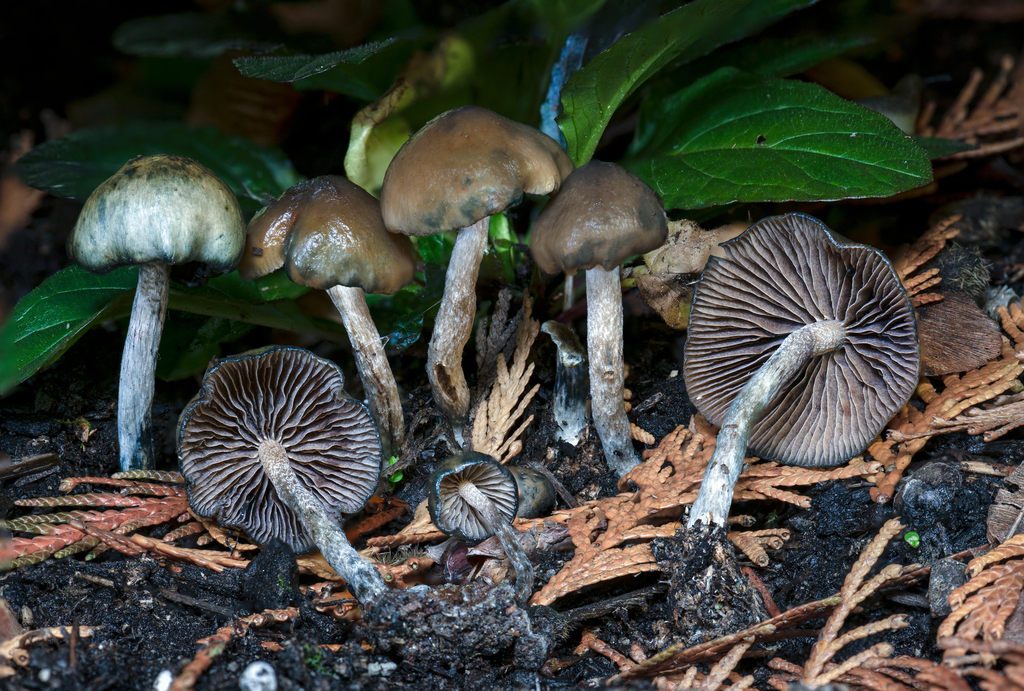
Psilocybe baeocystis
Psilocybe baeocystis is a psilocybin mushroom of the family Hymenogastraceae. It contains the hallucinogenic compounds psilocybin, psilocin and baeocystin.
The species is commonly known by various names such as bottle caps, knobby tops, blue bells, olive caps, blue Meanies.
From the article Psilocybe baeocystis on Wikipedia (CC BY-SA), quoted section by section
Description
Pileas: The cap is 15–55 mm (0.6–2.2 in) in diameter and conic to obtusely conic to convex. The cap margin is turned inwards when young, rarely becoming plane in age, often distinctly rippled, translucent-striate and bruising and aging greenish-bluish about the margin. It is dark olive brown to buff brown in color, occasionally steel blue; when dried it tends toward copper brown in the center. It is hygrophanous, fading to milk white, and viscid when moist from a gelatinous pellicle, usually separable. The flesh is thin and bruises blue easily. Gills: The gills are close with adnate to sinuate attachment and are grayish to cinnamon brown, with the edges remaining pallid. Spore Print: dark purplish brown Stipe: The stipe is 5–7 cm (2.0–2.8 in) long, 2–3 mm (0.1–0.1 in) thick, and equal to subequal. The color is pallid to brownish with white filaments, while often more yellowish towards the apex. Distinct rhizomorphs are found at the base. The stipe is brittle, stuffed with loose fibers, and the partial veil is evanescent and rapidly becomes indistinguishable. Taste: farinaceous Odor: farinaceous Stain: It stains blue easily where damaged.
Microscopic features. …
Range & habitat
Psilocybe baeocystis is solitary to cespitose, and scattered to numerous on ground bark, wood chips, peat moss, decaying conifer mulch, occasionally on lawns, pastures, and rarely in coniferous forests. Often found growing under plants like rhododendrons and rose bushes in mulched garden beds, sometimes growing amongst other Psilocybe species such as Psilocybe stuntzii and Psilocybe cyanescens. Psilocybe baeocystis grows from August through December, and rarely as early as the end of June. Psilocybe baeocystis is a hemiboreal mushroom, common throughout the Pacific Northwest.
Wikipedia: “Habitat and distribution”
In human culture
From the Greek words baeo (little) and kystis (bladder) 1945 P. baeocystis is first collected in Eugene, Oregon. 1958 P. baeocystis is formally described and published by Singer and Smith. 1962 Psilocin is first reported in this species. 1967-68 Baeocystin and norbaeocystin are discovered and named. 1981 Testing again reveals psilocybin, psilocin, baeocystin and norbaeocystin.
Wikipedia: “Etymology and history”
Where it lives
Recorded sightings
—
geo-referenced records in GBIF, from museums, herbaria and field observers.
Drag the globe to turn it. Dots are where records exist, not a range map; darker means more records.
In the stacks
Searching the stacks…
Every page naming Psilocybe baeocystis in the Biodiversity Heritage Library →
This page is assembled live from iNaturalist, GBIF, Wikipedia, the Source Library and the Internet Archive. It is not yet part of the hand-edited codex. iNaturalist taxon 499647.