- Fungi Including Lichens
- ›Basidiomycete Fungi
- ›Higher Basidiomycetes
- ›Mushrooms, Bracket Fungi, Puffballs, and Allies
- ›Agaricomycetidae
- ›Common Gilled Mushrooms and Allies
- ›Marasmiineae
- ›Porotheleaceae
- ›Atheniella
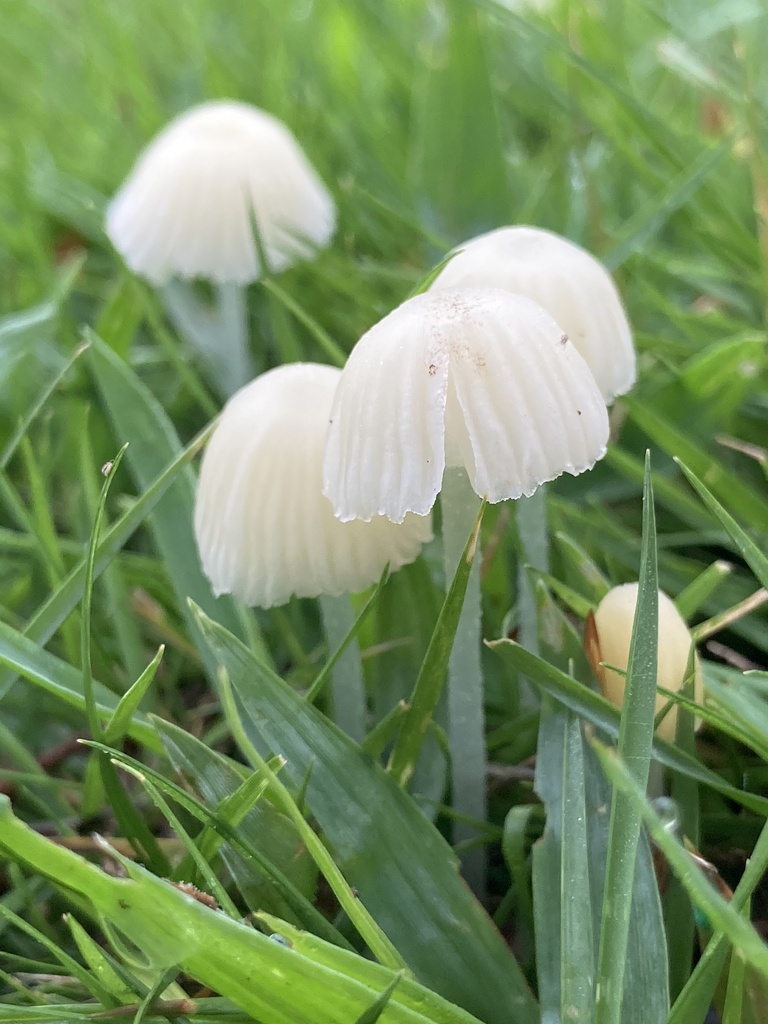
Ivory Bonnet
Atheniella flavoalba
Atheniella flavoalba, which has the recommended name of ivory bonnet in the UK, is a species of agaric in the family Cyphellaceae. The cap is initially conical, before becoming convex and then flat; it may reach up to 1.5 cm (0.6 in) across. The cap is ivory-white to yellowish white, sometimes more yellowish at the center. The tubular stems are up to 8 cm (3.1 in) long and 2.5 mm (0.10 in) thick, and have long, coarse white hairs at their bases. Atheniella flavoalba is found in Europe, the Middle East, and North America, where it grows scattered in pastures or in dense groups under conifers and on humus in oak woods.
From the article Atheniella flavoalba on Wikipedia (CC BY-SA), quoted section by section
Description
The cap of A. flavoalba is 1–2 cm (0.4–0.8 in) in diameter, conical when young, becoming somewhat bell-shaped, broadly conic or at times nearly convex. It may develop a papilla (a nipple-like structure) in its center. The cap margin is initially pressed against the stem, but in maturity either flares out or curves inward slightly. The cap surface is smooth, moist, and partially translucent, so that the outline of the gills underneath the cap may be seen. The mushroom is hygrophanous (changing color as it loses or gains moisture), being cream-buff to yellowish initially, with a paler (almost white) margin, and fading to buff in the center and yellowish-white along the margin when dry. The flesh is yellowish to white, thick under the disc but otherwise thin, moderately fragile, and without any distinctive odor and taste. The gills are ascending and somewhat hooked or toothed, narrow at first but becoming rather broad (2.5 mm and becoming 3–4 mm). They are nearly equal in width throughout or slightly ventricose in age, with a spacing that is close to subdistant. About 18–24 gills reach the stem, with two tiers of lamellulae (short gills that do not extend fully from the cap margin to the stem) that may develop veins running between them. The gills are white to creamy-white with edges that are even and whitish, and waxy in appearance and consistency. …
Range & habitat
The fruit bodies of Atheniella flavoalba grow scattered to densely gregarious in mossy pastures, needle beds under conifers, or on humus in oak woods during the autumn. The species is common in old grassland in Europe, but less common in North America though sometimes occurring in large quantities in certain localities. In the United States, it has been collected from Colorado, Idaho, Michigan, North Carolina, Oregon, Washington, Wyoming, Florida, and Kansas. It is also found in Israel. The species is listed as "Least Concern" in the Danish Red Data Book. Atheniella flavoalba is considered inedible.
Wikipedia: “Habitat and distribution”
In human culture
The specific epithet flavoalba ("yellow-white") is a compound of the Latin adjectives flavus ("yellow) and alba ("white").
Wikipedia: “Etymology”
Where it lives
Recorded sightings
—
geo-referenced records in GBIF, from museums, herbaria and field observers.
Drag the globe to turn it. Dots are where records exist, not a range map; darker means more records.
In the stacks
Searching the stacks…
Every page naming Atheniella flavoalba in the Biodiversity Heritage Library →
This page is assembled live from iNaturalist, GBIF, Wikipedia, the Source Library and the Internet Archive. It is not yet part of the hand-edited codex. iNaturalist taxon 499704.