- Fungi Including Lichens
- ›Basidiomycete Fungi
- ›Higher Basidiomycetes
- ›Mushrooms, Bracket Fungi, Puffballs, and Allies
- ›Agaricomycetidae
- ›Common Gilled Mushrooms and Allies
- ›Tricholomatineae
- ›Lyophyllaceae
- ›Hypsizygus
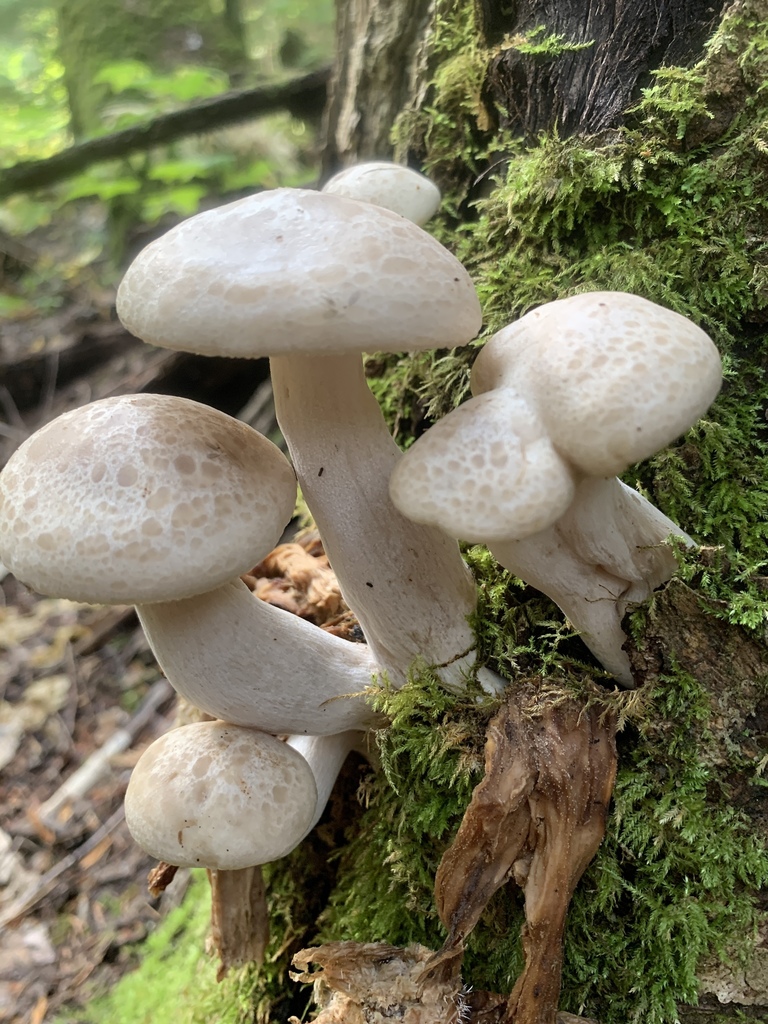
Beech Mushroom
Hypsizygus tessulatus
Hypsizygus tessulatus, the beech mushroom, is an edible mushroom native to East Asia. It is cultivated locally in temperate climates in Europe, North America and Australia and sold fresh in super markets. In nature, these are gilled mushrooms that grow on wood. Most often the mushroom is found on beech trees, hence the common name. Cultivated versions are often small and thin in appearance and popular in many nations across the world.
From the article Hypsizygus tessulatus on Wikipedia (CC BY-SA), quoted section by section
Description
The white to yellow cap is 5–15 centimetres (2–6 in) across, convex then flat and sunken. The gills are adnexed to sinuate, fairly close, whitish then cream. The stem is up to 11 cm (4+1⁄4 in) long and 3 cm (1+1⁄8 in) wide, larger at the base. The flesh is firm and white, with a pungent scent and mild taste. The spore print is white to buff.
Range & habitat
The species is native to East Asia and common in northern North America. It is found singly and scattered on hardwood, often far above the ground. It is often found on beech trees, hence the common name.
Wikipedia: “Distribution and habitat”
At the table
The mushrooms is edible but tough when raw, so should be cooked, which also eliminates its bitter taste. The cooked mushroom has a firm, slightly crunchy texture and a nutty flavor. Preparation makes the mushroom easier to digest. It is often eaten with stir-fried foods including wild game and seafood. It is used in soups, stews and sauces. When prepared alone, Shimeji mushrooms can be sautéed as a whole, including the stem or stalk (only the very end cut off), using a higher temperature; or, they can be slow roasted on a low temperature with a small amount of butter or cooking oil. Shimeji is used in soups, nabe and takikomi gohan.
Wikipedia: “Uses”
How it is grown
The species is cultivated locally in temperate climates in Europe, North America and Australia and sold fresh in supermarkets. Two commercial variations are known from Japan:
Buna-shimeji (ja:ブナシメジ), wild type brown coloration. Known as brown beech mushroom, beech mushroom, brown clamshell mushroom; Bunapi-shimeji (ja:ブナピー) is a white UV-induced mutant of the former, known as white beech mushroom, white clamshell mushroom. The original strain is registered by Hokto Corporation.
Wikipedia: “Cultivation”
Where it lives
Recorded sightings
—
geo-referenced records in GBIF, from museums, herbaria and field observers.
Drag the globe to turn it. Dots are where records exist, not a range map; darker means more records.
In the stacks
Searching the stacks…
Every page naming Hypsizygus tessulatus in the Biodiversity Heritage Library →
This page is assembled live from iNaturalist, GBIF, Wikipedia, the Source Library and the Internet Archive. It is not yet part of the hand-edited codex. iNaturalist taxon 499736.